Fundamentals
Due to the United States' delay in imposing tariffs on critical mineral imports, the asset faces downward pressure. Reuters reports that President Donald Trump instructed Trade Representative Jamieson Greer and Commerce Secretary Howard Lutnick on Thursday to negotiate with trade partners to adjust the import of critical minerals to ensure such imports do not threaten national economic security. Silver is no longer solely traded as a hedge against currency fluctuations; by early 2026, it increasingly functions as a strategic commodity influenced by industrial policies and supply chain security, rather than solely by inflation data. This shift stems from Washington's renewed focus on critical mineral resources. The strategic reserve-building concept is expanding from petroleum to metals that power decarbonization, defense technology, and manufacturing autonomy. In this context, silver's significance surpasses traditional market expectations. Its role is not merely symbolic but intersects with energy transition, electronics industry, and geopolitical competition. This positioning confers a premium characteristic on silver, aligning it more closely with strategic metals than with conventional precious metals. Often grouped with gold, silver's demand structure is fundamentally different; a significant and growing portion of global silver consumption is industrial, utilized in solar panels, high-conductivity electronics, advanced circuits, medical components, automotive systems, and defense equipment, due to its irreplaceability without performance degradation. As electrification accelerates, demand shifts from cyclical to structural. This is critical in transforming commodities into strategic assets. When demand is tightly coupled with technological and infrastructural developments, supply issues cannot be remedied by short-term price fluctuations but require capacity expansion, processing capabilities, and time. Consequently, silver exhibits a greater sensitivity to supply chain pressures than gold.
Signs of improvement in the U.S. labor market, coupled with the strong retail sales data released earlier this week, support the Federal Reserve's stance to maintain steady interest rates in the coming months. This, in turn, could provide near-term support to the U.S. dollar. Following the December employment report, Morgan Stanley analysts postponed the market rate cut expectations from January and April to June and September. Chicago Fed President Austan Goolsbee stated on Thursday that, given clear signs of a stable labor market, the Fed should focus on lowering inflation. Meanwhile, San Francisco Fed President Mary Daly indicated that monetary policy is "well-positioned" to respond to economic shifts. Recently, several Federal Reserve officials have reaffirmed a cautious approach; notably, Kansas City Fed President Schmid explicitly opposed rate cuts, citing high inflation and potential new government policies that may further boost demand and tighten supply, exerting upward pressure on prices. Goolsbee and Atlanta Fed President Bostic both emphasized that monetary policy must continue to monitor inflation trends. Currently, interest rate futures imply a 97% probability that the Fed will hold rates steady at the January 27-28 meeting, with expectations of approximately two rate cuts by 2026 remaining unchanged.
Technical Analysis
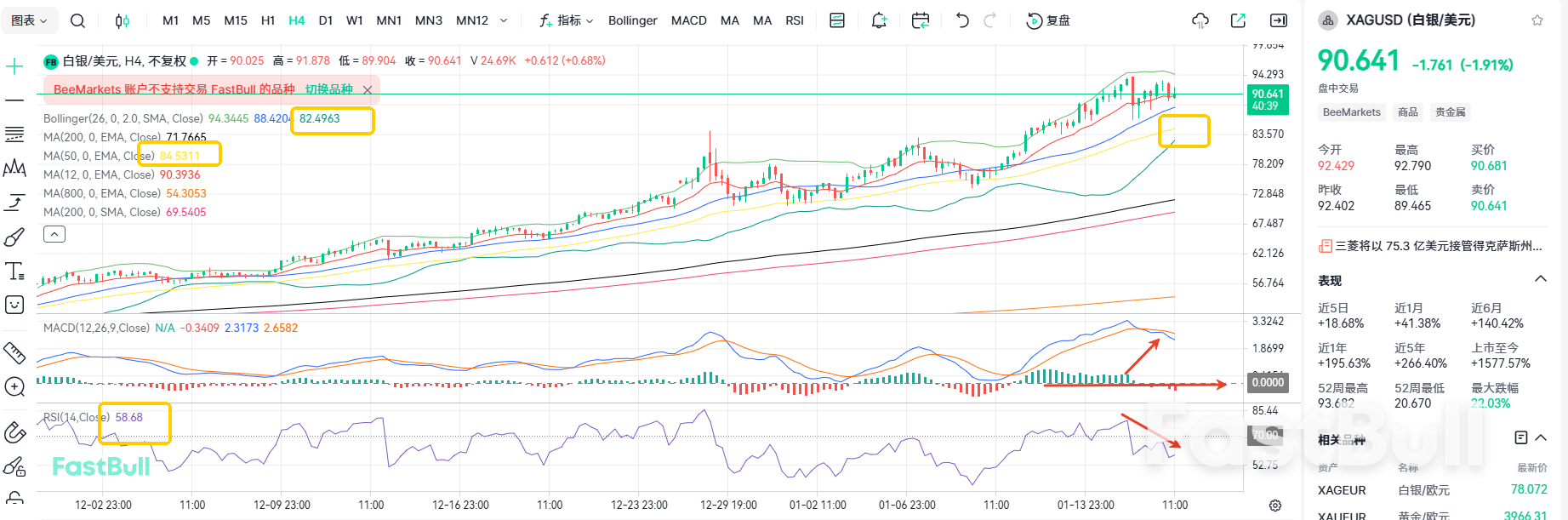
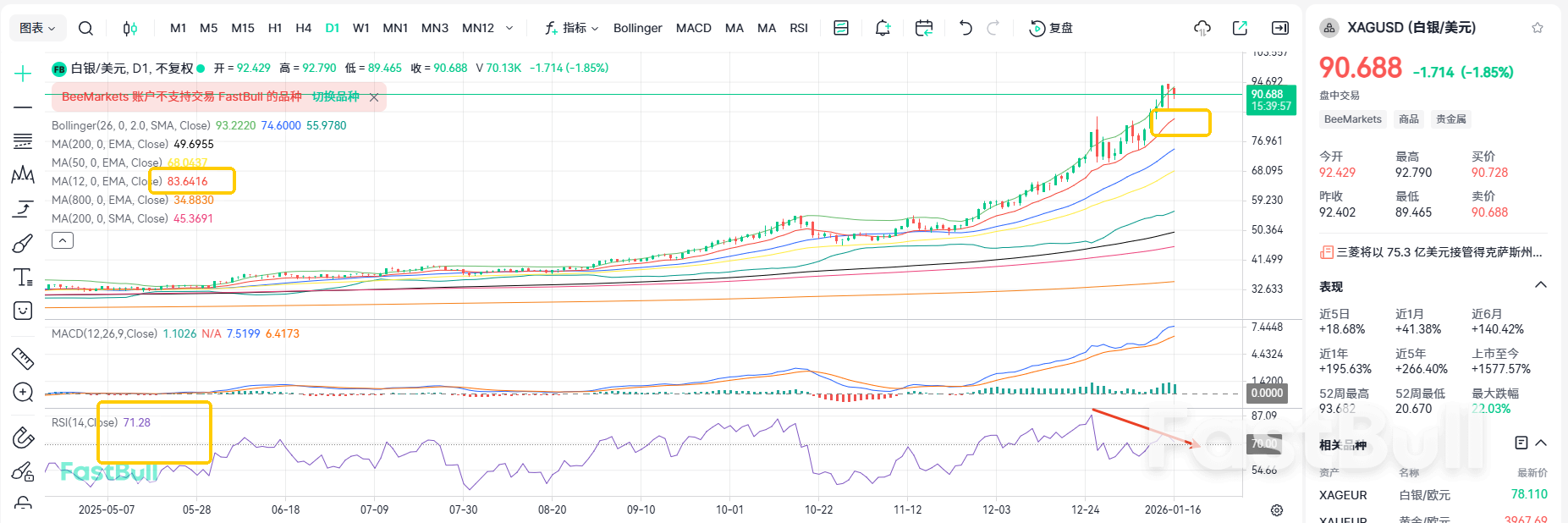
In the 4H timeframe, Bollinger Bands are constricting, indicating a narrowing of volatility. The SMAs are flat, with the price oscillating around the EMA12. The MACD has exhibited a death cross, followed by a 'death kiss' signal, with the MACD line and signal line currently retracing toward the zero-axis from a distance, suggesting the corrective phase is incomplete. The RSI stands at 58, reflecting a predominantly wait-and-see sentiment among investors. Support levels are aligned near the EMA50 and the midline of the Bollinger Bands, approximately at 84.5 and 88.4 respectively. In the 1D timeframe, Bollinger Bands are expanding upward, and SMAs are diverging ascendingly. After a long lower shadow on yesterday’s candle and a subsequent dip today, it indicates potential correction toward the EMA12. If the price sustains above EMA12, an upward move to test the upper Bollinger Band is possible; failure to hold this level may lead to a decline toward the middle Bollinger Band and EMA50, around 74.5 and 68. The RSI is at 71, indicating an overbought condition. In the short term, while new highs are achieved, the RSI peaks are gradually declining, suggesting a high probability of a market pullback. It is recommended to go short before going long.
Trading Recommendations
Trading Direction: Sell
Entry Price: 91
Target Price: 85
Stop Loss: 93.5
Support: 85, 80, 75
Resistance: 93, 95, 100


