Fundamentals
Investors currently appear optimistic about Sanae Takaichi's fiscal policies, anticipating responsible fiscal management and economic growth. This sentiment may encourage the Bank of Japan to maintain its hawkish stance, which continues to support the Japanese Yen. A Kyodo News analysis of a post-general election survey of lawmakers, released on February 11th, revealed that among the 403 respondents, 81.1% supported amending Article 9 of the Constitution to explicitly include the Self-Defense Forces, with only 9.4% opposed. Support for a constitutional amendment to establish an emergency powers clause was even higher at 83.4%, with 8.9% against. The Liberal Democratic Party and Nippon Ishin no Kai collectively secured over two-thirds of the seats in the recent election, meeting the threshold for proposing constitutional amendments. Regarding consumption tax, 36.7% of LDP respondents favored "maintaining the current tax rate," indicating cautious voices within the party regarding tax increases. The analysis suggests that constitutional amendment discussions in the Diet will officially enter a substantive phase, shifting the focus of partisan debate from "whether to amend" to "how to amend." Preparations for Japan-U.S. diplomacy are underway, with the Foreign and Defense Ministers set to visit Europe to coordinate the Prime Minister's upcoming visit to the U.S. in March. Foreign Minister Motegi Toshimitsu and Defense Minister Koizumi Shinjirō announced on the 10th that they will attend the Munich Security Conference in Germany on the 13th. Motegi plans to articulate a policy of "strengthening cooperation with allies and like-minded countries" during a panel discussion on Indo-Pacific security, while Koizumi will hold meetings with defense officials from various European nations, emphasizing the "inseparability of security in the Euro-Atlantic and the Indo-Pacific." Government sources revealed that bilateral talks between Japan and the U.S. are being coordinated during their time in Germany with Secretary of State Rubio, paving the way for Prime Minister Sanae Takaichi's visit to the U.S. in March. Key discussion points will include further solidifying the deterrence of the Japan-U.S. alliance and industrial collaboration under the framework of U.S. investment.
The U.S. dollar is struggling to maintain its recent upward momentum, which was initially boosted by non-farm payroll data. This difficulty stems from market expectations of further Federal Reserve interest rate cuts in 2026 and concerns surrounding the Fed's independence, factors that are increasing volatility in the USDJPY. The January U.S. employment figures surpassed market expectations, indicating a relatively stable labor market. This stability provides a basis for the Federal Reserve to maintain its current interest rate policy and continue monitoring inflation trends. According to data from the Bureau of Labor Statistics, non-farm payrolls increased by 130,000 in January, a revision from the 48,000 increase reported for December. Economists surveyed by Reuters had anticipated a job gain of 70,000. The unemployment rate decreased to 4.3% from 4.4% in December. A portion of the better-than-expected job growth can be attributed to seasonal factors. Industries such as retail and logistics hired fewer temporary workers during the past Christmas season than in previous years, and January typically sees the peak of holiday-related layoffs. Due to smaller initial hiring volumes, subsequent reductions in workforce were also less pronounced, statistically inflating the January employment figures. The employment report, originally scheduled for release last Friday, was postponed due to a three-day federal government shutdown. Effective January, the Bureau of Labor Statistics has implemented its annual update to the birth-death model, which measures job changes resulting from new business creations and closures. This update incorporates the latest sample information. The model had previously faced criticism for overestimating job growth, and economists project that this update may reduce monthly job gains by as much as 50,000 compared to recent months. Moving forward, the Bureau of Labor Statistics will also introduce new annual population controls to the household survey, including updated population estimates and migration data. This adjustment was also delayed due to the government shutdown. Despite a January uptick in employment, economists widely perceive the U.S. labor market as exhibiting persistent weakness, even amidst robust economic expansion. Uncertainties surrounding trade and immigration policies continue to exert downward pressure on hiring prospects. These concerns arise in the wake of President Trump's vacillated threats of additional tariffs on European allies. Concurrently, job market anxieties and sustained high inflation have eroded public confidence in the administration's economic stewardship. Kevin Hassett, Chairman of the Council of Economic Advisers, has indicated that a deceleration in labor force growth may result in subdued job creation in the coming months. Census Bureau data reveals that the U.S. population increased by only 1.8 million, or 0.5%, to a total of 341.8 million in the year ending June 2025. Given a contracting labor pool, economists posit that the U.S. economy requires the creation of approximately 50,000 or fewer jobs per month to keep pace with the growth of the working-age population.
Technical Analysis
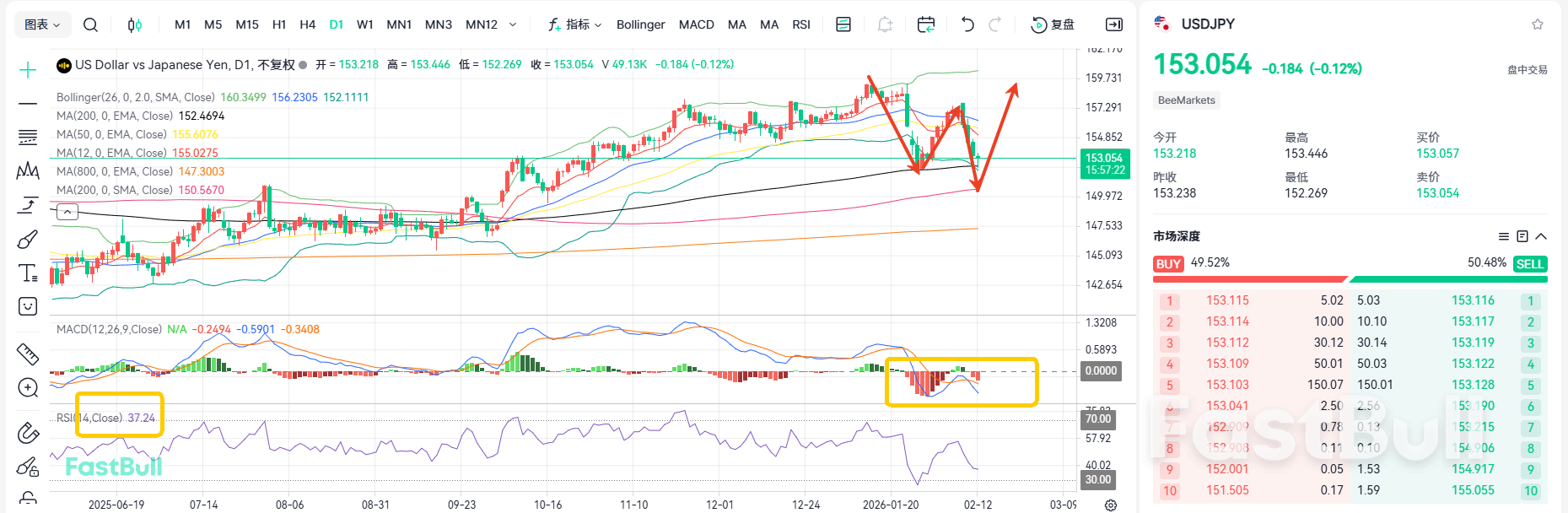
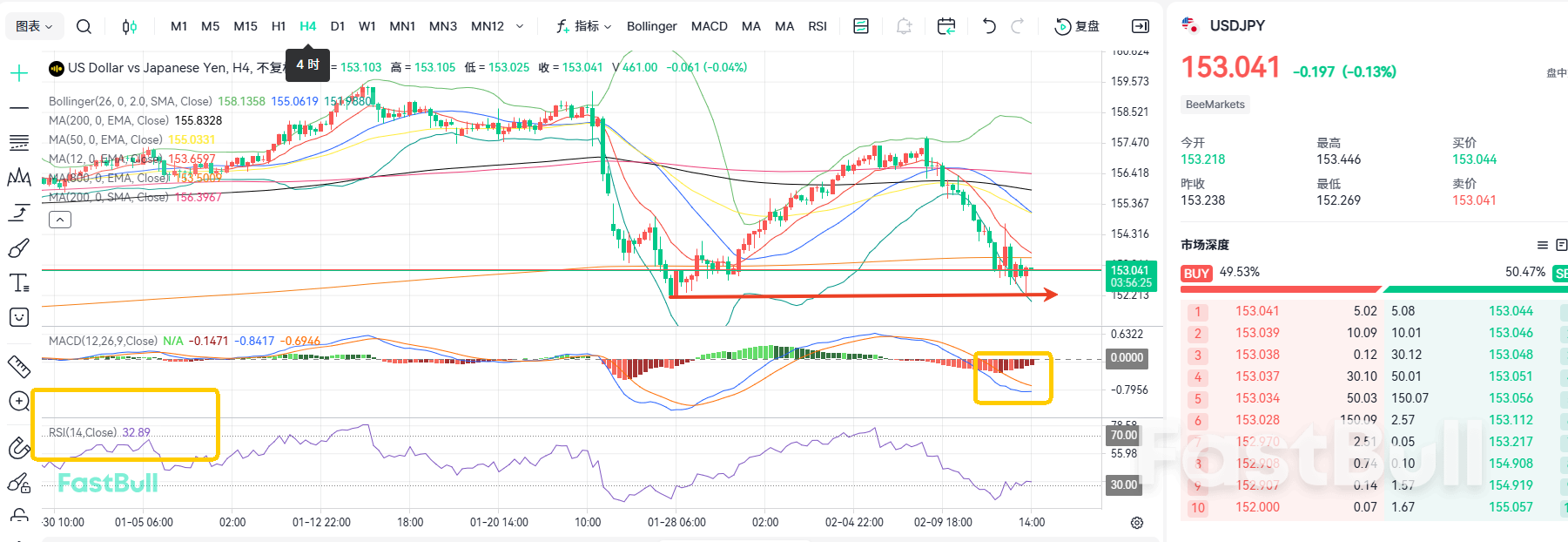
Analyzing the USDJPY in the 1D timeframe, the Bollinger Bands are widening downwards, and the moving averages are diverging bearishly. The price is oscillating downwards along the lower Bollinger Band, and the MACD has formed a death cross, indicating a slight reduction in selling pressure. This suggests that while the downtrend persists, it may be nearing its conclusion. The pair is likely to break below the previous low, with support expected around the 152 and 151 psychological levels. The RSI is at 37, indicating an oversold condition, with market participants predominantly selling. In the 4H timeframe, the Bollinger Bands are also widening downwards, and the moving averages are diverging bearishly. The price is consolidating near the previous low. The MACD is approaching a golden cross, with the MACD line and signal line below the zero line, implying that the downward movement is not yet complete. The RSI is at 32, reflecting a pessimistic market sentiment, and a further decline below 152 is probable. The suggested strategy is to initiate short positions first, followed by long positions.
Trading Recommendations
Trading Direction: Buy
Entry Price: 152
Target Price: 160
Stop Loss: 149.5
Support: 152, 150, 149.5
Resistance: 160, 161, 162


