Gold is surging with remarkable conviction on Thursday, with XAU/USD trading comfortably above the $4,800 per ounce threshold during the first half of the European session and closing in rapidly on the nearly three-week high set in Wednesday's session. The catalyst for this powerful move is nothing short of a geopolitical earthquake — a fragile but consequential ceasefire framework between the United States and Iran that has sent shockwaves through every corner of global financial markets, reshaping the risk landscape in real time and triggering one of the most dramatic single-session repositioning events of the year.
The news broke late Wednesday when US President Donald Trump posted on Truth Social that he would suspend all planned military strikes against Iran for a period of two weeks, on the condition that Tehran agrees to a complete, immediate, and safe reopening of the Strait of Hormuz. Within hours, Iran confirmed it had accepted the terms of the temporary ceasefire, with negotiations scheduled to begin on Friday in Islamabad, Pakistan. Iran's Foreign Minister Seyed Abbas Araghchi followed with a formal statement confirming that safe passage through the Strait will be permitted for the two-week ceasefire period — a development that markets had not dared to seriously price in just 48 hours ago.
The market reaction has been swift, sweeping, and in some respects, utterly transformative. As a financial reporter who has tracked this crisis from its opening shots, I want to be clear about what we are witnessing: this is not a routine risk-on bounce. This is a fundamental repricing of the geopolitical risk premium that had been embedded across virtually every major asset class — from crude oil and equity futures to Treasury yields, the US Dollar, and gold itself. The question now is not whether that repricing is justified. It clearly is. The question is how much further it has to run, and what happens if this ceasefire collapses before the two weeks are up.
For gold, the picture is complex and fascinating. The precious metal is rallying sharply — and I believe correctly — but the drivers behind this particular move are not the ones that typically propel gold higher. Under normal circumstances, gold thrives in environments of fear, uncertainty, and elevated inflation expectations. What we are seeing today is different: gold is rising in a risk-on environment, driven by a collapsing US Dollar, falling Treasury yields, and evaporating rate hike expectations. This is a Dollar-weakness-driven gold rally rather than a fear-driven one, and understanding that distinction matters enormously for assessing how durable and sustainable the move is.
The US Dollar Index tells the story most vividly. The DXY has tumbled to a nearly one-month low in reaction to the ceasefire news, as traders aggressively unwound the safe-haven Dollar positions they had accumulated throughout weeks of escalating Middle East tensions. The Greenback had been a primary beneficiary of the risk-off environment that dominated markets since the conflict began, drawing capital away from risk-sensitive currencies and into the perceived safety of the world's reserve currency. With the immediate threat of conflict escalation temporarily suspended, that safe-haven premium is being rapidly and ruthlessly repriced out of the Dollar — and gold, which trades in Dollars on global markets, benefits mechanically from every tick lower in DXY.
The oil market is doing the heavy lifting for the broader narrative shift. Crude prices have fallen sharply following Araghchi's confirmation that the Strait of Hormuz will be passable for two weeks — and the implications for inflation expectations are immediate and significant. For weeks, markets had been pricing in the prospect of sustained supply disruptions through one of the world's most critical energy chokepoints, with the knock-on effects for global inflation, consumer energy costs, and central bank policy paths all skewed aggressively to the hawkish side. The partial removal of that risk — even if only temporary — has triggered a swift and meaningful downward revision in near-term inflation forecasts, which in turn has dramatically cooled bets for an imminent Federal Reserve rate hike.
This shift in rate expectations is cascading directly into US Treasury markets. Bond yields are falling as investors reprice the probability of a Fed tightening cycle that had been building relentlessly in the weeks prior. Lower Treasury yields reduce the opportunity cost of holding gold — a non-yielding asset — making the precious metal more attractive on a relative basis. The combination of a weaker Dollar and lower real yields is, historically, one of the most potent and reliable fuel combinations for a sustained gold rally, and both are now operating simultaneously in XAU/USD's favor.
That said, I want to offer a note of genuine caution that I think the market is underweighting in the euphoria of this initial reaction. A two-week ceasefire is not a peace agreement. It is a pause — a diplomatic breathing space that buys time for negotiations in Islamabad but resolves nothing about the underlying structural tensions between the US, Israel, and Iran that ignited this conflict in the first place. The history of Middle East diplomacy is littered with ceasefires that collapsed days or hours after they were announced. If negotiations in Islamabad stall, if Iran is seen to be violating safe passage guarantees, or if a new provocation emerges — the risk-off trade could snap back with extraordinary speed, reversing the Dollar selloff, reigniting oil's premium, and potentially undermining the gold rally as the fear bid re-emerges in a different configuration.
For gold bulls specifically, the lack of follow-through buying above $4,800 in the current session warrants tactical caution. The metal has reclaimed significant ground from the $4,600 lows set just days ago, but the speed of the recovery means that positioning is likely stretched on the long side in the very near term. A consolidation or modest pullback from current levels would not be unhealthy — indeed, it would create a more sustainable base for the next leg higher if the ceasefire holds and risk appetite continues to broaden.
The $4,800 level itself is now the key pivot. A sustained 4-hour close above this threshold, followed by acceptance above $4,820–$4,830, would signal that bulls have absorbed the supply at this level and are positioned for a test of the three-week high zone and beyond. On the downside, $4,700–$4,720 represents the first meaningful support region, with the $4,600 floor remaining the definitive line of defense for the medium-term bullish thesis.
Technical Analysis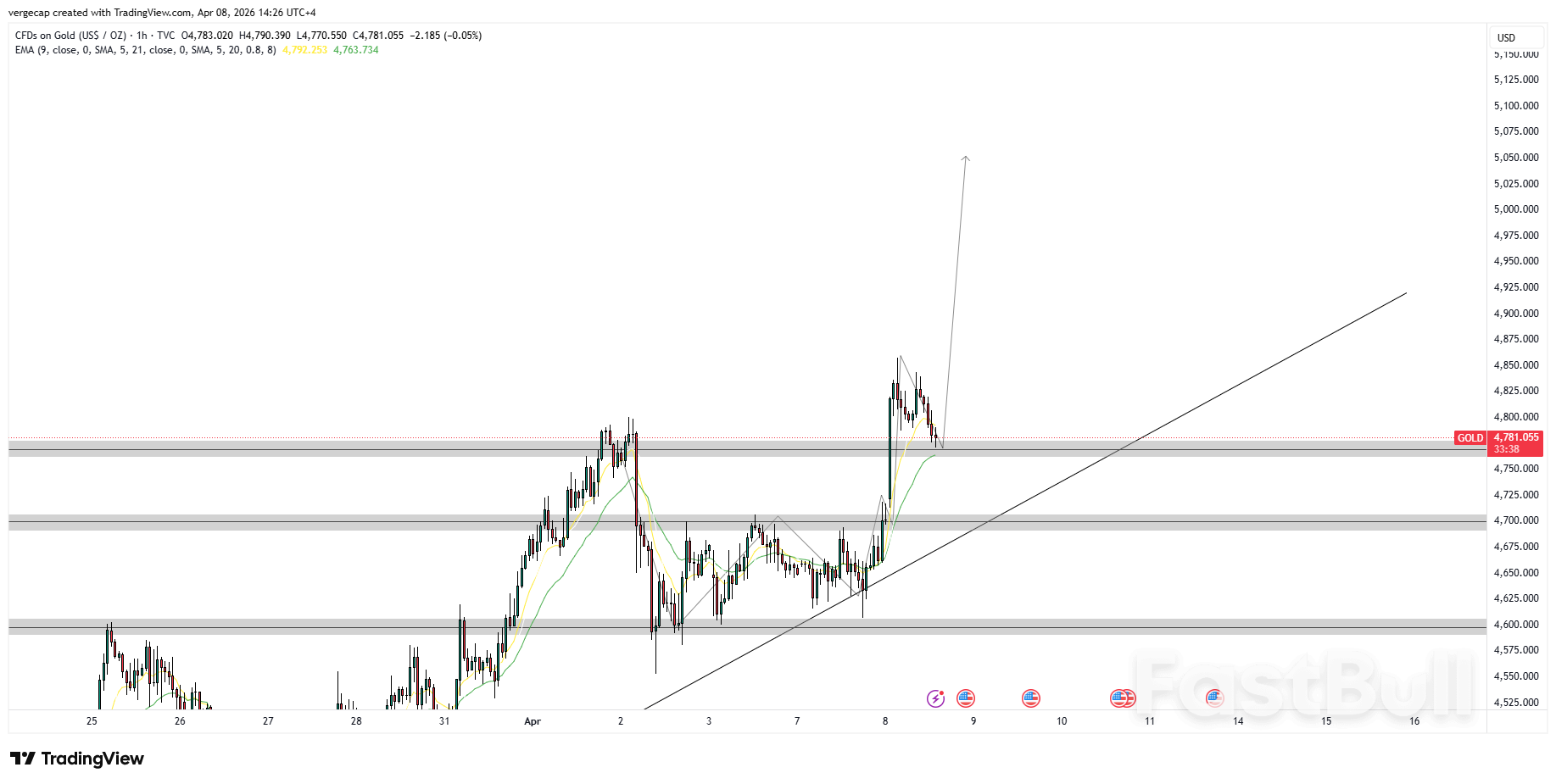
From a technical perspective, Gold remains entrenched within a powerful and well-structured bullish framework on the 1-hour chart, with price currently consolidating around $4,781 following an extraordinary ceasefire-driven spike that briefly propelled XAU/USD to the $4,860–$4,875 area earlier in the session. While the pullback from those highs may unsettle some near-term bulls, the broader technical architecture of this chart is unambiguously constructive — and the current consolidation reads more as healthy digestion of a rapid move than any meaningful reversal of the dominant trend.
The most structurally important feature on this chart is the rising ascending trendline that originates from the $4,600 lows set in early April and has been guiding price progressively higher throughout the recovery. This trendline is currently sloping upward and approaching the $4,760–$4,770 zone — a level that now serves as the first critical dynamic support on any continued pullback from the session highs. As long as price respects this trendline on a closing basis, the bullish case for Gold remains technically intact and the measured move projection toward the $5,000–$5,050 target area drawn on the chart stays firmly in play.
The $4,775–$4,780 horizontal band — which acted as a notable resistance ceiling during the late March and early April consolidation phase — has now been breached with conviction and is in the process of converting to support. Price is currently hovering just above this zone, and the manner in which it holds or fails at this level over the coming hours will be the key near-term technical tell. A sustained hourly close above $4,780 would confirm that former resistance has been successfully absorbed as a new floor, establishing a higher-low structure and paving the way for a renewed push toward the session highs and beyond. A failure to hold $4,780 on a closing basis, however, would suggest that the market is not yet ready to sustain above this level and would likely trigger a deeper pullback toward the $4,700 support band.
The 9-period EMA, currently sitting at $4,792, is positioned fractionally above the current price — a consequence of the sharp pullback from the $4,860–$4,875 spike highs — and now represents the immediate dynamic resistance that price must reclaim to restore the short-term momentum profile. The 21-period SMA at $4,763 is rising cleanly beneath price and aligns closely with the ascending trendline support zone, creating a confluent support cluster between $4,760 and $4,770. This dual-layer support — trendline plus 21 SMA — is a technically significant area that would be expected to attract fresh buying interest on any further dip, provided the broader bullish catalyst remains intact.
The $4,700 horizontal zone represents the next meaningful support level below the trendline. This area served as a key pivot throughout the early April consolidation and successfully contained multiple intraday selloffs before the explosive breakout move of the current session. A corrective move that finds support at $4,700 and holds on a closing basis would preserve the higher-low structure and remain entirely consistent with a continuation of the broader uptrend. Below $4,700, the $4,600 structural floor — the origin point of the current rally — represents the last line of defense for the medium-term bullish thesis. A sustained break below $4,600 would represent a complete technical failure of the recovery structure and would shift the near-term bias decidedly neutral to bearish.
On the upside, the measured move arrow projected on the chart targets the $5,000–$5,050 psychological milestone — a level of staggering significance for gold markets that would represent a historic milestone and attract enormous attention from both technical and fundamental participants globally. The $4,860–$4,875 session high represents the immediate upside barrier, and a clean hourly close above this level would likely reinvigorate momentum buying and accelerate the path toward the $5,000 target with considerable speed given the current fundamental backdrop of Dollar weakness and falling Treasury yields.
The moving average configuration, despite the brief inversion of price below the 9 EMA, remains broadly constructive. The 21 SMA continues to slope higher, confirming that the medium-term trend is intact. The temporary dip below the 9 EMA is consistent with post-spike consolidation behavior and does not constitute a trend reversal signal in isolation.
TRADE RECOMMENDATION
BUY GOLD (XAU/USD)
ENTRY PRICE: $4,781.00
STOP LOSS: $4,695.00
TAKE PROFIT: $5,020.00


