Silver prices staged a sharp reversal during European trading on Tuesday, erasing early session losses to trade positively around $69.70 per ounce. The turnaround was primarily fueled by a reversal in the US dollar, which surrendered its modest Asian session gains, breathing new life into the white metal after an initial bout of selling pressure.
The US Dollar Index (DXY), a barometer of the greenback against a basket of six major currencies, was last seen flat at 99.20, having given back its earlier uptick. From a technical perspective, the dollar’s inability to sustain upside momentum is shifting the tactical landscape for precious metals, making silver an increasingly attractive risk-reward proposition for investors eyeing the recent pullback as a potential entry point.
However, beneath the surface of this price recovery lies a deeply uncertain fundamental outlook, caught between conflicting geopolitical narratives and a shifting global monetary policy horizon. While a softer dollar typically acts as a tailwind for dollar-denominated commodities, the broader macro backdrop for silver remains fraught with complexity.
The primary source of volatility stems from the Middle East, where contradictory signals out of Washington and Tehran are keeping traders on edge. Earlier, former President Donald Trump posted on Truth.Social that he had instructed the Department of War to pause scheduled military strikes on Iranian power plants for five days, citing “very good and productive conversations with Tehran” aimed at a “complete and total resolution of our hostilities in the Middle East.”
That narrative was swiftly and categorically rejected by Iranian officials. Parliament Speaker Mohammad Bagher Ghalibaf denied that any talks had taken place, while Iran’s Foreign Ministry reiterated that its stance on the Strait of Hormuz—a critical chokepoint for global energy supplies—remains unchanged. According to the Islamic Republic News Agency (IRNA), Tehran has not responded to messages relayed by third-party nations regarding US requests for dialogue.
This classic geopolitical "he-said, she-said" dynamic leaves markets in a precarious position. In theory, heightened geopolitical tensions should bolster the safe-haven appeal of assets like silver and gold. Yet, the current price action tells a different story. Precious metals are notably underperforming what one might expect given the level of geopolitical risk, largely because the conflict is fueling a surge in energy prices.
The spike in oil prices—a direct consequence of threats to Middle Eastern supply chains—is complicating the inflation outlook for major economies. Consequently, market speculation that global central banks will embark on aggressive interest rate cuts this year is rapidly unwinding. For non-yielding assets like silver, a higher-for-longer interest rate environment is a significant headwind. Unlike equities or bonds, silver offers no coupon or dividend, and its carrying cost becomes prohibitive when real yields remain elevated.
Technical Analysis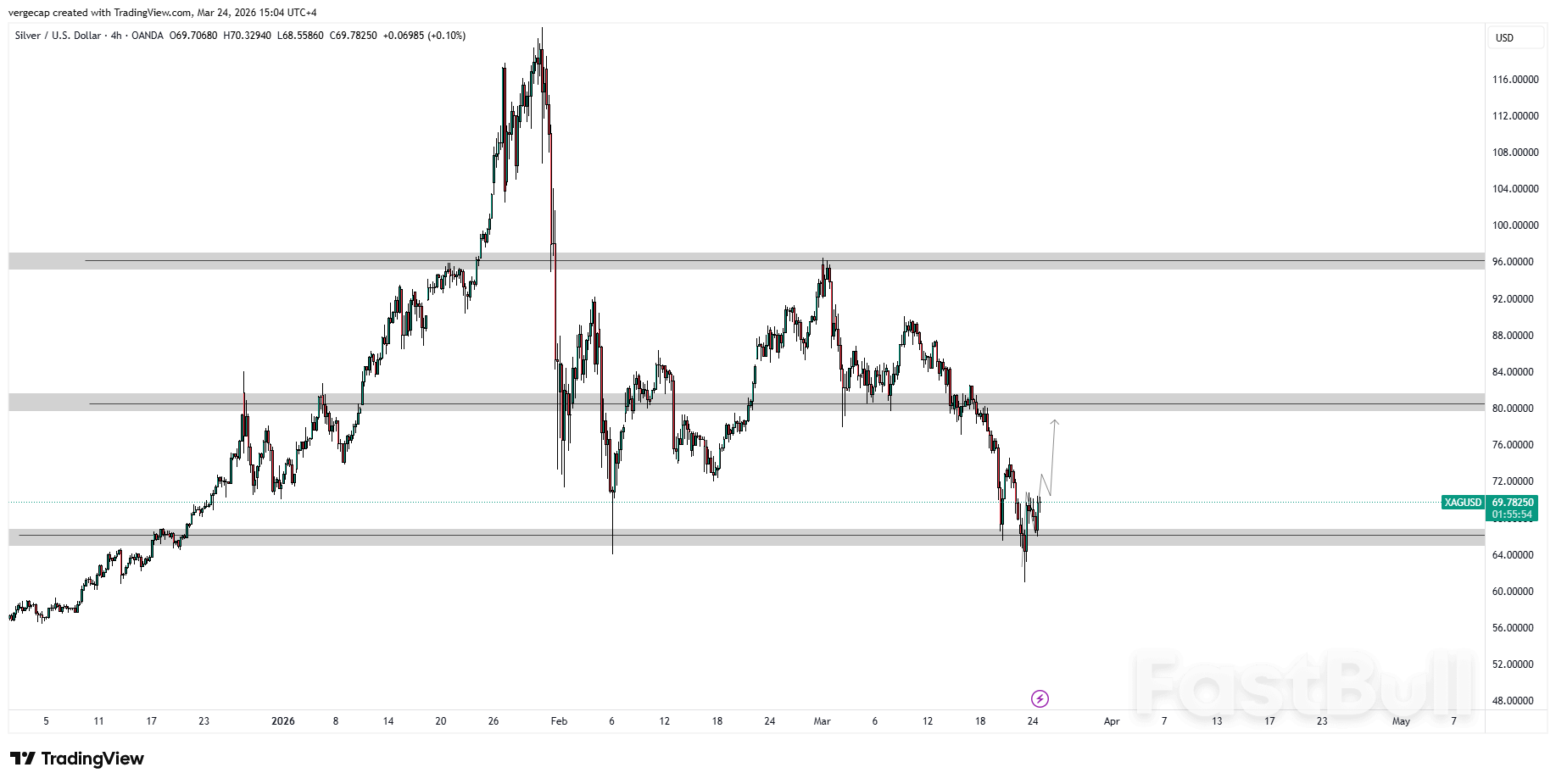
From a technical perspective, silver has transitioned into a corrective bearish phase following its sharp rejection from the $115.00–$116.00 peak, with price action now approaching a key demand zone on the 4-hour chart. The broader structure shows a breakdown from prior bullish momentum, as the market has shifted into a pattern of lower highs and lower lows, signaling increasing downside pressure.
Currently, prices are attempting to stabilize near the $65.00–$67.00 support region, which has emerged as a critical demand zone after absorbing recent selling pressure. This area is acting as a short-term floor, with price showing signs of basing after an extended decline. However, the recovery remains tentative, and the lack of strong bullish follow-through suggests that this could be a pause within a broader downtrend rather than a confirmed reversal.
To the upside, immediate resistance is located around the $80.00–$82.00 zone, which previously acted as support and has now turned into a supply area. A sustained move above this region would be required to signal a meaningful shift in market structure, potentially opening the door for a recovery toward $90.00 and subsequently the $96.00 resistance zone. However, given the current bearish structure, this scenario remains secondary unless momentum decisively shifts.
On the downside, a break below the $65.00 support level would confirm continuation of the bearish trend and expose the $60.00 psychological level as the next target. A sustained move below this threshold could accelerate selling pressure, potentially driving prices toward the $55.00 region, marking a deeper corrective phase.
Momentum indicators suggest stabilization but not yet reversal. The Relative Strength Index (RSI) is likely recovering from oversold territory, indicating a potential for short-term consolidation or a corrective bounce. Meanwhile, the Moving Average Convergence Divergence (MACD) remains below the zero line, reflecting prevailing bearish momentum, although a flattening histogram suggests that downside pressure may be easing in the near term.
TRADE RECOMMENDATION
BUY SILVER
ENTRY PRICE: 71.00
STOP LOSS: 64.50
TAKE PROFIT: 80.00


