The U.S. crude benchmark is attempting to stabilize this Monday, but the rally lacks the fervor and fundamental conviction that propelled it just weeks ago. West Texas Intermediate (WTI) is trading moderately higher, changing hands at $63.30 per barrel in the early session. However, this price action feels more like a tentative pause than a resumption of the bullish trend. The commodity remains trapped within the recent technical range, a stark $3.00 per barrel below the $66.25 zenith touched in late January. The narrative has distinctly shifted from one driven by the palpable fear of sudden supply shock to a more nuanced calculus balancing receding geopolitical tensions against nascent hopes for global demand support.
The primary weight on the market is the clear and ongoing de-escalation between the United States and Iran. The intensifying negotiations surrounding the Islamic Republic’s nuclear program have, for now, significantly dialed back the market’s worst-case scenario: an outright military conflict that would almost certainly spill across the vital oil-producing regions of the Middle East. Last week’s diplomatic momentum has acted as a persistent drag, systematically unwinding the geopolitical risk premium that traders had aggressively priced into contracts throughout January. The specter of a severe, immediate strain on global supply chains is receding from the front of traders’ minds, allowing a cooler assessment of actual physical inventories and near-term demand signals.
It is crucial to remember just how powerful that fear premium was. WTI surged over 14% in January alone, catapulting from eight-month lows around $54.90 hit in a late-December sell-off. That dramatic rebound was almost exclusively fueled by a dangerous tit-for-tat between Washington and Tehran, which included the highly publicized deployment of substantial U.S. military assets to the region. The market was pricing in the tangible probability of disrupted shipping lanes and compromised infrastructure. Now, with diplomats at the fore, that premium is evaporating. The rally has lost its core catalyst, and the price action reflects a market in search of a new directional driver.
Yet, the floor has not fallen out completely. Providing a key underpinning to prices on Monday are growing convictions in the money markets that the Federal Reserve’s trajectory is set to turn more supportive. Swaps and futures markets are increasingly betting the central bank will be compelled to lower borrowing costs further in the coming months. This expectation is offering a crucial counterbalance to the geopolitical unwind. The logic is straightforward: a less restrictive monetary policy in the United States—still the world’s largest economy and a premier crude consumer—should stimulate broader economic activity. This, in turn, would bolster demand for hydrocarbons, easing persistent market anxieties about a looming supply glut amid robust output from non-OPEC+ producers, notably the United States itself.
Technical Analysis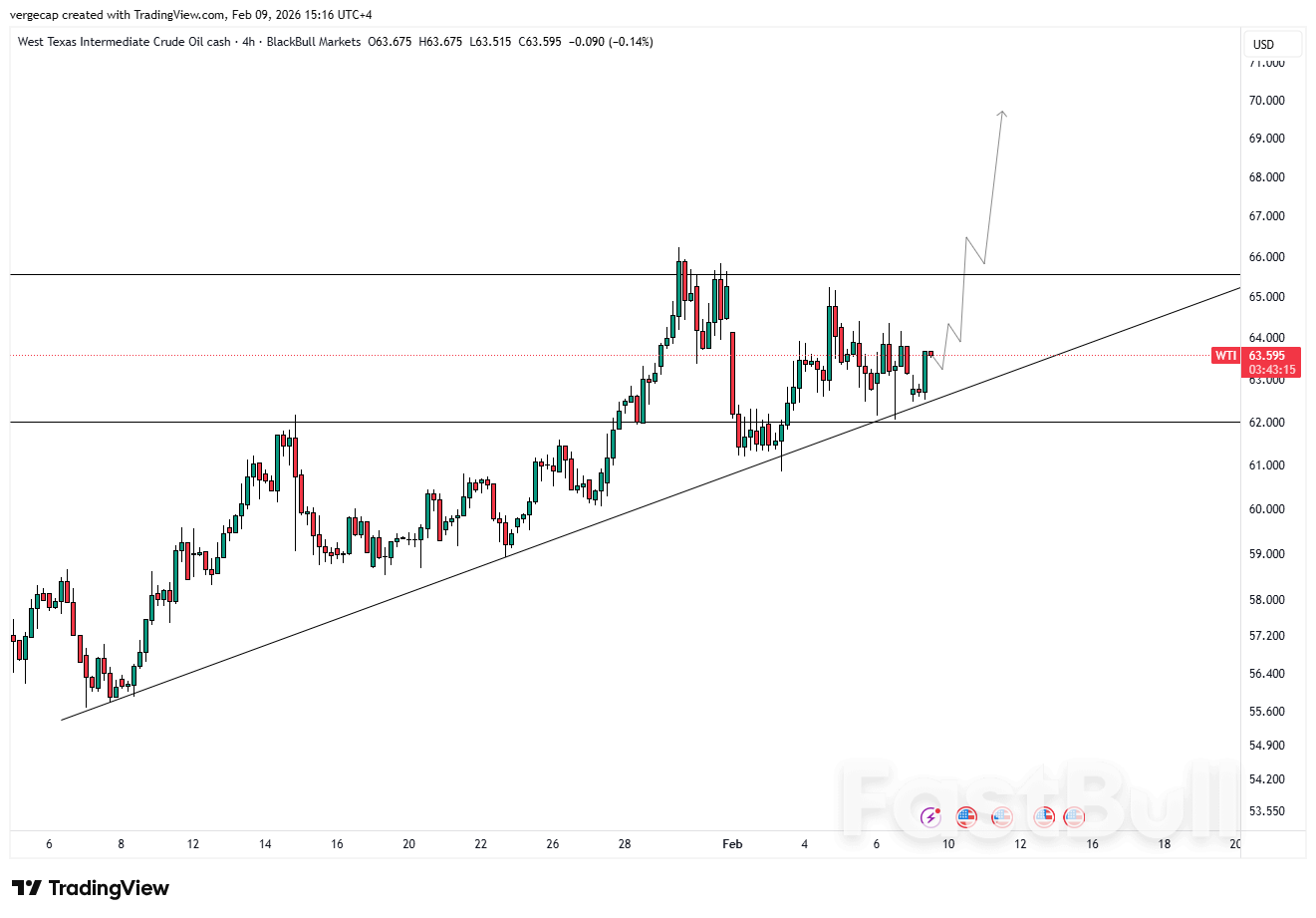
From a technical perspective, WTI crude oil is maintaining a constructive bullish structure, with price action consolidating above rising trendline support following a strong impulsive advance. On the 4-hour chart, crude has been carving out a sequence of higher highs and higher lows, and the broader move remains guided by a well-respected ascending trendline stretching back to early January.
After rallying sharply toward the $65.50–$66.00 area, price entered a consolidation phase rather than reversing aggressively — a key sign that the move is being digested, not unwound. The market is now hovering around the $63.50–$64.00 region, just above the rising trendline, suggesting that bulls are defending higher ground.
The ascending trendline, currently intersecting near $62.80–$63.00, represents the most important dynamic support level. This area is reinforced by prior horizontal structure that acted as resistance before the latest breakout. As long as price holds above this confluence zone, the broader bullish trend remains intact. A decisive break below $62.80, especially on a closing basis, would weaken the immediate outlook and expose a deeper pullback toward $61.50, followed by $60.50, where the previous consolidation base is located. A move beneath $60.50 would mark a more meaningful structural deterioration and shift the market into a broader corrective phase.
On the upside, immediate resistance stands at $65.50–$66.00, the recent swing high and a level that has capped advances so far. A sustained break and close above this barrier would signal trend continuation and likely trigger fresh momentum buying. Such a breakout would open the path toward the $68.00 region initially, with further extension toward the $70.00 psychological level, which aligns with the bullish projection illustrated on the chart.
The consolidation above rising support suggests accumulation rather than distribution. Price compression near the upper half of the range often precedes another leg higher, particularly when it occurs within an established uptrend. The structure reflects a market pausing to gather momentum rather than signaling exhaustion.
Overall, the technical landscape favors a buy-on-dips approach while WTI holds above the $62.80 trendline support and continues to form higher lows.
TRADE RECOMMENDATION
BUY WTI
ENTRY PRICE: $63.60
STOP LOSS: $62.00
TAKE PROFIT: $68.00


