Crude oil prices are tearing higher on Thursday, with West Texas Intermediate surging more than 7% to trade around $101.10 per barrel during the European session — a dramatic reversal after two consecutive days of losses that had briefly raised hopes the energy market might find a degree of stability. Those hopes have been thoroughly extinguished. What we are witnessing now is not a routine bounce — it is a fear-driven repricing of energy risk on a scale that should alarm policymakers, central bankers, and consumers alike.
The catalyst, as has been the case so many times in recent weeks, is the Middle East conflict — and specifically the increasingly unpredictable diplomatic and military signals emanating from Washington. President Donald Trump, in comments that were meant to project strength and control, instead delivered a message that energy markets read as deeply unsettling. Trump stated that Iran is "no longer a significant threat" — a characterization that struck many seasoned observers as premature at best and dangerously misleading at worst — while simultaneously warning that military strikes could intensify over the coming weeks. The contradiction was impossible to ignore: if Iran poses no significant threat, why would strikes be escalating? Markets, which trade on clarity and forward guidance, got neither.
Trump also sought to downplay the strategic importance of the Strait of Hormuz, insisting that the United States does not depend on the critical waterway and suggesting it would "reopen naturally" once the conflict concludes. To anyone who understands the anatomy of global energy flows, that statement is staggering in its optimism. Roughly 20% of the world's oil and a significant portion of liquefied natural gas passes through the Strait of Hormuz on any given day. There is nothing "natural" about its reopening when the Iranian Revolutionary Guard Corps Navy is actively patrolling it and Tehran has explicitly vowed to keep it closed.
Iran's response to Trump's ceasefire narrative was swift and unambiguous. Tehran flatly rejected Trump's assertion that it had sought a ceasefire, with officials reiterating that the Strait of Hormuz will remain closed and under the operational control of the IRGC Navy. This direct contradiction of the US President's framing creates a dangerous information vacuum — one where traders cannot trust the official narrative and are forced to price in worst-case scenarios to protect themselves. In that environment, oil only goes one direction: up.
Then came the tanker strike — and if there was any residual doubt about the severity of this crisis, that event erased it. An oil tanker leased to QatarEnergy was struck by an Iranian cruise missile in Qatari waters on Wednesday, according to Reuters citing Qatar's defense ministry. This is not a skirmish near contested maritime borders or an ambiguous incident open to interpretation. This is a direct missile strike on commercial energy infrastructure in the territorial waters of a sovereign Gulf nation. The implications are enormous. Every shipping company, every energy trader, and every insurer with exposure to Gulf routing is now reassessing risk models that were already stretched to their limits. Maritime insurance premiums will surge. Shipping routes will be diverted. The physical movement of crude oil and LNG through the Gulf is becoming not just expensive but genuinely dangerous.
As a financial reporter who has covered commodity markets through multiple geopolitical crises, I want to be direct: this is not a situation that resolves quickly. The combination of a missile strike on Qatari waters, the IRGC's explicit control of the Hormuz chokepoint, and Washington's mixed messaging creates an environment where oil supply risk is not merely elevated — it is structurally embedded into the market for weeks if not months to come.
The assessment from the International Energy Agency adds another layer of alarm that deserves serious attention. The IEA head warned on Thursday that supply disruptions are expected to begin materially impacting Europe's economy in April — the current month. Critically, the IEA noted that European economies had until now been cushioned by cargoes that were secured and locked in prior to the outbreak of the conflict. That buffer is running out. As pre-conflict supply contracts expire and are not renewed at viable rates, European refiners and energy distributors will face the full force of the supply shock in real time. This is not a future risk — it is an imminent one.
Technical Analysis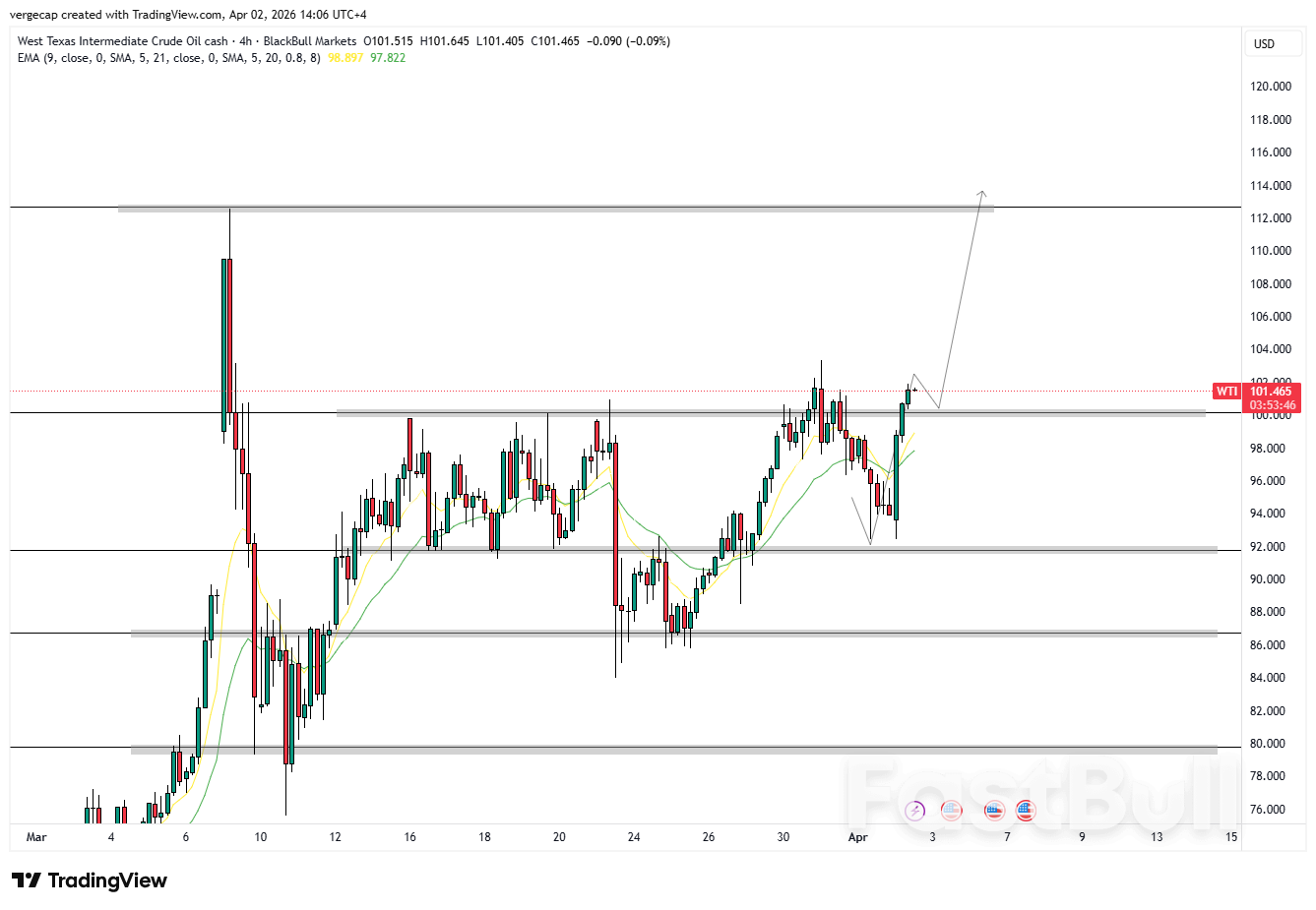
From a technical perspective, WTI Crude Oil is exhibiting a compelling and structurally significant bullish configuration on the 4-hour chart, with price having just staged a decisive breakout above the $100.00 psychological barrier to trade around $101.465. The broader chart tells a story of extraordinary volatility — a conflict-driven spike to approximately $110.00 in early March, followed by a violent collapse to the $79.00–$80.00 lows, and then a methodical, multi-week recovery that has now culminated in a clean break of the $100.00 threshold. This progression from climactic selloff to structured recovery to breakout is a textbook sequence, and it carries meaningful technical weight.
The $100.00 level represents far more than a round number on this chart. It has served as a visible pivot zone, capping multiple rally attempts throughout the late March consolidation phase before finally yielding to bullish pressure in the current session. A sustained 4-hour close above this level — which price is currently holding — transforms $100.00 from resistance into foundational support and opens the door to the next major objective. The conviction of the breakout candle, combined with the clean separation of price from both moving averages, suggests this move is driven by genuine momentum rather than a false break that risks immediate reversal.
The 9-period EMA and 21-period SMA, currently tracking at $98.90 and $97.82 respectively, are both sloping sharply higher beneath price and operating in a clean bullish stack formation. This alignment confirms that the short and medium-term trend are in full agreement to the upside. These moving averages now define the dynamic support corridor on any near-term pullback. A retest of the $98.90–$99.00 zone that holds on a closing basis would represent a high-quality continuation entry, reinforcing the breakout and resetting the risk/reward for a push toward higher targets.
The $92.00 horizontal level remains the critical structural floor on the 4-hour chart. This zone acted as a significant support and resistance boundary multiple times throughout March, and its integrity is essential to the medium-term bullish thesis. A corrective move that finds support at or above $92.00 would preserve the higher-low structure that has defined the recovery since the $79.00 lows. However, a sustained break below $92.00 — particularly on a closing basis — would represent a serious deterioration in market structure and signal that the breakout above $100.00 was a failed attempt, exposing the $86.00–$87.00 demand zone below. A deeper failure through $86.00 would bring the $80.00 structural floor back into focus and mark a complete failure of the bullish recovery narrative.
On the upside, the measured move projection drawn on the chart targets the $112.00–$113.00 major resistance ceiling — the zone that capped the initial conflict-driven spike in early March. This level represents the definitive test for the bulls and the natural destination for a sustained breakout above $100.00. The distance from current price to this target is approximately $11.00–$12.00, a move entirely consistent with the width of the prior consolidation range and the magnitude of the geopolitical supply premium being priced into the market. A sustained close above $112.00 would open the door toward $116.00–$118.00, matching the absolute highs from the initial conflict spike.
The moving average configuration adds further confidence to the bullish outlook. The fact that both the 9-period EMA and 21-period SMA completed a golden cross well below current price and have maintained their upward slope throughout the recovery phase speaks to the durability of the trend. Price has not revisited these averages in a sustained manner since the late March breakout began, a sign of strong underlying demand absorption on any dip.
TRADE RECOMMENDATION
BUY WTI CRUDE
OIL ENTRY PRICE: $101.00
STOP LOSS: $97.50
TAKE PROFIT: $112.00


