WTI crude remains under pressure on Monday, extending its decline for a fourth consecutive session and slipping below $94 per barrel during European trading. The US oil benchmark has now retreated nearly 8% from last week's highs, as signs of stronger-than-expected Saudi exports ease some of the supply concerns that previously pushed prices toward $100.
The latest pressure follows reports that Saudi crude flows remained surprisingly resilient during September, despite disruptions to the country's East-West pipeline. JP Morgan data cited over the weekend indicated that exports have continued at a strong pace, challenging expectations that infrastructure problems would significantly restrict Saudi supply.
Conditions around the Strait of Hormuz have also improved. US Central Command said oil shipments through the crucial waterway reached their highest levels in six months during the past two weeks, helped by naval protection and mine-clearing operations. Improved tanker traffic through Hormuz has reduced fears of an immediate supply shortage and contributed to the latest correction in crude prices.
However, the geopolitical risk premium has not disappeared. Middle East tensions remain elevated after Houthi forces launched missile and drone attacks targeting Riyadh, while the United States and Iran exchanged renewed threats as the conflict approaches its seventh month.
Those developments are helping prevent a more aggressive collapse in oil prices. OCBC sees potential for renewed support following the latest attacks on Saudi Arabia, particularly given that the East-West pipeline has already suffered damage and loadings at Yanbu have faced disruption. Saudi authorities reported that the latest attacks were intercepted without additional damage to oil infrastructure, but the incidents underline the continuing vulnerability of regional energy facilities.
The immediate oil outlook therefore remains caught between improving physical supply flows and persistent geopolitical risks. Stronger Saudi exports and increased Hormuz traffic favor further normalization in prices, while another successful attack on energy infrastructure could quickly revive supply fears.
For now, WTI's retreat below $94 reflects easing concerns over near-term availability rather than a complete disappearance of the Middle East risk premium. Further downside could remain limited unless Saudi exports continue normalizing and threats to regional oil infrastructure begin to subside.
Technical Analysis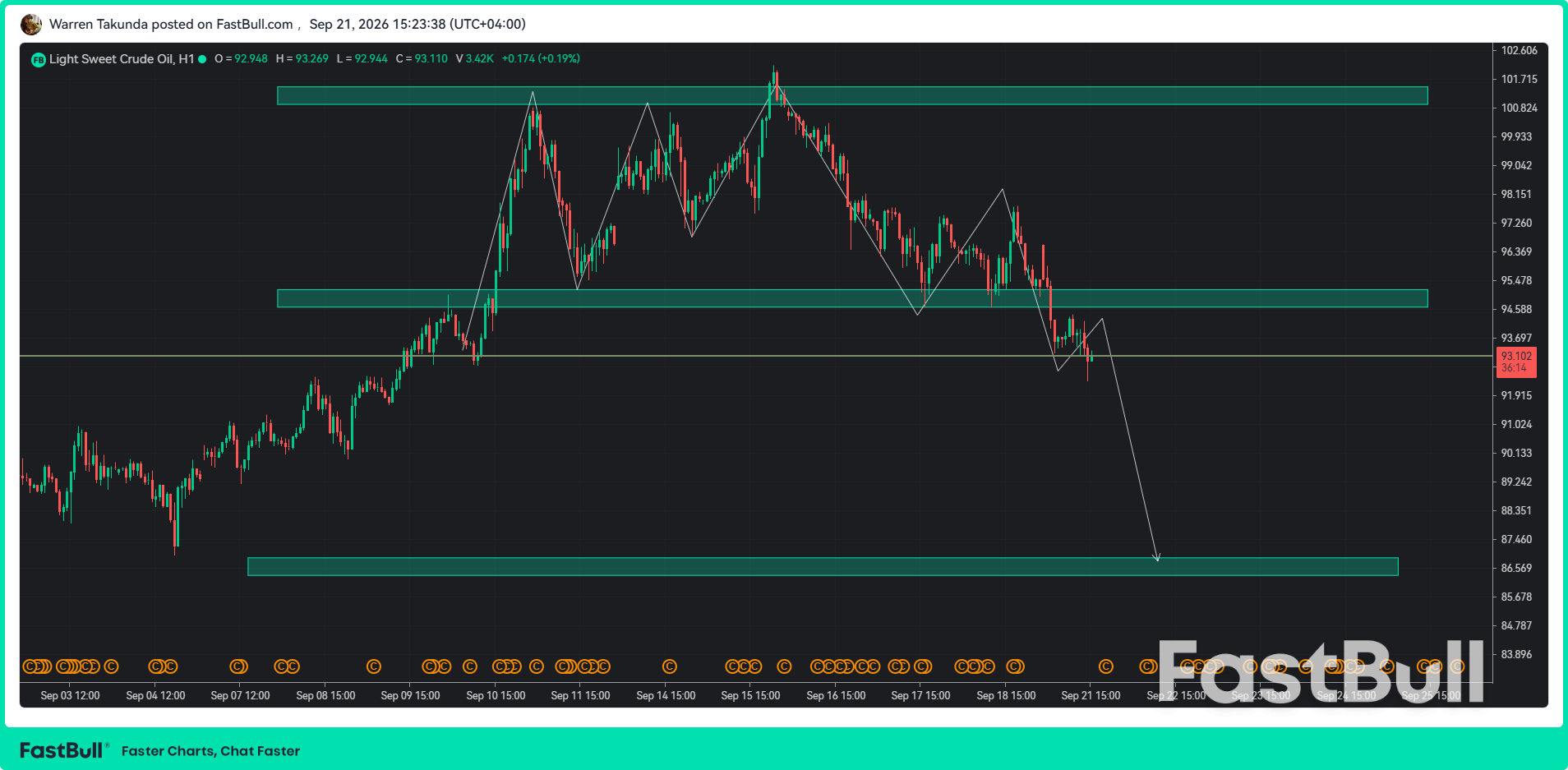
WTI remains firmly under pressure on the 1-hour chart, with price trading around $93.10 after extending the sequence of lower highs and lower lows that has developed from the September peak above $101. The recent deterioration suggests the broader correction still has room to run despite attempts by buyers to stabilize the market.
The key technical development is the breakdown beneath the $94.60–$95.10 support zone. This area had repeatedly attracted buyers during previous pullbacks, but price has now moved decisively underneath it. As a result, the zone has shifted from support into an important resistance barrier that sellers could defend on any recovery.
In the immediate term, WTI could still stage a corrective rebound toward $93.80–$94.30 following the speed of the latest decline. Such a move would not materially alter the bearish structure. Instead, failure to recover above $94.60–$95.10 would reinforce the idea that rallies are being used as opportunities to re-establish short positions.
The broader structure has also deteriorated considerably since the rejection from the major $100.80–$101.40 supply zone. Successive rebounds have failed at progressively lower levels, confirming that buying momentum is weakening while sellers continue to dictate direction.
If price extends beneath the recent low around $92.40, downside momentum could accelerate. The chart leaves relatively limited structural support immediately below current levels, placing greater attention on the major $86.50–$86.90 demand zone. This represents the primary bearish objective and an area where stronger buying interest could eventually return.
A recovery above $95.10 would weaken the immediate bearish setup and could encourage a deeper correction toward $96.30–$97.30. Until that happens, however, the technical picture continues to favor a short-term rebound followed by another leg lower.
Overall, WTI remains in a well-defined bearish phase. The loss of $95 support, combined with the persistent lower-high structure, keeps the path tilted toward $86.50–$87.00.
TRADE RECOMMENDATION
SELL WTI
ENTRY PRICE: $93.10
STOP LOSS: $97.20
TAKE PROFIT: $86.80


