West Texas Intermediate crude oil is clinging to a positive bias for the second consecutive session on Thursday, consolidating around the $91.64 per barrel mark during early Asian hours after recovering a sharp 4% selloff from the prior session. The intraday uptick, while not explosive, carries meaningful weight — and in my view, it tells the real story of a market that simply refuses to price in a peace that does not yet exist.
Wednesday's dramatic drop was, frankly, a textbook case of the market getting ahead of itself. Oil tumbled after U.S. President Donald Trump told reporters from the Oval Office that Washington and Tehran were "in negotiations right now," claiming the other side was "talking sense." For a few brief hours, traders dumped crude as the geopolitical risk premium deflated rapidly. Brent crude declined as much as 2.2% to around $100 a barrel on Wednesday, with WTI slipping a similar magnitude to $90.32, after Trump suggested he had held back from threatening strikes on Iranian energy infrastructure because of ongoing diplomatic outreach.
But by Thursday morning, the rally was already reasserting itself — and for good reason.
Iranian Foreign Minister Abbas Araghchi stated bluntly on state television that his government has not engaged in talks to end the war, "and we do not plan on any negotiations." The message could not have been clearer. While Trump's team — which reportedly includes special envoy Steve Witkoff, Jared Kushner, Secretary of State Marco Rubio, and Vice President JD Vance — insists dialogue is ongoing, Tehran is publicly singing an entirely different tune.
Iran's five-point counteroffer to Washington's 15-point peace plan includes war reparations, recognition of Iranian sovereignty over the Strait of Hormuz, and safeguards against future attacks on the Islamic Republic — demands that, by any realistic diplomatic assessment, are unlikely to fly in Washington. Iran's state broadcaster Press TV confirmed the counteroffer would give Tehran full control over the Strait of Hormuz — a condition that U.S. President Trump had previously floated as a possible joint arrangement between himself and the ayatollah.That those talks collapsed almost immediately speaks volumes about how far apart the two sides truly are.
An Iranian military spokesman said the situation at the Strait of Hormuz "will not return to what it was," declaring that Iran would determine who is allowed to pass through the strategic waterway — adding that "the authority to issue passage permits is ours."That is not the language of a government preparing to negotiate. That is the language of a government that believes it holds the cards — and in terms of energy market leverage, it is not entirely wrong.
The Strait of Hormuz is not simply a shipping lane. It is the jugular vein of the global energy system. The International Energy Agency has called the closure of the strait the largest ever disruption to oil supply, with roughly a fifth of the world's oil and liquefied natural gas normally transiting the waterway.Over 1,000 ships — most of them oil tankers — remain stranded near the strait, and some 20,000 seafarers are reportedly trapped near the passageway.
Iran has allowed a small number of ships from countries it deems neutral parties to pass through — including vessels linked to Pakistan and India — but ships associated with the United States, Israel, or allied nations remain barred.This selective passage is not a reopening. It is a geopolitical weapon being wielded with surgical precision, and energy markets are pricing that reality accordingly.
Iran's attacks on regional energy infrastructure have sent oil prices skyrocketing since the conflict began on February 28, putting immense pressure on the United States to find a path to ending the chokehold and calming markets.Brent crude has neared $120 a barrel during the most intense phases of the conflict and, despite Wednesday's pullback to around $100, remains up roughly 35% since hostilities began.
If there were any doubt about the trajectory of this conflict, the U.S. military's latest moves should dispel it. At least 1,000 troops from the 82nd Airborne Division will be deployed to the Middle East in the coming days, sources told the Associated Press — paratroopers specifically trained to jump into hostile or contested areas to secure key territory and airfields.
The U.S. is positioning ground-capable forces in the region following Iran's rejection of the ceasefire proposal, a shift that gives Washington new — though limited and high-risk — options for potential operations inside Iran. Reports from Axios and CBS suggest the Pentagon has even drafted detailed plans for deploying U.S. ground troops into Iran and is considering scenarios involving Kharg Island, Iran's key oil export hub. The Wall Street Journal has reported the Pentagon is deploying three warships and thousands of Marines to the Middle East.
The market is right to take notice. Every incremental troop deployment, every leaked Pentagon planning document, every drone strike on Gulf energy infrastructure is a reminder that this conflict is not winding down — it is widening.
Wall Street is adjusting. Goldman Sachs recently raised its 2026 Brent crude forecast to $85 from $77, acknowledging the shift in global trade routes driven by the conflict. J.P. Morgan analysts have noted that even in the event of a quick ceasefire, oil will face a lasting "security tax" due to new shipping routes and higher insurance costs throughout 2026.
U.S. oil production remains robust at 13.6 million barrels per day, but analysts warn it cannot compensate for a long-term closure of the Hormuz Strait.The supply disruption at the world's most critical chokepoint is structural in nature — not something that can be fixed by turning on a few more Texas wells.
From a technical perspective, WTI sits at a critical resistance level, with the bullish trigger at $94.50 — the 50% Fibonacci retracement — a break above which could quickly push prices back toward the psychologically significant $100 mark as traders rush to cover short positions. On the downside, key support rests at $88.28, though with the geopolitical backdrop as combustible as it is, a sustained move below that level looks unlikely absent a credible diplomatic breakthrough — and there is no credible diplomatic breakthrough in sight.
The brief oil selloff on Wednesday was a classic "buy the rumor, sell the fact" dynamic in reverse — traders sold the war, bought the peace talk, and are now being swiftly reminded that Trump's optimism and Iran's actual position are two entirely different things. Every session that passes without a reopening of the Strait of Hormuz is another session that reinforces the supply shock narrative. The fundamentals — military escalation, Hormuz closure, surging insurance costs, stranded tankers, and a UN Secretary-General warning of a fertilizer crisis — all point in the same direction. WTI's bullish bias is not noise. It is the market telling you, in the most direct language it knows, that this crisis is far from over.
Technical Analysis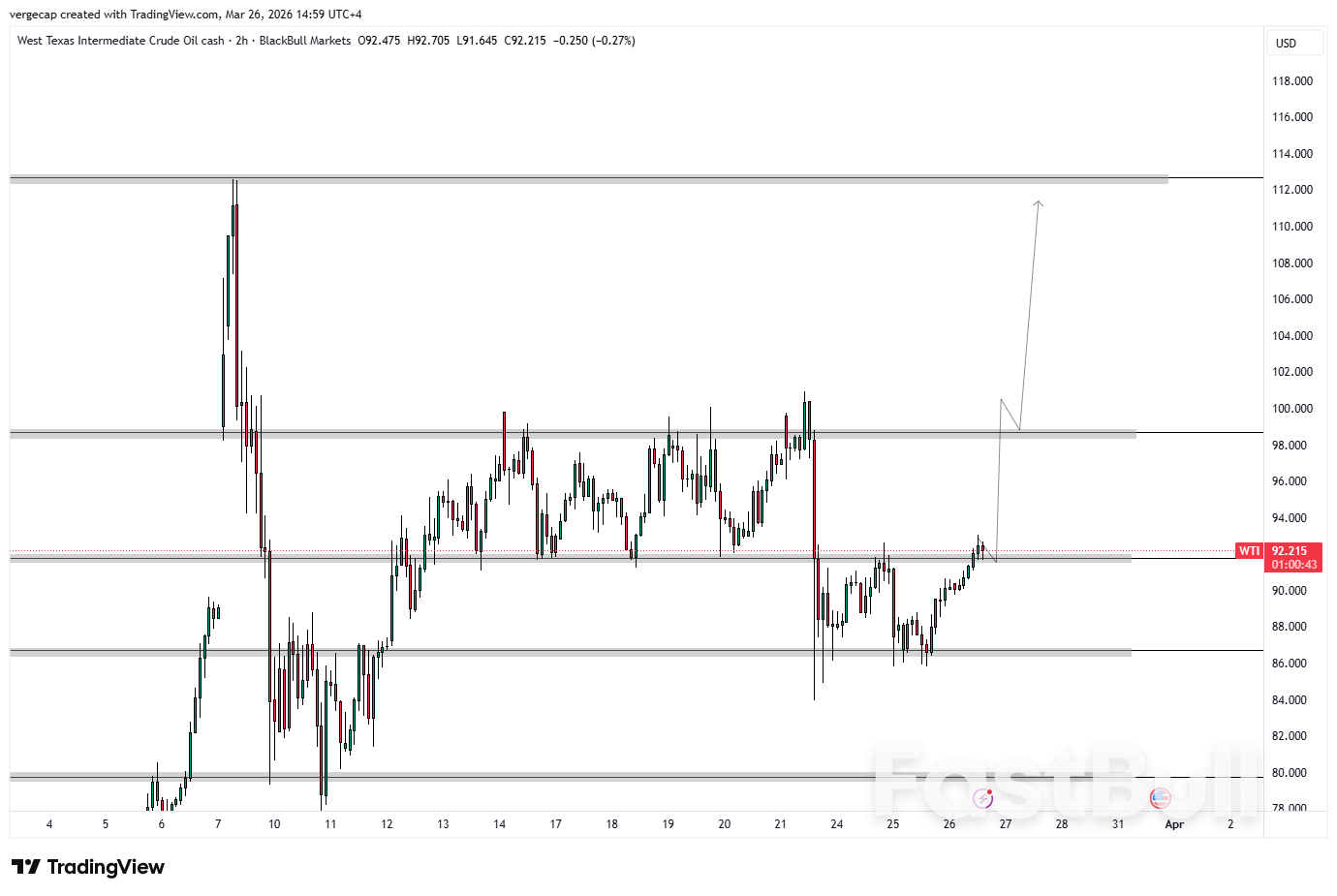
From a technical perspective, West Texas Intermediate Crude Oil is carving out a constructive recovery structure on the 2-hour chart following a brutal multi-day corrective selloff. After spiking to a peak of approximately $113.00 in early March — driven by the initial shock of the Strait of Hormuz closure — WTI underwent a sharp two-phase correction, finding its most recent floor around the $85.00–$86.00 demand zone before staging a meaningful recovery. Price currently trades at $92.215, sitting at a pivotal inflection point that will determine whether the recovery extends into a full-fledged bullish leg or stalls for another round of consolidation.
The chart displays a clear horizontal structure across multiple key price levels. The immediate area around $92.00–$93.00 represents a near-term battleground, marked by a notable dotted support/resistance line that previously acted as a floor during the mid-March consolidation phase. The fact that price has recovered back to this level from the lows and is now attempting to establish it as support is technically encouraging. A sustained hold above this zone would confirm a base-building process is underway and shift the near-term bias firmly back to the upside.
The next major hurdle lies within the $98.00–$100.00 resistance band — a thick horizontal zone visible on the chart that capped multiple rallies during the March 14–21 consolidation period. This level is significant for two reasons: it represents a dense concentration of prior price activity, and it also aligns with the psychological $100.00 handle that carries considerable weight in commodity markets. The projected price path annotated on the chart suggests bulls are targeting an initial push into this zone as the first meaningful objective, before attempting a more aggressive breakout toward the chart's upper boundary.
Should WTI clear the $98.00–$100.00 resistance band convincingly — ideally on a closing 2-hour basis with follow-through — the path toward the $112.00 major resistance zone opens materially. That level marked the peak of the early March geopolitical spike and currently stands as the most critical overhead barrier on the chart. A reclaim of $112.00 would represent a complete retracement of the corrective selloff and signal renewed bullish dominance, aligning with the bullish projection arrow drawn on the chart targeting that zone in the days ahead.
On the downside, immediate support rests at the $88.00–$87.00 zone, where the most recent swing lows formed. A breach of this level on a closing basis would be technically damaging and suggest the recovery is failing. Below there, the $85.00–$86.00 floor represents a last line of defense for bulls — a zone that absorbed aggressive selling pressure last week and must hold to preserve the broader recovery thesis. A sustained move beneath $85.00 would shift the structure decisively bearish and expose the $80.00 psychological support level, which stands as the chart's lowest visible demand zone.
The annotated projection on the chart — showing a minor near-term pullback toward the $99.00–$100.00 area before a sustained push toward $112.00 — reflects a measured bullish outlook that acknowledges overhead resistance while maintaining conviction in the upside trend. Given the unresolved Strait of Hormuz closure, ongoing military escalation, and Iran's outright rejection of Washington's ceasefire proposal, the geopolitical risk premium embedded in crude oil is unlikely to dissipate quickly, providing a fundamental tailwind that keeps the technical bullish structure supported.
TRADE RECOMMENDATION
BUY WTI CRUDE OIL
ENTRY PRICE: $92.50
STOP LOSS: $87.00
TAKE PROFIT: $112.00


