Crude Oil is back. And frankly, anyone who thought Thursday's pullback marked the beginning of a sustained retreat was kidding themselves.
WTI, the US benchmark, has reclaimed the $93.50 handle at Friday's European session open, picking up exactly where it left off before a brief and, in my view, entirely unconvincing dip dragged prices down to $88.93 during Thursday's US trading hours. The bounce was fast, it was decisive, and it sends a clear message to would-be bears: this market is not ready to roll over.
The broader bullish trend that has gripped energy markets for the past two weeks remains very much alive, and with each passing day, the case for Oil sustaining levels at or above the psychologically critical $100 per barrel level grows stronger. Let me explain why.
The brief Thursday retreat was triggered by a rare moment of what appeared to be goodwill from Tehran. Reports emerged that the Iranian government had permitted passage for 10 Oil tankers through the Strait of Hormuz — a gesture that markets initially seized upon as a potential signal of de-escalation. Energy traders, exhausted by weeks of relentless geopolitical volatility, were desperate for any reason to take profits, and they got one, however thin the basis.
But that enthusiasm evaporated almost as quickly as it materialized. By Friday's Asian session, Oil was already climbing back, and the reasons are not hard to find. Ten tankers through a strait that normally handles the equivalent of 20 million barrels per day of crude and refined products is not a ceasefire. It is barely a footnote. The Hormuz blockade, for all practical purposes, remains in effect, and the structural supply disruption that has sent energy markets into crisis mode is nowhere near resolved.
I have covered commodity markets long enough to recognize the pattern: a diplomatic headline triggers a knee-jerk selloff, the market digests the reality, and then prices resume their prior course. That is exactly what we are watching play out again here. The dip to $88.93 was an opportunity, not a turning point.
US President Donald Trump announced this week that he was extending the deadline to strike Iran's energy infrastructure into April, stepping back — at least temporarily — from the more aggressive posture that had sent markets into a tailspin in recent days. On the surface, that sounds like positive news for risk assets and a potential dampener on Oil prices.
But markets barely flinched. And I think that reaction, or rather the lack of one, tells you everything you need to know about where sentiment currently sits.
The problem is that nobody believes the negotiation narrative right now. Trump insists that talks are going "very well." Iranian leaders, meanwhile, say they are still waiting for Washington to formally respond to their conditions for a ceasefire. These two accounts are not just different — they are flatly contradictory. And when the official positions of the two primary combatants cannot even agree on whether meaningful dialogue is happening, traders are right to treat every headline with deep suspicion.
More telling than the diplomatic noise is the fact that the bombing has not stopped. Israel confirmed overnight that it had intercepted a fresh barrage of missiles launched from Iranian territory, while its air forces carried out strikes on targets in both Beirut and Tehran. Extended deadlines mean nothing if the kinetic conflict on the ground continues to escalate. The market understands this, which is why WTI barely blinked at the Trump announcement and is now trading well above $93 again.
If the diplomatic fog and ongoing airstrikes were not enough, the Wall Street Journal dropped what may be the most consequential energy market story of the week on Thursday: the Pentagon is actively considering deploying 10,000 additional US troops to the Middle East.
This is where the situation moves from serious to potentially catastrophic for global energy supply. A ground invasion — or even the credible threat of one — fundamentally changes the calculus on how long this conflict lasts and, critically, how long the Strait of Hormuz remains functionally closed to commercial shipping.
The Strait is not just a geopolitical flashpoint. It is the single most important chokepoint in the global energy system. Roughly 20 million barrels per day of crude oil and petroleum products flow through that narrow passage in normal times, along with approximately 30% of global seaborne liquefied natural gas trade. A prolonged US military ground presence in the region makes a swift reopening of the strait dramatically less likely — and every day the waterway remains impaired is another day that the global supply deficit deepens.
From a pure market mechanics standpoint, this is an environment where Oil prices holding near $100 or above for the better part of 2026 is not a worst-case scenario. It is a base case. And if the conflict escalates further — if Iranian strikes on Gulf energy infrastructure intensify or if the ground troop deployment actually proceeds — then the path toward $110, $115, and beyond becomes uncomfortably plausible.
I think WTI is going to $100, and I think it gets there sooner rather than later. The fundamental supply disruption is real, it is large, and it is not going away. The diplomatic signals are contradictory at best and deceptive at worst. And now, the specter of a full-scale US ground military presence in the region is being seriously discussed at the Pentagon.
Every time this market has sold off on peace hopes, it has recovered. Every time a ceasefire rumor has triggered a washout, buyers have returned. The pattern is consistent and it reflects an underlying market reality: the supply shock is not priced away by headlines alone. It only resolves when the Strait reopens, when tankers move freely, and when Gulf producers can resume normal export operations. None of those conditions are anywhere close to being met.
For traders and investors, the message is clear. Volatility will remain extreme, and headline risk cuts both ways. But the structural bias for Crude Oil remains firmly to the upside as long as the guns are firing and the Strait of Hormuz is shut. I would be using any dips toward the $90–$91 range as buying opportunities, with $100 as the near-term target and the risk squarely to the upside beyond that.
The conflict is not ending next week. The market is slowly but surely coming to terms with that.
Technical Analysis 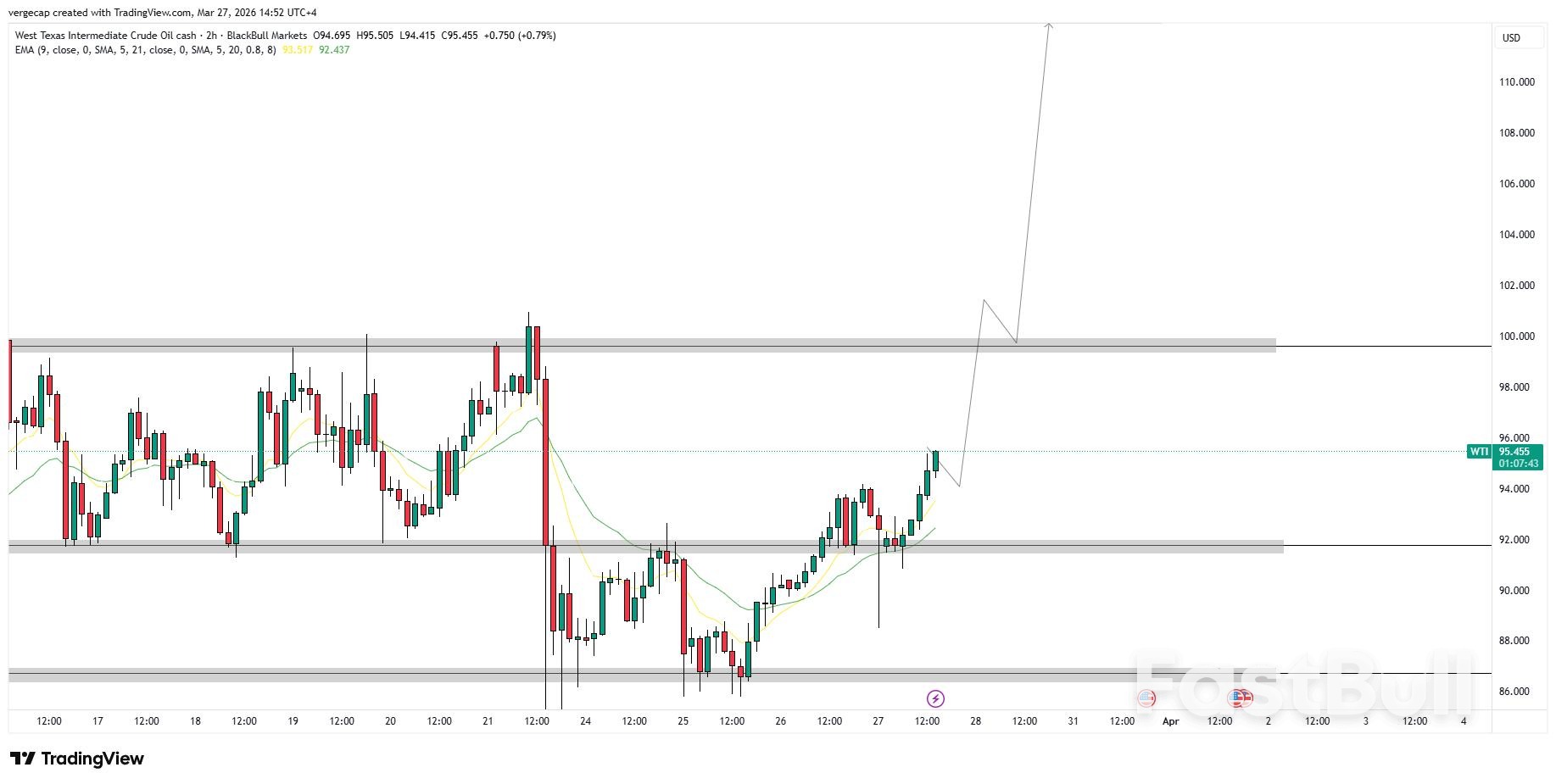
WTI Crude Oil is presenting a compelling and increasingly well-defined bullish recovery structure on the 2-hour chart. After a brutal vertical selloff from the $100.00 psychological ceiling on March 21, which dragged prices all the way down to a session low of approximately $87.00 on March 24-25, the market has staged an aggressive and decisive recovery. Price is currently trading at $95.455, up 0.79% on the session, with bulls firmly back in the driver's seat and momentum building into the Friday European close.
The recovery from the $87.00 lows has been sharp, clean, and notably well-structured. A clear sequence of higher lows has formed across the past two sessions, a textbook sign of accumulation and demand absorption following the prior selloff. The fact that price has reclaimed ground this aggressively after such a steep decline tells me buyers were waiting patiently at those lower levels and are now asserting control with conviction.
The moving average picture has turned constructive. The 9-period EMA, currently sitting at $93.517, has been recaptured and price is now trading comfortably above it — a near-term positive signal that short-term momentum has flipped back in favor of the bulls. More importantly, the 21-period SMA at $92.437 is beginning to curl upward from the recent lows, reinforcing the view that the corrective phase is over and the primary uptrend is reasserting itself. As long as price continues to hold above both of these dynamic support levels on any intraday pullbacks, the bullish structure remains fully intact. A return below the 9 EMA would warrant caution, but a decisive close beneath the 21 SMA at $92.437 would be the first genuine red flag for the near-term recovery thesis.
The chart reveals three clearly defined horizontal zones that will dictate how this trade develops over the coming sessions.
The most immediate and critical support zone sits between $92.00 and $92.50, a level that has been tested multiple times across the past week and held on each occasion. This zone represents both prior congestion and a structural pivot, and it is now reinforced by the proximity of the 21-period SMA. Any retest of this area should be treated as a buying opportunity, not a reason to panic, provided the level holds on a closing basis.
Beneath that, a deeper support band lies in the $86.50–$87.00 region — the same zone where price found its lows during Thursday's capitulation low. A break and sustained close below $92.00 would likely trigger a move back toward this area, representing a significant deterioration in structure and invalidating the current recovery thesis. Below $86.50, the technical picture would darken considerably, opening the door toward the $84.00–$85.00 zone where the next meaningful demand cluster resides.
On the upside, the dominant feature on this chart is the $99.50–$100.00 resistance zone — a thick horizontal band that capped prices on March 21 and triggered the sharp selloff that followed. This level is the single most important technical barrier standing between current prices and a broader structural breakout. The projected price path drawn on the chart — which I find compelling — suggests price may tag the $100.00 zone, experience a brief but shallow pullback toward the mid-$98.00 to $99.00 area, and then use that retest as a launchpad for a sustained push into the $104.00–$110.00 territory. That scenario aligns neatly with the fundamental backdrop of a protracted Iran war and an effectively closed Strait of Hormuz.
The overall market structure on this 2-hour chart has transitioned from impulsive bearish — the March 21-24 collapse — back into a recovery and accumulation phase. The velocity of the rebound from $87.00 to current levels at $95.45 in less than 48 hours of trading is notable and speaks to the underlying demand pressure that the geopolitical supply shock continues to generate. This is not a slow, grinding recovery — it is an assertive one, and assertive recoveries in commodity markets typically have follow-through.
The immediate challenge for bulls is bridging the gap between $95.45 and the $100.00 resistance wall. A clean break and daily close above $100.00 would be a technically transformative event, shifting the chart into breakout mode and likely triggering significant momentum buying from systematic and trend-following funds that have been waiting on the sidelines for confirmation.
TRADE RECOMMENDATION
BUY WTI CRUDE OIL
ENTRY PRICE: $95.50
STOP LOSS: $91.80
TAKE PROFIT: $100.00


