West Texas Intermediate crude oil slipped from its highest levels in three weeks at the open of Monday's Asian session, retreating from an intraday peak of $101.40 per barrel as traders digested a whirlwind of contradictory signals emanating from Washington regarding the United States' posture toward Iran. Despite the pullback, selling pressure remained notably shallow, with prices finding a firm floor above the $98.50 mark — a reflection of just how tightly wound the geopolitical risk premium in energy markets has become.
The retreat was modest in both scale and conviction, and in my view, it tells you everything you need to know about where the balance of risks sits right now. This is not a market that wants to sell oil aggressively. Every dip is being met with buyers who understand that the fundamental supply disruption story — far from being resolved — is actually getting worse by the day.
At the center of Monday's volatility was US President Donald Trump, who delivered a characteristically mixed set of messages that left traders struggling to price a coherent geopolitical outcome. In an interview published by the Financial Times on Monday, Trump confirmed that seizing Iran's Kharg Island — the country's primary crude oil export terminal, responsible for handling the vast majority of Iran's petroleum shipments — remains an active option on the table. The President suggested that such an operation would require a prolonged US military presence, stating the US would need to "be there for a while."
The implications of such a scenario for global oil markets would be staggering. Kharg Island handles an estimated 90% of Iran's oil exports. Any military action targeting the facility would not merely disrupt Iranian supply — it would send shockwaves through the entire Persian Gulf energy complex, potentially triggering retaliatory strikes on broader regional infrastructure and permanently redefining the geopolitical risk premium baked into crude prices.
And yet, in almost the same breath, Trump offered what appeared to be an olive branch. The President reiterated that both direct and indirect negotiations with Tehran are ongoing, describing the new leadership of the Islamic Republic as "very reasonable" — language that stands in stark contrast to the hawkish tone of his Kharg Island remarks. Trump went further, citing Iran's decision to allow 20 large oil tankers to pass through the strategically critical Strait of Hormuz as a gesture of goodwill and respect toward Washington.
This is the Trump diplomatic playbook operating in real time — maximum pressure married to maximum ambiguity. For energy traders, it is an extraordinarily difficult environment to navigate. The market is being asked to simultaneously price a potential military escalation that could remove millions of barrels of supply from the global market and a diplomatic resolution that could reverse those supply concerns overnight. The result, as we are seeing this morning, is a choppy, range-bound trade around the $99.00 area, with neither bulls nor bears willing to commit fully until the fog clears.
Tehran, for its part, is showing no appetite for the conciliatory framing coming out of Washington. Iranian authorities pushed back sharply on Monday, accusing Trump of engaging in bad-faith diplomacy — talking about negotiations publicly while, they allege, actively preparing for military invasion behind the scenes. In characteristically blunt language, Iranian officials warned that any US military incursion into Iranian territory would result in what they described as a "bloodbath" for American forces.
This kind of hardened rhetoric, coming directly from Iranian government channels, is not background noise. It materially reduces the probability of a near-term diplomatic off-ramp and should be weighing more heavily on market participants than the current price action suggests to me. When both sides are simultaneously talking about talks and threatening annihilation, history tells us that accidents — deliberate or otherwise — become far more likely.
One development that did contribute to modest downside pressure on WTI earlier in the Asian session was a statement from Pakistani authorities confirming that Islamabad intends to facilitate negotiations between Washington and Tehran in the near future. Pakistan has historically maintained lines of communication with both the United States and Iran, and its willingness to step in as a mediator was interpreted by some participants as a signal that a diplomatic channel, however fragile, remains open.
The price reaction, however, was fleeting. WTI dipped briefly on the headlines before stabilizing, a market response that speaks volumes about how seriously traders are taking the prospect of a near-term resolution. At this point, the prevailing view on trading desks appears to be that any negotiations are more likely to delay escalation than prevent it — particularly given the hardening of positions on both sides.
If Trump's Kharg Island comments were not enough to keep oil traders on edge, the weekend brought a dramatic and deeply concerning escalation from an entirely different front. Iran-backed Houthi militias based in Yemen launched a fresh series of missile strikes targeting Israel over the weekend, marking a significant widening of the conflict's geographic and political scope. More alarming still, the Houthis issued explicit threats to close the Strait of Bab el Mandeb — the narrow waterway connecting the Red Sea to the Gulf of Aden through which an estimated 10% of global seaborne oil trade passes daily.
This threat cannot be dismissed as empty posturing. The Houthis have demonstrated repeatedly over the past year that they possess both the intent and the capability to disrupt major shipping lanes. A sustained closure of Bab el Mandeb, combined with ongoing pressure on the Strait of Hormuz, would create a dual chokepoint scenario for global energy logistics that the market is nowhere near fully pricing at current levels. In my assessment, this is the single most underappreciated risk in the oil market right now, and any credible move toward executing on that threat would send prices well above $110 per barrel almost instantaneously.
Further compounding the picture, Kuwait confirmed over the weekend that an Iranian strike targeted a power and water desalination plant within its borders, resulting in the death of an Indian national worker and causing substantial structural damage to the facility. The incident is significant beyond its immediate humanitarian tragedy. It represents a direct Iranian military action against a Gulf Cooperation Council member state — a line that, once crossed, carries implications for broader regional security architecture and the involvement of Gulf states in what has until now been primarily framed as a US-Iran-Israel confrontation.
For oil markets, an attack on Kuwaiti infrastructure is a stark reminder that no Gulf producer is insulated from the spillover risks of this conflict. Kuwait produces approximately 2.5 million barrels per day. Any sustained threat to Kuwaiti production or export infrastructure would add yet another layer of supply anxiety to an already stretched market.
Stepping back and looking at the full picture, I find it very difficult to construct a bearish near-term case for crude oil from a fundamental standpoint. The conflict is widening, not narrowing. Diplomatic channels are fragile and contradictory. Supply chokepoint risks are multiplying. And the market's reaction to every piece of negative news — shallow dips, swift recoveries — tells its own story about the underlying demand for oil exposure at current prices.
The $98.50–$99.00 level looks like a credible near-term floor. A clean break and daily close above $100.50 would, in my view, open the door to a swift move toward $104.00–$105.00, with the $111.00–$112.00 zone representing the medium-term target should the Strait of Hormuz or Bab el Mandeb situation deteriorate further. The risks to this view are a sudden and credible ceasefire announcement or a comprehensive diplomatic breakthrough — events that, based on everything I am reading out of both Washington and Tehran this morning, seem some distance away.
Technical Analysis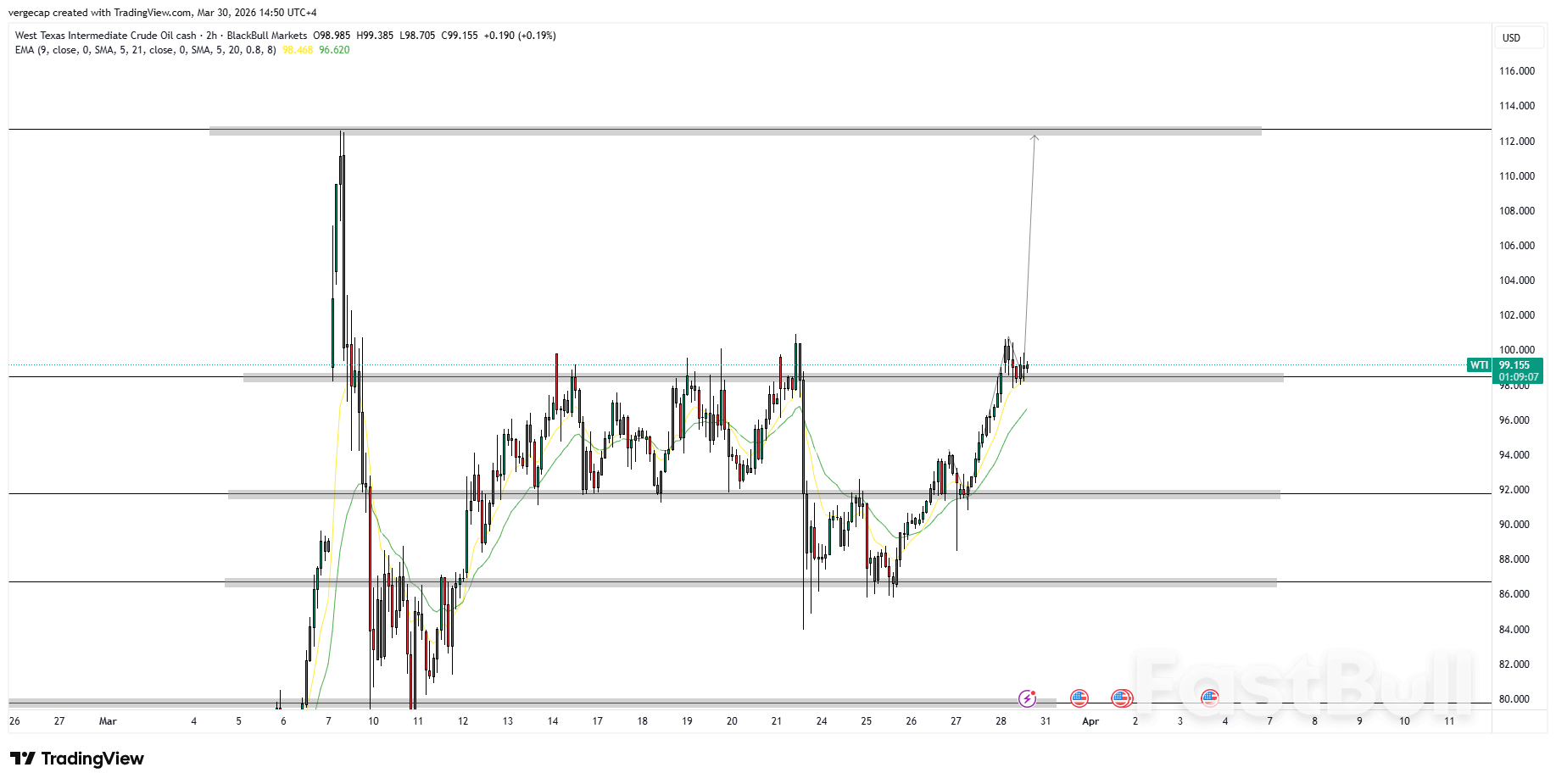
WTI Crude Oil is firmly entrenched in one of the most compelling bullish structures seen on the 2-hour chart this year, with price mounting a sustained and increasingly confident assault on the psychologically explosive $100.00 per barrel level. The recovery from the $84.00 lows of mid-March has been nothing short of remarkable in both its speed and its structure — a near-perfect sequence of higher lows and higher highs that has systematically dismantled every layer of resistance in its path, and the price action right now strongly suggests that the best of this move is still ahead.
The current rally is not a chaotic, news-driven spike. It is a methodical, technically sound advance built on solid moving average support, clean breakouts above key horizontal resistance zones, and a momentum profile that screams continuation rather than exhaustion. The 9-period EMA, currently tracking at $98.47, and the 21-period SMA at $96.62 are both rising steeply beneath price in a powerful bullish alignment — a configuration that trend-following traders will immediately recognize as one of the most reliable buy signals available on an intraday timeframe. Price has not meaningfully threatened either average during the entire advance from the $84.00 base, which speaks volumes about the underlying strength and conviction of the buying pressure driving this market higher.
The breakout above the $98.00–$99.00 resistance band — a zone that frustrated multiple rally attempts during the choppy March 13–21 consolidation — has been executed with authority. Bulls have not merely poked above this level and retreated; they have closed multiple 2-hour candles above it and are now using it as a springboard for the next leg higher. This structural reclaim of former resistance as new support is the hallmark of a genuinely healthy and sustainable uptrend, and it dramatically reduces the risk of a false breakout scenario playing out at current levels.
The $100.00 psychological threshold now stands as the final frontier before an entirely new chapter opens for WTI. A decisive and sustained 2-hour close above $100.00 would be a watershed moment for this market — one that would almost certainly trigger a wave of momentum buying, stop-loss covering from short positions, and fresh long entries from systematic and discretionary traders alike. The measured move projection drawn on the chart, extending from the breakout point toward the $111.00–$112.00 major resistance ceiling, represents the natural and technically justified target following confirmation of the $100.00 breakout. This zone aligns precisely with the mid-March geopolitical spike highs and the dominant horizontal supply level at the top of the chart — a target of approximately $12.00–$13.00 from current levels that is entirely consistent with the magnitude and velocity of the current rally.
On the downside, the bull case requires only the $98.00–$99.00 breakout zone to hold on any intraday pullback. A brief dip back toward $98.50 and a swift recovery would represent the ideal higher-low formation and the cleanest possible re-entry signal for any longs who missed the initial move. The next meaningful support below that sits at the $92.00 structural level — a zone that has been thoroughly tested and respected multiple times throughout March — though any retreat of that magnitude would require a dramatic and unexpected shift in the fundamental narrative to materialize. Below $92.00, the $87.00–$88.00 band provides the last meaningful technical defense before the $84.00 lows, though in the current geopolitical climate, a move of that scale back to the downside would require nothing short of a comprehensive and credible ceasefire announcement to engineer.
The broader technical picture could hardly be more constructive for oil bulls. Every indicator, every moving average, every structural element on this chart is pointing in the same direction — higher. The $100.00 level is not a ceiling. It is a launchpad. And with the fundamental backdrop of Middle East supply disruption, dual chokepoint risk across the Strait of Hormuz and the Strait of Bab el Mandeb, and an increasingly hawkish US posture toward Iranian infrastructure, the path of least resistance for WTI crude remains emphatically and decisively to the upside.
TRADE RECOMMENDATION
BUY WTI CRUDE OIL
ENTRY PRICE: $99.20
STOP LOSS: $96.00
TAKE PROFIT: $111.50


