Fundamentals
Tensions in the Middle East remain complex, with a mix of stalemate and escalation continuing to be a core factor disrupting global markets. U.S. President Donald Trump has claimed to have launched "massive and ongoing" strikes against Iran, while also sending mixed signals by stating that the war with Iran will "end very soon" and ahead of schedule, hinting at a subtle shift toward conditional negotiations. The White House Press Secretary later clarified the tone of these negotiations, explaining that the so-called "unconditional surrender" does not refer to full military occupation but rather aims to thoroughly weaken Iran's ballistic missile program and nuclear capabilities until it no longer poses a substantial threat to regional security. However, Iran's response has been exceptionally firm, with its foreign minister explicitly stating that the new Supreme Leader is determined not to engage in any negotiations with the United States, completely closing the door to diplomatic resolution. On the military front, tensions have further escalated: Iran has laid numerous mines in the Strait of Hormuz, a vital artery for global energy transportation, while the U.S. military quickly retaliated by sinking 16 small Iranian mine-laying vessels in nearby waters. Currently, navigation through the Strait of Hormuz remains suspended, and the continued paralysis of this critical chokepoint is tightening an increasingly dangerous knot in the global energy supply chain. From a micro perspective of market participants and capital flows, holdings in SPDR Gold Trust, the world’s largest gold ETF, increased by 2.858 tons on the day, bringing total holdings to 1,073.565 tons. This indicates that even amid sharp fluctuations in gold prices, some long-term allocation funds are choosing to enter the market. Strategists at TD Securities accurately described the dollar's current role in their latest report, calling it a "conditional safe-haven asset." They noted that the dollar is no longer a natural, unconditional safe-haven asset, but the shock triggered by geopolitical conflicts in major oil-producing regions—due to the direct threat they pose to U.S. energy security autonomy—has sparked the dollar's appeal as a safe-haven currency again. As a relatively closed economy, the U.S.'s energy independence and geographic isolation have become key factors attracting risk-averse capital. However, given the crowded short positions on the dollar before the conflict erupted, the passive unwinding of these short positions has technically provided support for the dollar. Analysts suggest that if the dollar were still the world's unrivaled sole safe-haven asset, its current gains would likely be more pronounced. BlackRock released an extremely optimistic long-term outlook, arguing that the bull market for precious metals is far from over, with gold serving as the "ballast stone" of investment portfolios, while silver possesses stronger offensive attributes. A 2025 central bank survey provides supporting evidence: 95% of central banks expect their global gold reserves to continue increasing in 2026, a significantly higher proportion than 81% in 2024 and 52% in 2021. Considering that large economies such as China and Brazil still have gold accounting for less than 10% of their foreign exchange reserves, official sector demand for gold will be a solid support for gold prices for a long time.
Given that the closure of the Strait of Hormuz could lead to prolonged disruptions in oil supplies and reignite inflation, the market will closely monitor the U.S. Consumer Price Index (CPI) for clues about the Fed's rate-cutting path. Subsequently, the U.S. Personal Consumption Expenditures (PCE) Price Index, set to be released on Friday, will have a critical impact on recent dollar price movements and inject new momentum into gold prices. The International Energy Agency proposed releasing the largest oil reserve in its history to lower crude oil prices, triggering another round of selling in oil markets, boosting risk sentiment, and weakening the dollar's safe-haven appeal. Conversely, this has supported gold prices in their continued rebound from near $5,000 per ounce. The annualized growth rate of the U.S. core CPI for February is expected to remain unchanged at 2.5%. Following a 0.3% increase in January, the monthly growth rate of the core CPI in February is projected to rise by 0.2%. Meanwhile, the annualized growth rate of the overall CPI for the same period may remain at 2.4%. In light of the latest developments in the Middle East war and oil price volatility, investors' reactions to U.S. inflation data may be temporary and short-lived, as these factors could overshadow investor sentiment.
Technical Analysis
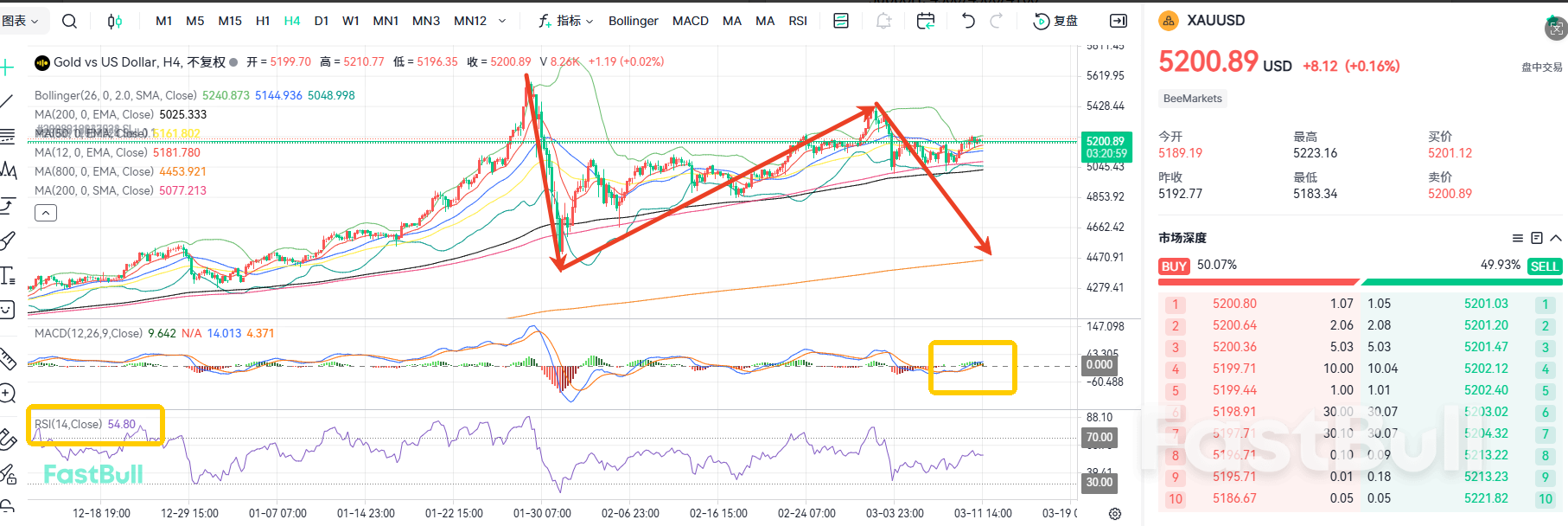
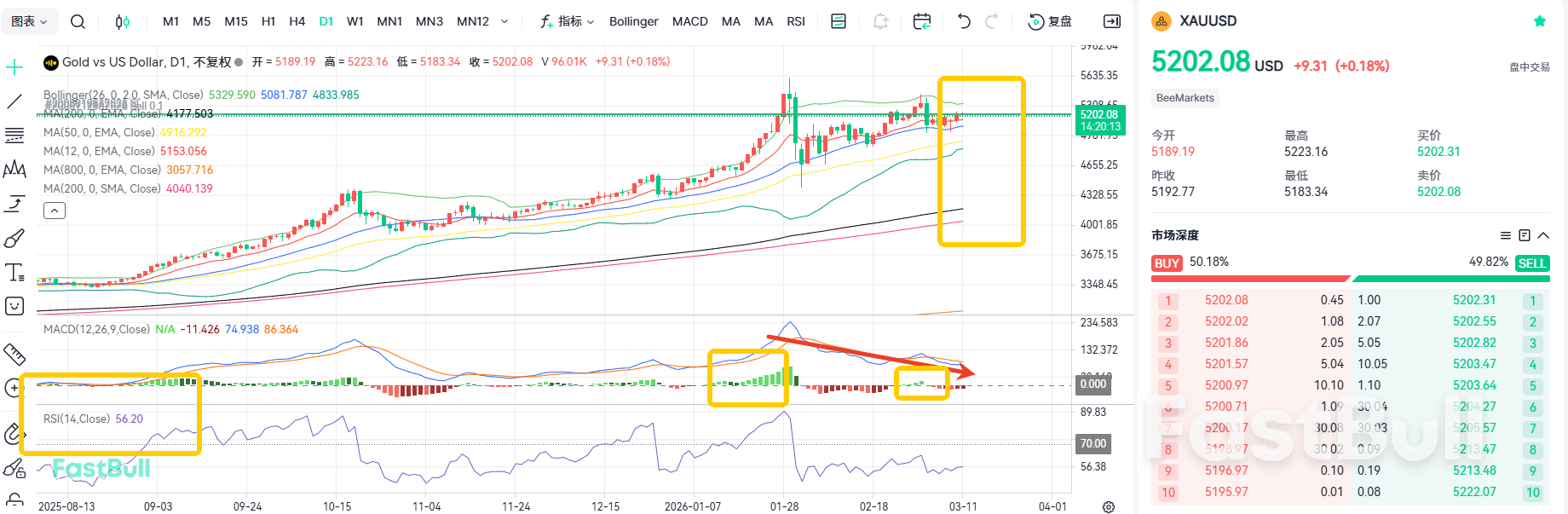
Based on the 4H chart, the Bollinger Bands are narrowing, and moving averages are flattening, indicating a volatile market. Prices are oscillating between the Bollinger Upper and Lower Bands; if they fail to hold above $5,000, a test at the $4,900 level is likely. If they can maintain support at $5,000, gold could ascend higher toward $5,500 and $5,600. After forming a golden cross, the MACD and signal lines have returned above the zero line. The RSI is at 54, suggesting that most market participants are in a wait-and-see mode. Daily, prices touched the Bollinger Upper Band and faced resistance, forming a candlestick with a long upper shadow. A large bearish candle emerged, breaking below the EMA12 and the Bollinger Middle Band. Overall, the pullback has not yet ended. The MACD has formed a death cross, and upward momentum is gradually weakening, signaling a bearish divergence and indicating a potential decline. The RSI stays at 56, reflecting strong market caution. Thus, selling at highs is recommended.
Trading Recommendations
Trading direction: Sell
Entry Price: 5200
Target Price: 4300
Stop Loss: 5700
Support: 4500/4300/4100
Resistance: 5400/5500/5600


