The US Dollar traded on a steady footing against the Japanese Yen on Friday, hovering just below the psychologically significant 160.00 level, as renewed geopolitical uncertainty surrounding Iran prompted investors to unwind bearish Dollar positions. USD/JPY extended its recovery from midweek lows near 157.88, climbing back toward the 159.20 region, reflecting a cautious shift in sentiment as markets reassess risk exposure.
The Greenback’s resilience comes amid growing doubts over the durability of the fragile ceasefire framework involving Iran. Market participants have become increasingly wary after Iranian officials cast uncertainty over their participation in upcoming peace talks scheduled to take place in Islamabad. The hesitation from Tehran has injected fresh volatility into global markets, particularly as tensions remain elevated in a region critical to global energy supply.
At the same time, US officials have raised concerns over Iran’s handling of maritime activity through the Strait of Hormuz, a vital artery for global oil shipments. The lack of visible improvement in ensuring safe passage has further unsettled investors, reinforcing fears of potential supply disruptions that could ripple across energy markets and reignite inflationary pressures globally.
This backdrop has underpinned the US Dollar, as investors seek relative safety and reassess the scale of prior bearish positioning. The unwinding of short Dollar trades has been a key driver behind USD/JPY’s rebound, particularly as risk sentiment deteriorates and volatility rises.
Meanwhile, the Japanese Yen continues to face structural headwinds. The currency weakened notably in March, declining nearly 2% as a surge in oil prices—triggered by the Iran conflict—heightened concerns about stagflation within Japan’s economy. As a major net importer of energy, Japan is particularly vulnerable to sustained increases in oil prices, which erode purchasing power and complicate the broader economic outlook.
Rising inflationary pressures are also beginning to challenge the domestic policy narrative. The government, under Prime Minister Sanae Takaichi, has leaned toward fiscal stimulus measures aimed at cushioning households from rising living costs. However, this approach risks clashing with the tightening bias that may be required from the Bank of Japan if inflation proves more persistent than previously anticipated.
Recent data has only reinforced these concerns. Japan’s Producer Price Index showed a notable acceleration in March, rising 2.6% year-on-year compared to 2.1% previously. On a monthly basis, producer prices surged 0.8%, marking a sharp increase from February’s modest 0.1% gain. These figures highlight the growing pipeline pressures within the economy, suggesting that higher input costs may continue to feed through to consumer prices in the months ahead.
This evolving inflation dynamic places the Bank of Japan in a delicate position. While the central bank has long maintained an ultra-accommodative stance, the persistence of inflationary pressures—coupled with currency weakness—could force policymakers to reconsider the pace and timing of future rate hikes. For now, however, policy divergence between Japan and the United States continues to favor the Dollar.
Technical Analysis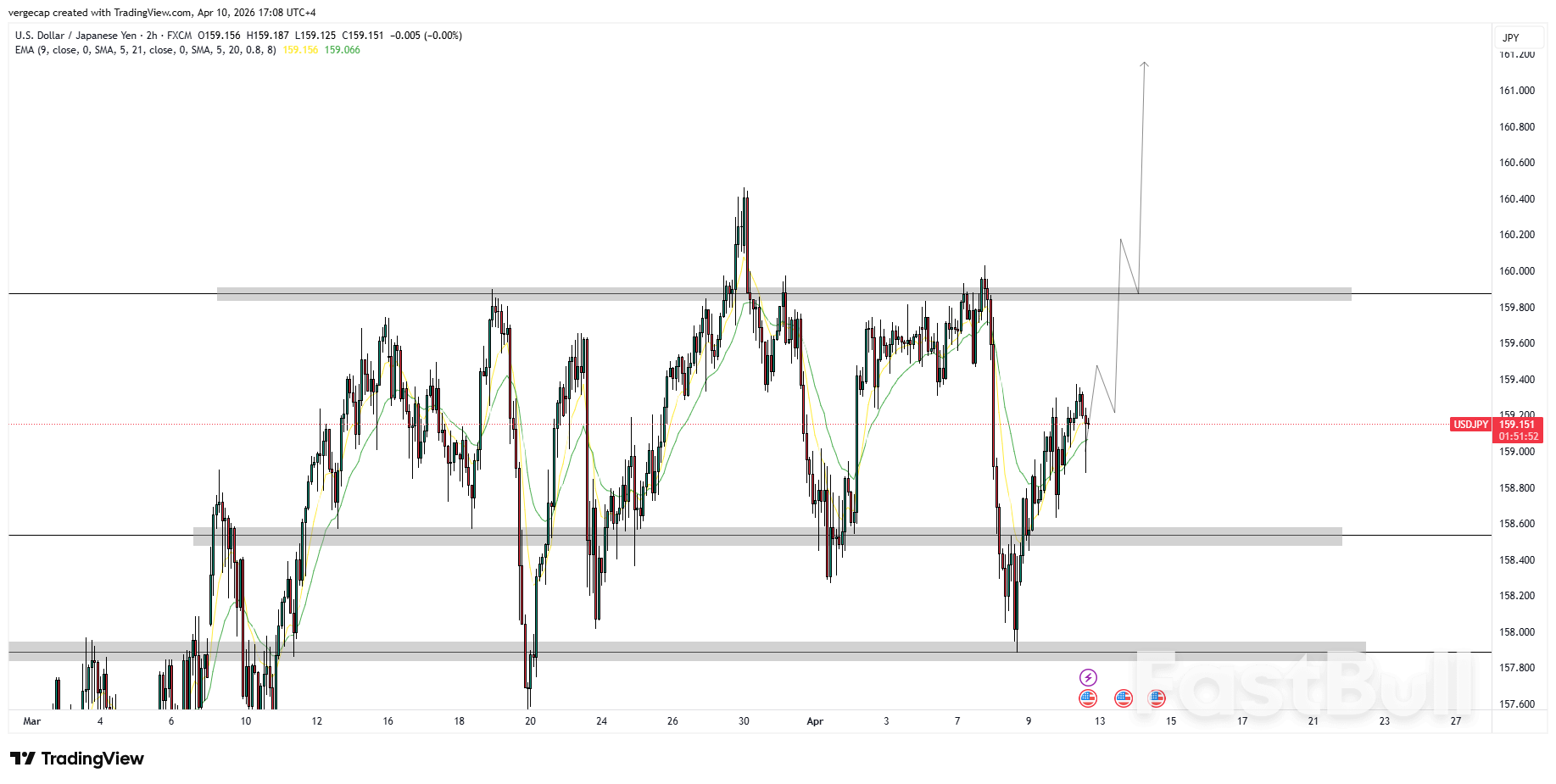
From a technical perspective, USD/JPY is currently trading within a well-defined consolidation range, reflecting a market that remains indecisive despite underlying bullish pressure. On the 2-hour chart, price action is oscillating between a clear resistance zone near 159.80–160.00 and a strong support base around 158.50–158.60, forming a horizontal range that has contained price movement over recent sessions.
The pair is currently hovering around the 21-period and 50-period Simple Moving Averages (SMAs), which are positioned at approximately 159.15 and 159.06 respectively. Both moving averages are flattening, indicating a loss of directional momentum in the near term and reinforcing the consolidation narrative. The lack of clear separation between price and these moving averages suggests that neither bulls nor bears have established firm control.
Despite the range-bound structure, there are early signs of a potential bullish bias developing. Price has recently rebounded sharply from the lower boundary near 158.00 and is now attempting to form higher lows, suggesting that buying interest is gradually building on dips. However, this constructive setup remains incomplete without a decisive breakout above the upper boundary.
A sustained move above the 159.80–160.00 resistance zone would mark a significant technical breakout, potentially triggering momentum-driven buying. Such a move would likely expose upside targets toward 160.80 initially, followed by the 161.50 region, aligning with the projected bullish path indicated on the chart. A break of the psychological 160.00 level would be particularly important, as it could accelerate bullish positioning and reinforce trend continuation.
On the downside, failure to break higher combined with a rejection from the resistance zone could keep the pair trapped within the current range. Immediate support lies at 158.50, with a deeper support zone near 158.00. A decisive break below this level would signal a deterioration in structure, potentially opening the door for a move toward 157.50 and exposing the lower end of the broader range. Such a development would invalidate the emerging higher-low pattern and shift sentiment toward a more bearish outlook.
The repeated tests of both resistance and support levels highlight a market in equilibrium, often a precursor to a significant breakout. The presence of sharp rejection wicks near both extremes further confirms active participation from both buyers and sellers, increasing the likelihood of a volatility expansion in the near term.
Momentum conditions appear neutral, consistent with consolidation dynamics. While there are signs of recovery from recent lows, there is no clear indication of strong directional acceleration yet. This suggests that the market may continue to trade sideways in the short term until a catalyst—such as a macroeconomic release or geopolitical development—drives a decisive move.
TRADE RECOMMENDATION
BUY USD/JPY
ENTRY PRICE: 159.20
STOP LOSS: 158.00
TAKE PROFIT: 161.20


