The USD/JPY pair staged a dramatic reversal on Thursday, plunging more than 2% as the Japanese Yen surged across the board following an escalation in verbal intervention from Tokyo. After briefly touching a fresh multi-month high near 160.73 earlier in the session, the pair sharply reversed course and slid to around 156.47 at the time of writing—its lowest level since early March. The move underscores just how fragile bullish Dollar positioning has become at elevated levels, particularly as Japanese authorities step up their rhetoric against speculative currency activity.
The catalyst behind the sharp selloff was a notably stronger warning from Japan’s Finance Minister, Satsuki Katayama, who stated that officials are “getting closer to taking decisive steps” in the foreign exchange market. This language marks a clear escalation from prior comments and signals that policymakers are increasingly uncomfortable with the pace and extent of Yen depreciation. In recent weeks, authorities have repeatedly flagged “excessive” currency moves, especially as USD/JPY pushed toward the 160 threshold—a level historically associated with direct intervention.
From a market perspective, the reaction was swift and aggressive. The sharp intraday reversal suggests a rapid unwinding of crowded short-Yen positions, as traders moved to reduce exposure amid rising fears of official action. In my view, this kind of price behavior highlights a critical shift in sentiment: while the broader trend has favored Dollar strength, positioning had become stretched, leaving the market vulnerable to exactly this kind of abrupt correction.
However, despite the intensity of the move, the underlying macroeconomic forces driving Yen weakness remain largely unchanged. The interest rate differential between the United States and Japan continues to dominate the narrative. The Federal Reserve’s commitment to maintaining a restrictive policy stance contrasts sharply with the Bank of Japan’s gradual and cautious normalization path, leaving Japanese yields well below their US counterparts. This persistent gap continues to incentivize carry trades—where investors borrow in low-yielding Yen to invest in higher-yielding assets—thereby exerting structural downward pressure on the currency.
Governor Kazuo Ueda has reiterated the central bank’s intention to proceed carefully with policy tightening, but the pace remains insufficient to meaningfully close the yield gap. As a result, even as Japanese bond yields edge higher, they have yet to provide sustained support for the Yen in the face of robust US returns.
Domestic policy dynamics are also contributing to the currency’s vulnerability. The pro-stimulus stance under Prime Minister Sanae Takaichi has raised concerns about Japan’s already elevated debt levels, further complicating the policy outlook. Increased fiscal spending may support growth in the near term, but it also risks reinforcing structural imbalances that weigh on investor confidence in the Yen.
Externally, rising energy costs are adding another layer of pressure. Japan’s heavy reliance on imported energy leaves it particularly exposed to higher Oil prices, which have surged amid ongoing geopolitical tensions in the Middle East. This dynamic deteriorates the country’s trade balance and increases demand for foreign currency, further undermining the Yen’s fundamental position.
That said, the events of Thursday serve as a clear reminder that policy risk remains a powerful counterforce to market-driven trends. The proximity of USD/JPY to historically sensitive levels has clearly heightened the probability of intervention, and even the threat of such action can be enough to trigger sharp market adjustments. In my assessment, this introduces a layer of two-way risk that traders can no longer ignore.
Technical Analysis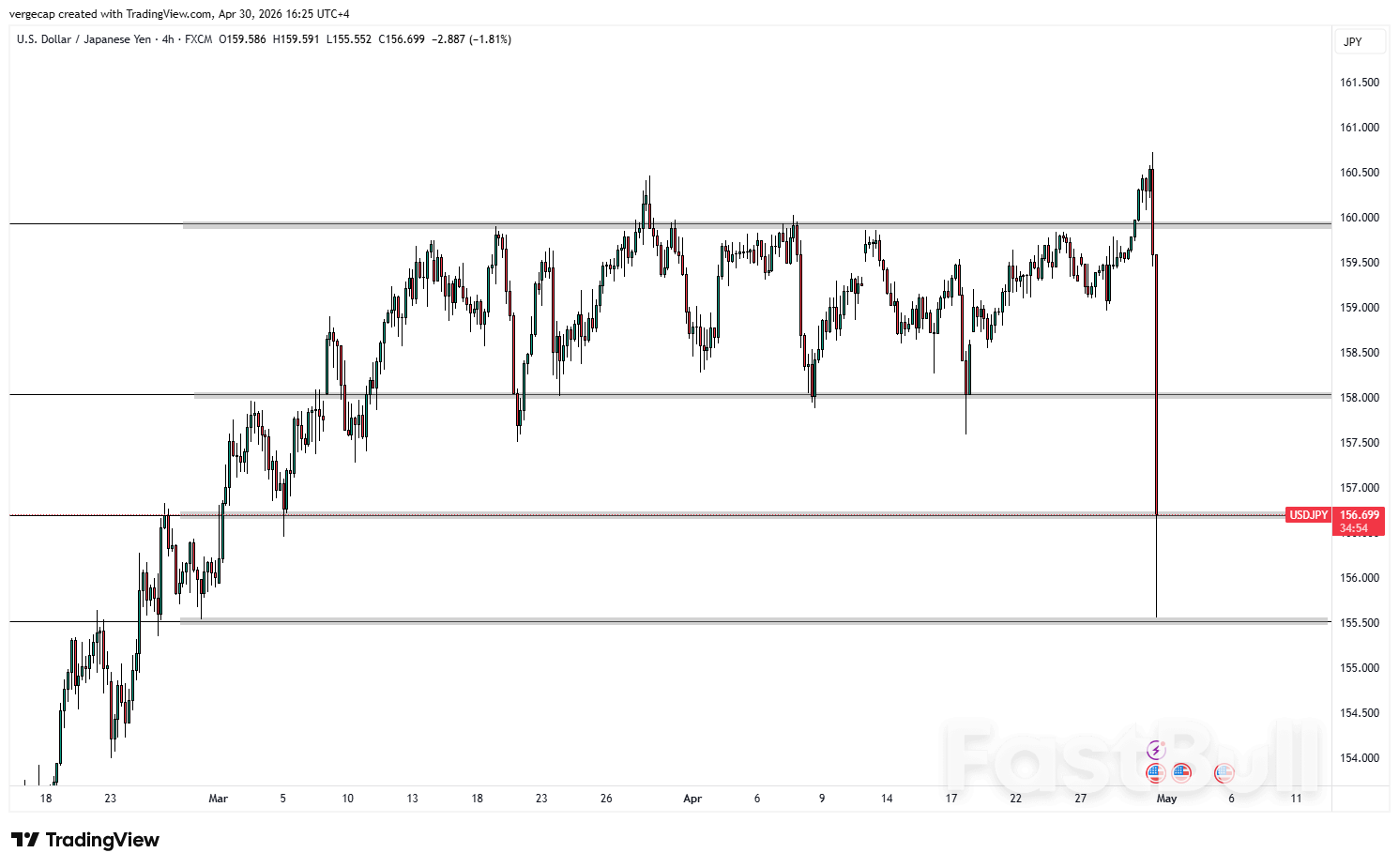
From a technical perspective, USD/JPY has undergone a sharp structural shift following an aggressive downside breakout, marking a clear departure from the previously stable consolidation range. On the 4-hour chart, price action had been confined within a broad horizontal channel between roughly 158.00 support and the 160.00 resistance zone, with repeated rejections at both extremes signaling equilibrium between buyers and sellers.
That balance has now decisively broken. The pair briefly spiked above the 160.00 psychological barrier—printing a local high near 160.50–160.70—before reversing violently and collapsing through multiple layers of support in a single impulsive move. This kind of rejection from a key resistance zone, followed by a high-momentum selloff, is typically indicative of exhaustion at the top and a potential trend inflection point, rather than a simple pullback.
The break below the 158.00 support zone is particularly significant. This level had acted as a reliable floor throughout April, absorbing repeated downside attempts. Its failure now transforms it into immediate resistance, reinforcing a bearish near-term bias. Price is currently stabilizing around the 156.50–156.70 region, which aligns with a prior demand zone and may offer temporary support.
However, the speed and depth of the decline suggest that bearish momentum is dominant. A sustained move below the 156.00 handle would confirm continuation of the breakdown and expose the next downside targets near 155.50, followed by the 154.80–155.00 region, where earlier accumulation phases occurred. A deeper extension could bring the broader 154.00 support zone into focus, signaling a more pronounced correction within the larger uptrend.
On the upside, any recovery attempt is likely to face strong resistance initially at 158.00, followed by the 159.50–160.00 zone. For bullish momentum to reassert itself, USD/JPY would need to reclaim and hold above these levels—particularly the 160.00 threshold. Without such a move, upside attempts are likely to be viewed as corrective bounces within a newly established bearish phase.
Momentum dynamics strongly favor the downside. While indicators are not explicitly shown, the nature of the move—characterized by a long bearish impulse candle and minimal retracement—suggests a surge in selling pressure and a potential shift in market positioning. This type of price action is often associated with forced liquidations or rapid unwinding of crowded trades, which can extend volatility in the near term.
In my view, this breakdown represents more than just a reactionary move—it signals a meaningful change in market structure, at least in the short term. While the broader macro trend has supported USD/JPY strength, the failure at 160.00 combined with the decisive breach of key support levels introduces a more cautious outlook.
TRADE RECOMMENDATION
SELL USD/JPY
ENTRY PRICE: 156.70
STOP LOSS: 158.20
TAKE PROFIT: 154.80


