The US Dollar has staged a tentative but meaningful recovery against the Japanese Yen on Thursday, climbing back above the 159.00 handle during the European session after a bruising stretch of Dollar weakness that had tested the resolve of Greenback bulls across the board. The recovery is fragile, qualified, and deeply dependent on headlines that continue to arrive with whiplash-inducing speed — but for a currency that has been under sustained selling pressure for the better part of the past week, even a modest recovery above a psychologically significant level counts as progress.
At the time of writing, USD/JPY trades just above 159.00, paring losses that had dragged the pair sharply lower in the preceding sessions as risk aversion, softer US inflation data, and growing optimism about a potential US-Iran diplomatic resolution combined to weaken the Dollar and bolster the safe-haven Yen simultaneously. Thursday's session has seen that equation shift — not dramatically, but enough to stabilize a pair that had been drifting with increasing momentum toward the downside.
The catalyst for the Dollar's partial recovery is, perhaps unsurprisingly, the same geopolitical story that has been driving virtually every major FX move for weeks. The difference today is that the news flow has turned less favorable for peace optimism — and in this market, anything that dents hopes for a Middle East resolution tends to support safe-haven flows back into the Dollar while simultaneously limiting Yen appreciation, given Japan's own acute vulnerability to elevated energy prices.
Thursday's session was briefly illuminated by genuine diplomatic progress. US President Donald Trump confirmed publicly that negotiations with Iran are actively underway and expressed confidence that they are likely to lead to a new and more substantive round of talks within the coming days. For a market that has been pricing in a prolonged and economically damaging conflict around the Strait of Hormuz, those words carried significant weight and initially contributed to a risk-on tone that pressured the Dollar as investors rotated out of safe-haven positions.
Adding to the cautious optimism, Israeli cabinet security member Galia Gamliel confirmed earlier on Thursday that Prime Minister Benjamin Netanyahu is scheduled to meet Lebanese President Joseph Aoun — a development that, while not directly related to the Iran nuclear standoff, was interpreted by markets as a broader signal that diplomatic channels in the region are opening rather than closing. The possibility of a negotiated resolution to multiple overlapping conflicts in the Middle East simultaneously, while still a distant and uncertain prospect, is exactly the kind of scenario that would remove an enormous risk premium from global asset prices and fundamentally alter the trajectory of currencies, commodities, and equities for months to come.
But just as that optimism was beginning to take hold, Tehran moved to complicate the narrative in characteristically assertive fashion. Iranian authorities issued explicit threats on Thursday to shut traffic through the Red Sea and the Gulf of Oman if the United States does not lift its naval blockade of Iranian ports — a direct escalation of the maritime dimension of the conflict that sent an immediate shiver through markets. These are not idle words. The Red Sea and the Gulf of Oman represent critical arteries for global shipping and energy transportation, and any disruption to traffic in these waterways would have immediate and severe consequences for global oil supply chains, insurance costs, and broader commodity markets.
The market reaction was swift and telling. Risk appetite, which had been building cautiously through the early European session on the back of Trump's diplomatic comments, reversed on the Iranian threats. The Dollar recovered modestly as traders unwound some of their earlier short positions, and the Yen — having benefited from safe-haven demand for much of the week — gave back a portion of its recent gains as the complex, two-way nature of this geopolitical story reasserted itself. This is the brutal reality of trading in the current environment: optimism and pessimism are separated by a single headline, and position management has become as much about risk control as directional conviction.
From my perspective, the situation in the Strait of Hormuz and its surrounding waterways remains the single greatest source of binary risk in global financial markets today. The gap between a diplomatic breakthrough and a military escalation has rarely felt narrower, and the asymmetry of potential outcomes — transformative upside for risk assets if peace materializes, catastrophic downside if conflict intensifies — demands that traders maintain disciplined exposure and avoid the temptation to chase moves in either direction without robust stop-loss protection.
Away from the immediate geopolitical drama, a significant development unfolded in the currency diplomacy sphere on Thursday that deserves more attention than it has received in the noise of the Middle East headlines. Japanese Finance Minister Satsuki Takayama confirmed that Japan and the United States have formally agreed to strengthen bilateral communication on exchange rates, following a meeting with US Treasury Secretary Scott Bessent. The timing and framing of this announcement are deliberate and unmistakable — Tokyo is putting Washington, and the broader market, on notice that it is watching the Yen's trajectory with active concern and that it considers coordinated communication on exchange rates a necessary and legitimate tool to address what it regards as excessive Yen weakness.
This is not a minor diplomatic footnote. Japan's willingness to invoke exchange rate coordination language in the context of a formal bilateral meeting with the US Treasury represents a meaningful escalation in its currency management posture. The Yen has been under sustained pressure for months, driven by the Bank of Japan's cautious approach to rate normalization, the Dollar's resilience, and more recently by the inflationary shock from Middle East energy prices — which, paradoxically, has hurt the Yen by raising Japan's import costs while simultaneously complicating the BoJ's rate hiking timeline. When energy prices surge, Japan — as a major net energy importer — faces deteriorating terms of trade that typically weigh on the currency, even as the inflationary pressures those higher prices create might theoretically argue for tighter monetary policy.
The market's initial reaction to Takayama's comments was relatively muted — the impact, as acknowledged in today's reporting, has been marginal in terms of immediate price action. This is not unusual. Verbal intervention and coordination language tend to have their greatest impact when they are backed by the credible threat of direct market action, and without concrete evidence that the BoJ or the Ministry of Finance is prepared to intervene directly in the FX market, traders are unlikely to aggressively reduce Yen short positions on words alone. Nevertheless, I would not dismiss the significance of Thursday's statement. The explicit reference to "excessive JPY weakness" in the context of a formal US-Japan Treasury meeting sets a political floor beneath the Yen and raises the cost of running large speculative short positions in the currency. It also signals that if USD/JPY continues to drift higher toward levels that attract political attention — say, toward 160.00 or beyond — the probability of coordinated intervention increases materially.
As if the geopolitical dimension were not providing sufficient stimulation, Thursday's US macroeconomic calendar offers several data points and speaking engagements that have the potential to move markets meaningfully in the latter half of the session. The Philadelphia Federal Reserve Manufacturing Survey for April is due for release and will be scrutinized for evidence of whether the Middle East shock has begun to filter into US manufacturing activity, supply chain costs, and business confidence. A weak reading would reinforce the case for Federal Reserve caution and add to the Dollar's structural headwinds; a resilient print would give the Greenback a modicum of fundamental support at a moment when it clearly needs it.
Industrial Production data for March will similarly be watched for signs of how the US economy was performing in the weeks immediately before the geopolitical situation fully escalated. These are backward-looking numbers, but in the current environment where every data point is being filtered through the lens of "what does this mean for the Fed," even slightly stale data carries market-moving potential.
Perhaps most consequential will be the scheduled speeches from New York Federal Reserve President John Williams and Fed Board member Stephen Miran. Williams, as president of the most market-facing of the regional Fed banks, carries particular weight when he speaks, and any commentary on the inflation outlook, the labour market, or the Fed's reaction function to energy-driven price pressures will be parsed with extraordinary care by traders looking for any signal on whether the central bank is tilting toward a hawkish response to the geopolitical shock or whether it remains committed to a data-dependent, patient approach.
My expectation is that both Fed officials will stick closely to the institutional script — acknowledging the geopolitical uncertainty, reaffirming the data-dependency mantra, and avoiding any explicit guidance on the timing of future moves. But in markets as sensitive as these, even a single phrase can be enough to move the needle.
Technical Analysis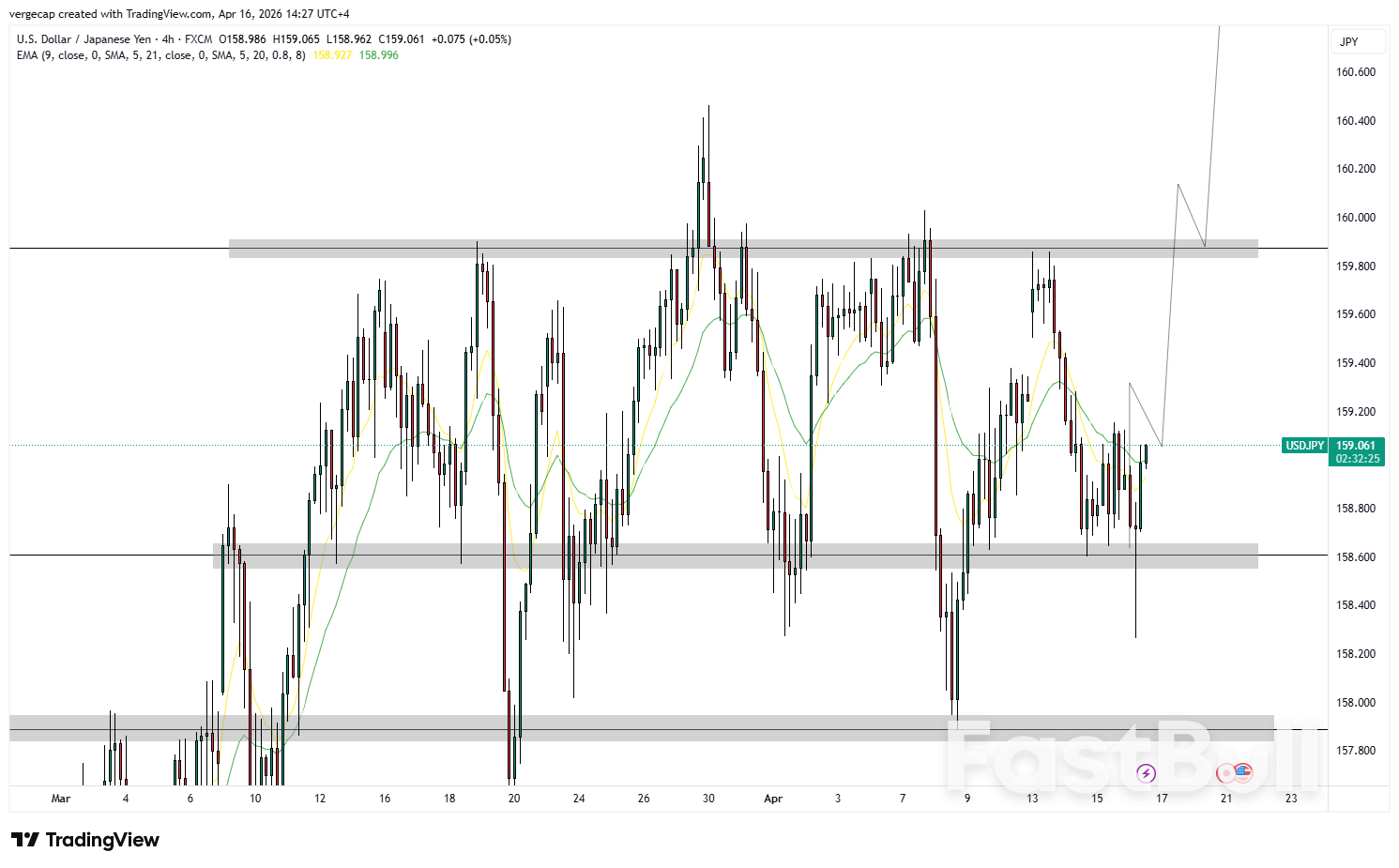
From a technical perspective, USD/JPY remains confined within a broad consolidation structure, lacking a clear directional trend despite repeated volatility spikes. On the 4-hour chart, price action is oscillating within a well-defined horizontal range, with resistance established near the 159.80–160.00 region and support anchored around the 158.50–158.60 zone. This range-bound behavior reflects a market in equilibrium, where neither buyers nor sellers have been able to establish sustained control.
Price is currently trading near the mid-range around 159.00, following multiple failed attempts to break higher toward the 160.00 psychological barrier. The repeated rejection from this upper boundary highlights the presence of strong supply, with sellers consistently stepping in to cap upside momentum. At the same time, dips toward the 158.50 support zone have attracted buying interest, preventing a deeper downside move and reinforcing the integrity of the range.
The 21-period Simple Moving Average (SMA) is flattening and hovering near current price levels, indicating a lack of short-term directional conviction. This moving average has been frequently crossed by price, further emphasizing the choppy and indecisive nature of the market. Meanwhile, the 50-period SMA is also relatively flat and positioned slightly below, near the 158.80 region, acting as a secondary layer of dynamic support within the range. The absence of a clear slope in both moving averages reinforces the neutral bias.
A decisive break below the 158.50 support zone, particularly if accompanied by a sustained move beneath the 50-period SMA, would signal a bearish resolution of the range. In such a scenario, downside targets would likely extend toward the 157.80–158.00 region, which aligns with a previous demand area. A sustained move below that level would expose deeper losses toward the 157.00 handle, marking a shift toward a more pronounced bearish structure.
On the upside, bullish traders remain focused on a clean break above the 159.80–160.00 resistance zone. A sustained push through this barrier would represent a significant technical breakout, likely triggering momentum buying and opening the door for a move toward the 160.80–161.00 region. Such a move would mark a continuation of the broader bullish trend seen on higher timeframes and could attract strong participation from trend-following traders.
Momentum indicators suggest consolidation rather than exhaustion. The Relative Strength Index (RSI) is likely hovering around the neutral 50 level, reflecting balanced momentum and the absence of strong directional bias. This aligns with the range-bound structure currently in play. Meanwhile, the Moving Average Convergence Divergence (MACD) is fluctuating near the zero line, with a flattening histogram that points to subdued momentum and reinforces expectations for continued sideways price action in the near term.
Overall, USD/JPY remains trapped in a consolidation phase, with traders awaiting a decisive breakout to determine the next directional move. Until then, range-bound strategies may continue to dominate, with key levels at 158.50 and 160.00 defining the near-term structure.
TRADE RECOMMENDATION
BUY USD/JPY
ENTRY PRICE: 159.00
STOP LOSS: 157.80
TAKE PROFIT: 160.80


