The Japanese Yen remained under pressure against the US Dollar during Thursday’s European trading session, with USD/JPY holding firmly near the 158.00 level, its highest point in roughly two weeks, as traders continued favoring the Greenback amid fading expectations for Federal Reserve interest-rate cuts this year.
The pair’s resilience reflects broad-based US Dollar strength following this week’s hotter-than-expected US inflation report, which significantly altered market expectations surrounding the Federal Reserve’s monetary policy outlook. Investors are increasingly pricing in a prolonged period of elevated US interest rates, a scenario that continues to widen the policy divergence between the Federal Reserve and other major central banks.
The US Dollar Index (DXY), which measures the Greenback against a basket of six major currencies, has gained roughly 0.72% so far this week and was trading near 98.55 at the time of writing. Treasury yields also remained elevated as markets adjusted to the possibility that the Federal Reserve may keep rates unchanged throughout the remainder of the year, with some traders even beginning to speculate about the risk of another policy tightening move should inflation remain persistent.
According to the CME FedWatch Tool, markets currently see a 66.8% probability that the Federal Reserve will maintain rates at current restrictive levels through year-end or potentially deliver at least one additional rate hike. In my view, the inflation data released earlier this week has effectively dismantled the market narrative surrounding imminent policy easing, forcing investors to reprice the US Dollar sharply higher across the currency market.
Tuesday’s US Consumer Price Index report showed headline inflation accelerating to 3.8% year-over-year in April, the highest level recorded in nearly three years. The stronger inflation print reinforced concerns that underlying price pressures remain deeply embedded within the US economy despite previous tightening measures from the Federal Reserve.
That backdrop has supported renewed upside momentum in USD/JPY, particularly as Japan continues to maintain comparatively low interest rates despite growing speculation surrounding another potential Bank of Japan policy adjustment. Earlier this week, the Bank of Japan’s Summary of Opinions from the April policy meeting revealed that several policymakers see a possible interest-rate hike as early as the next meeting, even amid uncertainties tied to geopolitical risks in the Middle East.
However, those hawkish signals from the BoJ have so far failed to provide meaningful support for the Yen, as the overwhelming strength of the US Dollar and rising US yields continue dominating price action. Investors also remain cautious about potential intervention risks from Japanese authorities should USD/JPY continue approaching psychologically sensitive levels above 158.00.
Market participants are now turning their attention toward upcoming US Retail Sales figures for April, scheduled for release later Thursday. Economists expect consumer spending to rise by 0.5% following the previous 1.7% increase. A stronger-than-expected reading would likely reinforce confidence in the resilience of the US economy and further support the higher-for-longer Fed narrative, potentially driving additional gains in the US Dollar.
Traders are also closely monitoring comments from US President Donald Trump following his meeting with Chinese President Xi Jinping, as any developments surrounding US-China relations could influence broader market sentiment and safe-haven demand.
Technical Analysis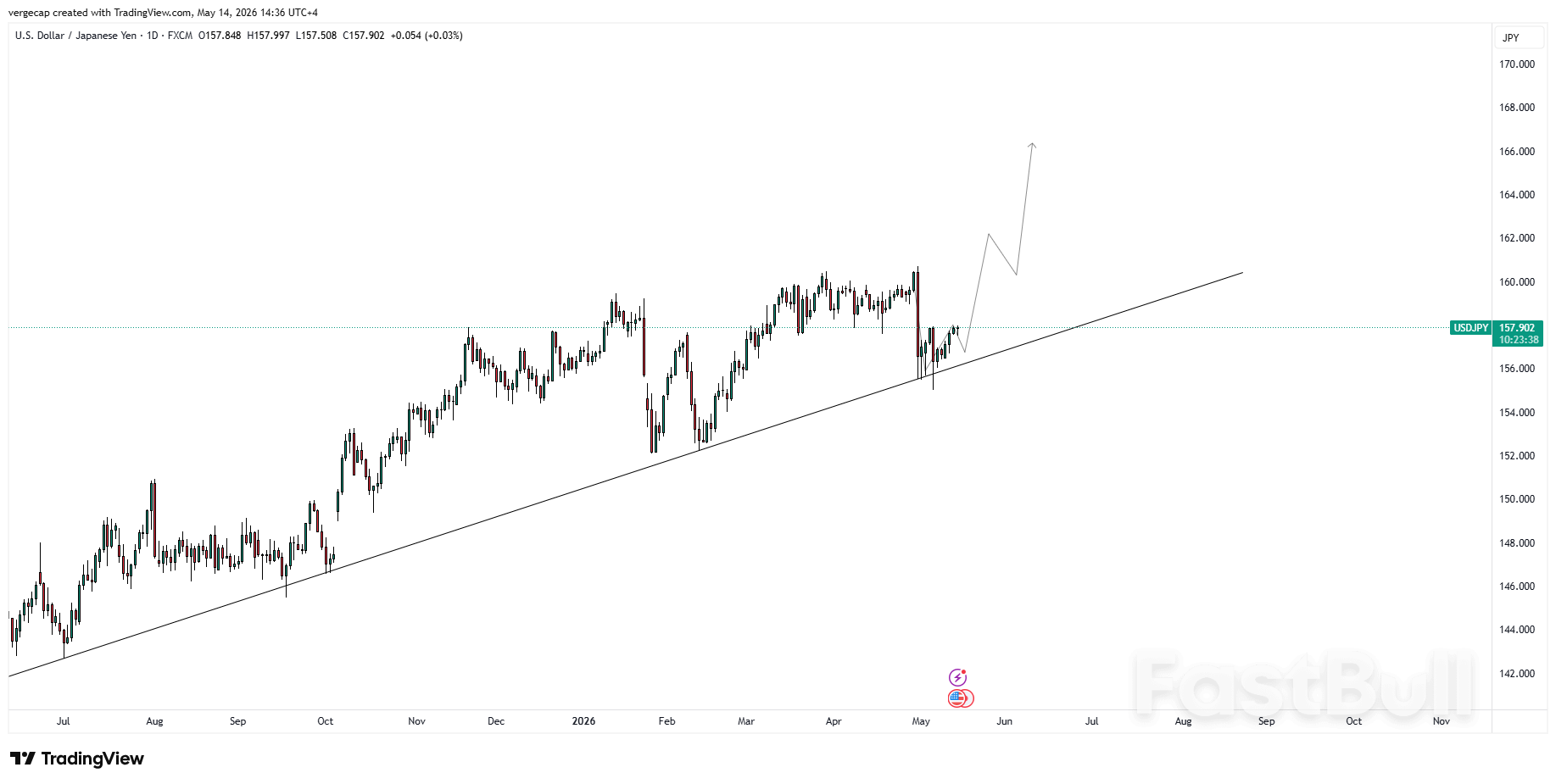
From a technical perspective, USD/JPY remains firmly embedded within a broader bullish trend structure on the daily chart. Price action continues to respect a well-defined ascending trendline that has supported the market since mid-2025, highlighting persistent demand on pullbacks and reinforcing the longer-term bullish outlook. Recent price behavior shows the pair consolidating above this rising support zone near 156.00–156.50 after rebounding sharply from a temporary breakdown attempt earlier in May.
The market is currently trading around the 157.90 region, where buyers are attempting to reclaim short-term momentum following the latest corrective phase. The successful defense of the ascending trendline is technically significant, as it suggests that the recent decline was corrective rather than the beginning of a broader bearish reversal. As long as daily closes remain above the rising trend support, the underlying market structure continues to favor upside continuation.
Immediate resistance is located near the psychological 158.00–158.20 region, where the pair has recently stalled multiple times. A sustained breakout above this barrier would likely confirm renewed bullish momentum and expose the next upside target around 160.00, which represents a major psychological resistance and prior consolidation area. Beyond that, bullish continuation could accelerate toward the projected 162.00 region, followed by the broader bullish objective near 166.00, as illustrated by the projected continuation structure on the chart.
On the downside, the ascending trendline near 156.00 remains the most critical technical support. A decisive break below this level would weaken the immediate bullish structure and increase the risk of a deeper retracement toward the 154.00–152.50 support zone, where previous accumulation and breakout activity occurred. A sustained move beneath that region would represent a more meaningful deterioration in trend conditions and could shift medium-term momentum in favor of sellers.
From a momentum standpoint, price action continues to display constructive bullish characteristics despite the recent consolidation. The series of higher lows remains intact, and the market has repeatedly rejected downside attempts near trend support. This behavior typically reflects ongoing institutional buying interest during corrective pullbacks rather than distribution. The current consolidation phase therefore appears more consistent with trend continuation than exhaustion.
Momentum indicators also support the broader bullish narrative. The Relative Strength Index (RSI) is likely stabilizing in moderately bullish territory after cooling from previous highs, suggesting that bullish momentum has reset without entering bearish conditions. This indicates room for another upward leg if resistance levels begin to give way. Meanwhile, the Moving Average Convergence Divergence (MACD) appears to be flattening near the equilibrium line, reflecting temporary consolidation while maintaining a broader positive bias. Such behavior often precedes renewed directional expansion once price breaks from compression.
Overall, the technical structure remains favorable for further upside as long as the pair continues to hold above ascending trend support. The market appears to be building energy beneath resistance, with the broader trend still pointing toward continuation into higher psychological levels.
TRADE RECOMMENDATION
BUY USD/JPY
ENTRY PRICE: 158.00
STOP LOSS: 155.80
TAKE PROFIT : 162.00


