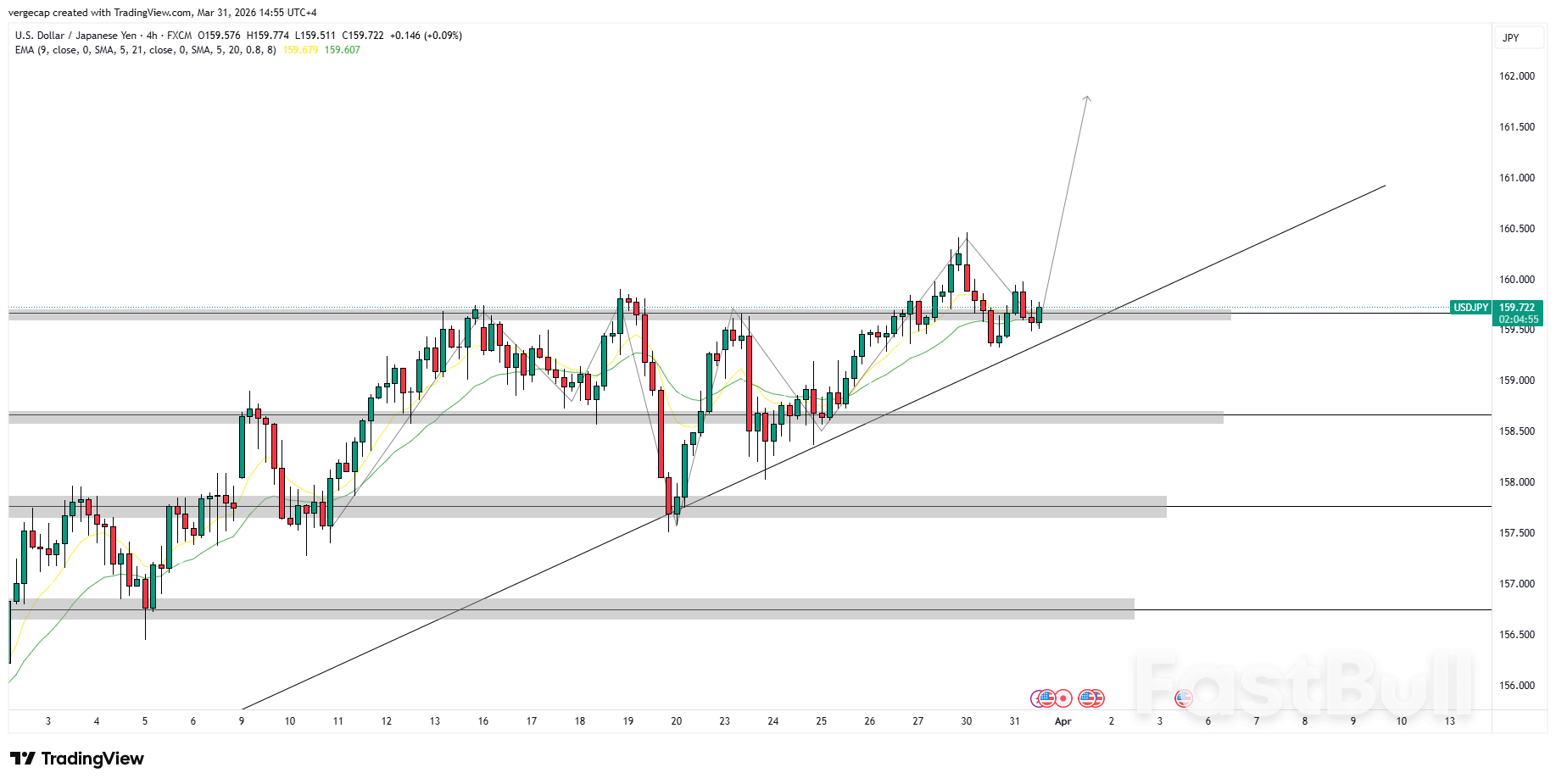
The yen remained on the back foot during Asian trading on Tuesday, with the USD/JPY pair extending its recovery from the previous session’s dip below the 159.50 level. Spot prices clung to modest gains after a key inflation reading out of Japan’s capital fell short of expectations, though the advance stalled just shy of the symbolic 160.00 handle as traders warily eyed the prospect of official intervention from Tokyo.
Government data released early Tuesday revealed that headline consumer inflation in Tokyo—a leading indicator for nationwide price trends—slowed to 1.4% in March from 1.5% in February. That marked the softest reading since March 2022, signaling that broader price pressures in the world’s fourth-largest economy are cooling more swiftly than anticipated. The core CPI, which strips out volatile fresh food prices, rose 1.7%, a deceleration from the previous month’s 1.8%. Even the more stubborn measure of inflation—core-core CPI, which excludes both fresh food and energy—eased to 2.3% from 2.5%.
For a Bank of Japan that has only just begun its tentative journey away from decades of ultra-loose monetary policy, the numbers delivered a clear warning shot. The case for an imminent rate hike—one that some market participants had begun to price in following the BoJ’s historic March move—now appears considerably weaker. With domestic demand showing fragility and geopolitical tensions adding fresh layers of uncertainty, the central bank is likely to remain in a protracted wait-and-see mode.
That dynamic has handed further momentum to the dollar. The greenback, already riding a wave of bullish sentiment, surged to a fresh year-to-date high against a basket of currencies in the previous session. Traders have now fully priced out any lingering expectations of near-term rate cuts from the Federal Reserve, with the conversation shifting instead toward the possibility of another hike before year-end. The catalyst? A toxic mix of resilient U.S. economic data and mounting anxiety over war-driven commodity price spikes, particularly in energy, that threaten to reignite inflation just as the Fed was eyeing an exit door.
But for all the dollar’s swagger, the yen’s slide has not gone unchecked—nor unnoticed. In what traders described as the strongest verbal intervention yet, Japan’s Vice Finance Minister for International Affairs, Atsushi Mimura, issued a pointed warning on Monday, stating unequivocally that authorities are prepared to take “decisive action” should speculative currency moves persist. His remarks followed similarly hawkish language from BoJ Governor Kazuo Ueda, who said the central bank would monitor foreign exchange fluctuations with heightened vigilance.
The market has learned to listen. With Tokyo having spent over ¥9 trillion last year defending the yen, the threat of actual intervention is no idle one. While the fundamental drivers—a widening U.S.-Japan rate differential and the Fed’s prolonged hawkish pivot—remain firmly in place, the risk of a sudden, violent pullback is capping the upside for USD/JPY. For now, the 160.00 level has become not just a psychological barrier but a line in the sand.
From my perch, this is becoming the defining tug-of-war of the quarter: raw fundamental gravity pulling the pair higher, countered by the heavy hand of Japanese policymaking. The Tokyo inflation print gave dollar bulls fresh ammunition, but the reluctance to break 160.00 tells you everything you need to know about the market’s respect for intervention risk. We are in a zone where central bank politics meets pure price action—and until either the Fed signals a decisive pivot or the BoJ actually steps in, this standoff will likely persist, with volatility set to spike at the slightest provocation.
Technical Analysis
From a technical perspective, USD/JPY is positioned at a pivotal and technically loaded inflection point on the 4-hour chart, with price sitting precisely at the intersection of a rising ascending trendline and a critical horizontal support zone near 159.50–159.70 — a confluence that represents one of the highest-quality bullish setups visible on this timeframe. The pair has been constructing a well-defined uptrend since bottoming at the 156.70 area in early March, and the current pullback to trendline support should be viewed not as a sign of weakness but as the market presenting a textbook re-entry opportunity for bulls ahead of what the chart suggests could be a powerful continuation move.
The ascending trendline, drawn connecting the March 5 low near 156.70 through the March 20 swing low around 157.80, has now been tested on multiple occasions and has held with remarkable consistency. Each touch of this trendline has been followed by a swift and aggressive recovery, demonstrating that institutional buyers are actively defending this ascending support structure. The current retest near 159.50 — the latest in this series of higher-low formations — carries the same technical significance and, critically, is occurring in the context of price holding above the prominent 159.50–159.70 horizontal support band, a level that has served as both support and resistance repeatedly throughout the second half of March.
The 9-period EMA at 159.68 and the 21-period SMA at 159.61 are both converging directly around the current price of 159.72, creating a tight but technically meaningful cluster of dynamic support at precisely the same level where the ascending trendline is providing structural backing. This triple confluence — horizontal support, trendline support, and dual moving average support — compressed into such a narrow price zone is an exceptionally strong technical signal. When price holds at a confluence of this density, the probability of a meaningful bounce and continuation of the prevailing trend increases substantially.
The broader structure on the chart reinforces the bullish narrative. From the March 5 low at 156.70, USD/JPY has etched a clear and disciplined pattern of higher lows — 156.70, then 157.80, then 158.50, and now the current test near 159.50 — each one holding above the ascending trendline and each one followed by a push to new highs within the developing uptrend. This is textbook trend structure, and until the trendline is convincingly violated on a closing basis, the bias must remain firmly and unambiguously bullish with dips treated as buying opportunities.
On the upside, the immediate target following a confirmed bounce from current support is the 160.00 psychological level — a barrier that capped price during the March 26–27 advance before triggering a modest pullback. A clean 4-hour close above 160.00 would represent a significant technical milestone, opening the way toward the 160.50–161.00 resistance zone identified by the chart's projected move arrow. A sustained break above 161.00 would shift the medium-term focus toward the 162.00 area and signal that the uptrend has entered an accelerated phase.
The 159.00 level represents the first meaningful downside reference should the current trendline test fail to hold. A sustained 4-hour close below 159.00 would begin to undermine the ascending trendline structure and invite a deeper corrective move toward the 158.50 horizontal support band, which aligns with the prior March consolidation zone and the upper boundary of a broader support shelf. Below 158.50, the 157.80–158.00 zone serves as the last meaningful technical defense before the 157.00 major support floor comes into view. A break below 157.00 would negate the bullish thesis entirely and signal a more significant trend reversal — a scenario that currently appears a very low probability given the consistent behavior of buyers at every trendline retest seen on this chart.
The moving average configuration adds further weight to the bullish case. The 9-period EMA and 21-period SMA are tracking higher in a parallel bullish formation, and their proximity to price at the current trendline retest suggests that the dynamic support cluster has rarely been this powerful or well-defined during the entire uptrend. A recovery from here that puts clear distance above both averages would confirm that the shallow pullback has run its course and that the path toward 161.00 and beyond is open.
TRADE RECOMMENDATION
BUY USD/JPY
ENTRY PRICE: 159.75
STOP LOSS: 158.80
TAKE PROFIT: 161.50