The Japanese Yen is once again finding itself on the back foot, sliding to fresh multi-month lows against a resilient US Dollar as the specter of stagflation looms over the resource-poor nation. During the early European trading hours, USD/JPY climbed 0.4% to trade near the 158.50 handle, inching perilously close to the 19-month peak of 159.45 recorded last week. The primary catalyst for this sustained pressure? A potent cocktail of escalating geopolitical tensions in the Middle East and the subsequent surge in global crude prices, which is proving toxic for Japan’s import-dependent economy.
The conflict involving the United States, Israel, and Iran has sent shockwaves through energy markets. While West Texas Intermediate (WTI) crude has pulled back from its most extreme levels—dipping to around $101.00 per barrel from an intraday spike above $113.00—it remains a staggering 15% higher on the session. This correction follows reports that G7 nations, in coordination with the International Energy Agency (IEA), are discussing the potential release of strategic emergency oil reserves to cool the market. However, for a nation that imports nearly all of its fossil fuels, the damage may already be priced into the Yen. Surging energy costs widen Japan's trade deficit, forcing the government to sell Yen for Dollars to pay for expensive imports, thereby accelerating the domestic currency's depreciation.
The pain is being felt on the ground in Japan. Prime Minister Sanae Takaichi acknowledged the growing public anxiety over rising gasoline prices earlier today, stating that the administration is actively exploring countermeasures. However, Takaichi offered little in the way of immediate relief, admitting that it is currently "difficult to say now how the Middle East conflict might affect Japan's economy." This lack of concrete policy direction leaves the Yen vulnerable, as traders see limited domestic intervention to stem the currency's freefall.
From a macroeconomic perspective, there is a glimmer of hope on the horizon. Markets are looking ahead to Tuesday’s release of revised Q4 Gross Domestic Product (GDP) data. Economists anticipate an upward revision, with expectations that the economy expanded at a 0.3% quarterly clip, a notable acceleration from the preliminary 0.1% reading. While a stronger growth print could provide marginal support for the Yen, it is unlikely to shift the Bank of Japan's ultra-dovish stance as long as external headwinds persist.
On the other side of the equation, the US Dollar remains a fortress of strength. The US Dollar Index (DXY) surged 0.45% to hover near 99.35, buoyed by its traditional safe-haven appeal amidst the risk-off mood and the inflationary pressure from rising oil prices. The Greenback’s trajectory this week will hinge on Wednesday’s release of the US Consumer Price Index (CPI) for February. A hotter-than-expected inflation reading would solidify expectations that the Federal Reserve will maintain higher interest rates for longer, potentially driving USD/JPY past the critical 160.00 psychological barrier.
In the current environment, the Yen’s status as a traditional safe haven is being overwhelmed by its "bad-currency" dynamics—falling in value precisely when the economic outlook darkens due to higher import costs.
Technical Analysis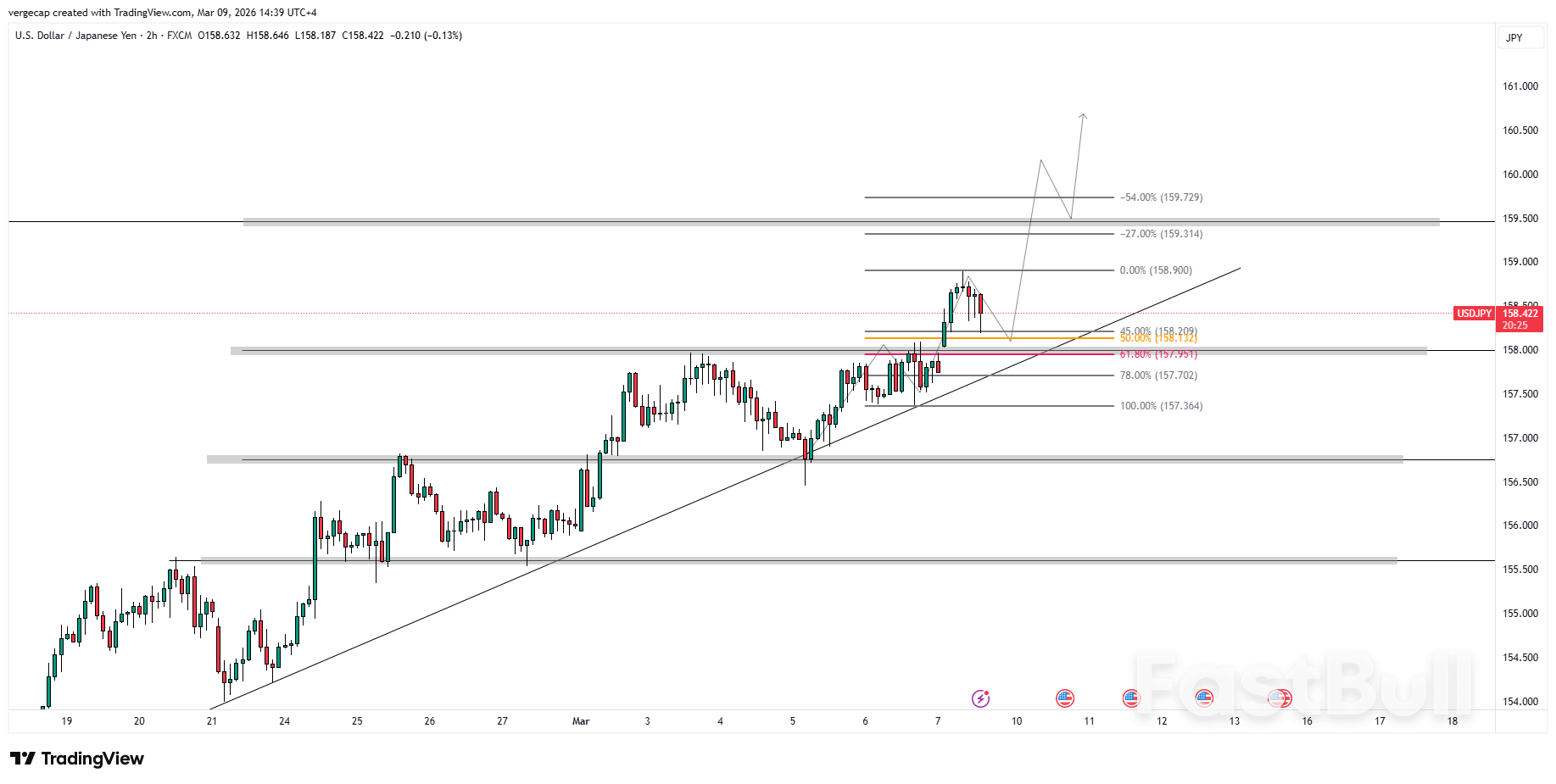
From a technical perspective, USD/JPY remains positioned within a well-defined bullish structure, with the 2-hour chart highlighting a steady sequence of higher highs and higher lows supported by a clearly established ascending trendline. This upward trajectory reflects sustained buying interest, with price continuing to respect the rising support structure that has guided the broader move higher since late February.
The pair recently pushed toward the 158.90 resistance level, where a short-term rejection has triggered a modest pullback. This level aligns with the 0.0% Fibonacci extension marker on the chart and represents the immediate resistance barrier that bulls must overcome in order to extend the rally further. Despite the rejection, the broader bullish trend remains intact as long as price continues to hold above the key confluence of support levels beneath the market.
Currently, USD/JPY is retracing toward the 158.20–158.13 region, which corresponds with the 45%–50% Fibonacci retracement zone of the most recent upward leg. This area also overlaps with a previously established horizontal support band, making it an important technical confluence zone that could attract renewed buying interest. A successful defense of this region would likely confirm the pullback as a healthy corrective move within the prevailing uptrend.
Below this, the 157.95 level, marked by the 61.8% Fibonacci retracement, represents a more critical layer of support. A decisive break beneath this level, particularly if accompanied by a sustained move below the ascending trendline, would signal a notable deterioration in the bullish structure and could trigger a deeper retracement toward the 157.70–157.36 region, where the 78% and 100% Fibonacci retracement levels are located.
However, as long as price remains above the 157.95 support zone, the broader trend continues to favor the upside. A rebound from the current retracement area would likely shift bullish focus back toward the 158.90 resistance level. A sustained break above this barrier could trigger renewed momentum buying, opening the door for a move toward the 159.30–159.70 region, which aligns with the 27% and 54% Fibonacci extension levels highlighted on the chart.
Beyond these levels, the projected upside structure suggests the potential for an extended rally toward the 160.50–161.00 region, which would mark a continuation of the broader bullish trend and a significant psychological milestone for the pair.
Momentum dynamics suggest a temporary consolidation phase rather than trend exhaustion. The recent pullback appears to be a controlled correction following the strong impulsive advance, allowing the market to stabilize before the next directional move develops. Such behavior is typical within strong trending environments where retracements often provide opportunities for trend continuation.
Overall, as long as USD/JPY remains supported above the 157.95–158.13 support zone, the technical outlook continues to favor further upside, with dips likely to be viewed as buying opportunities within the prevailing bullish structure.
TRADE RECOMMENDATION
BUY USD/JPY
ENTRY PRICE: 158.50
STOP LOSS: 157.90
TAKE PROFIT: 159.70


