The US Dollar’s ascendancy is becoming a relentless narrative in the currency markets, and nowhere is its strength more vividly displayed than against the Japanese Yen. On Thursday, the USD/JPY pair extended its winning streak to a fifth trading day, climbing 0.26% to hover near the 156.20 level. This isn’t merely a technical bump; it’s a deliberate march higher, powered by a fundamental re-rating of US monetary policy expectations and a stark policy divergence with a Japan seemingly committed to maintaining its ultra-loose stance.
Driving the Greenback’s broad-based strength, the US Dollar Index (DXY) carved out a fresh weekly peak at 97.90. The catalyst for this leg of the rally can be traced directly to last Friday’s seismic political announcement from the White House. President Donald Trump’s nomination of Kevin Warsh—a former Fed governor known for his hawkish leanings and critiques of quantitative easing—to chair the Federal Reserve has sent a shockwave through rate expectations. The market is swiftly repricing the “Fed put.” Warsh’s potential leadership suggests a central bank less inclined to cushion financial markets and more determined to normalize policy aggressively, a prospect that has bond yields ticking higher and supercharging the Dollar’s appeal.
Compounding this shift, the earlier whisper of a potential Fed pause has been all but silenced. Firm speculation now anchors the view that the Fed will hold rates steady at its upcoming March and April policy meetings. Crucially, this isn’t being interpreted as a prelude to cuts, but rather as a patient, vigilant stance. The reason is etched in the consistent economic data: inflationary pressures have stubbornly persisted above the Fed’s 2% target, creating an environment where maintaining restrictive policy is the default, and dovish fantasies are choked off. The Dollar thrives in this clarity—the era of cheap money is receding, and America’s currency is being pulled up in its wake.
All eyes now turn to the next data point that could reinforce this narrative: the US JOLTS Job Openings report for December, due at 15:00 GMT. The forecast calls for 7.2 million new job postings, an increase from November’s 7.146 million. A strong number would further cement the picture of a resilient, tight labor market, giving the Fed even less impetus to consider easing and potentially fueling the Dollar’s engine for another leg up. In this climate, good news for the US economy is unequivocally good news for the USD.
Meanwhile, on the other side of this pair, the Japanese Yen is playing its part in the rally—by broadly underperforming. The Yen’ traditional safe-haven bids are absent. The driver here is domestic politics. Expectations are firming that Prime Minister Sanae Takaichi, following the lower house elections on February 8, will unveil a substantial big-spending budget. This prospect of expanded fiscal stimulus, likely funded by perpetual debt monetization from the Bank of Japan, reinforces the “widening yield gap” story. As the US signals higher-for-longer rates, Japan is doubling down on its yield curve control policy. This divergence is kryptonite for the Yen, creating a powerful and sustained downward pressure.
The path of least resistance for USD/JPY remains pointedly higher. The combination of a hawkish Fed narrative—supercharged by the Warsh nomination—and a proactively dovish Japan creates a near-perfect macro storm for the pair. Unless today’s JOLTS data severely disappoints or a sudden shift in political tone emerges from Tokyo, the rally toward the 157.00 handle and beyond looks increasingly like the core theme for the weeks ahead. In the battle of central bank divergence, the Dollar is holding all the cards.
Technical Analysis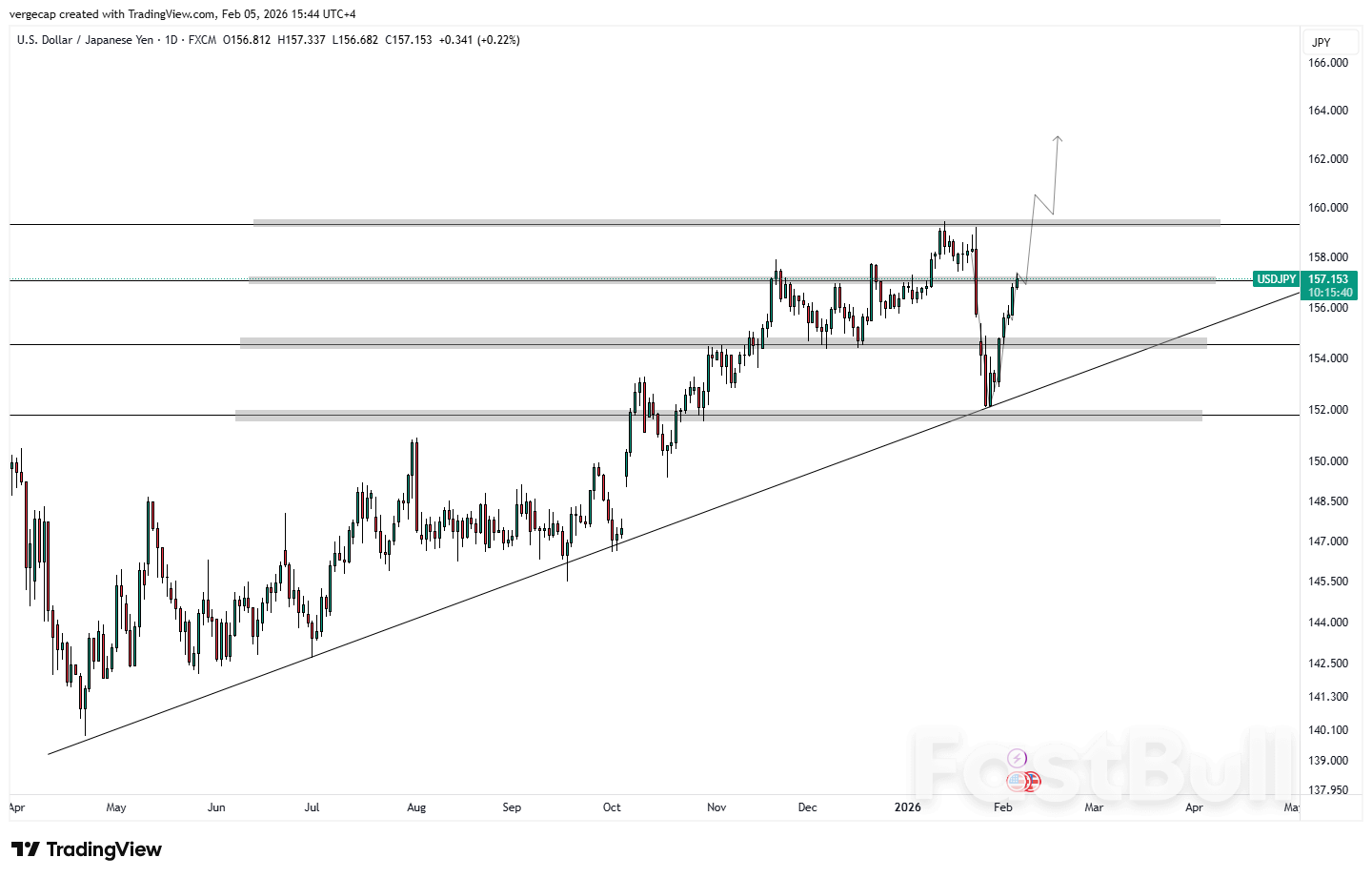
From a technical perspective, USD/JPY remains entrenched in a well-defined bullish structure on the daily chart, with price continuing to respect a long-term ascending trendline that has guided the uptrend since mid-2025. The recent sharp pullback into the 152.00–153.00 demand zone was aggressively bought, producing a strong bullish reaction that reinforces this area as a key layer of dynamic support within the broader uptrend.
Price has now rebounded back into the 156.50–157.50 mid-range resistance zone, which previously acted as a consolidation ceiling. The ability of bulls to quickly reclaim this region after the recent selloff suggests the decline was corrective rather than a structural trend reversal. As long as price holds above the rising trendline and the 154.50–155.00 support region, the broader bullish bias remains intact.
A decisive break above the 159.50–160.00 major resistance zone would represent a continuation of the primary uptrend and likely trigger momentum buying. Such a breakout would expose the 162.00–164.00 region, marking fresh multi-month highs and signaling continuation of the long-term bullish cycle.
On the downside, failure to hold above 154.50 would be the first sign of weakening bullish momentum and could trigger a deeper pullback toward the 152.00 demand zone. A sustained break below this area would signal a more meaningful structural shift and open the door toward 150.00–148.50, where the rising trendline originated.
Overall, price action suggests trend continuation following a corrective pullback, with buyers defending key support and positioning for a potential breakout toward 160+.
TRADE RECOMMENDATION
BUY USD/JPY
ENTRY PRICE: 157.10
STOP LOSS: 153.80
TAKE PROFIT: 164.50


