The US Dollar roared back to life against the Japanese Yen on Thursday, surging approximately 0.6% to touch intraday highs of 159.70 — recovering sharply from Wednesday's lows of 158.27 — as a toxic cocktail of Middle East escalation, presidential war rhetoric, and thin holiday-week liquidity conspired to send the currency pair hurtling back toward a level that has haunted currency traders for weeks: the psychologically and politically explosive 160.00 mark.
For market participants who had grown cautiously optimistic that a diplomatic off-ramp might emerge from the 34-day-old conflict between Iran and Israel, Wednesday's televised address from US President Donald Trump delivered a brutal reality check. Markets had widely anticipated the address to outline a framework for de-escalation or a ceasefire roadmap. Instead, what they received was a message that sent shockwaves from the foreign exchange desks of Tokyo to the trading floors of New York.
Trump, speaking in characteristically blunt terms, doubled down on his most aggressive posture yet toward Tehran, threatening to "take Iran back to the Stone Age" and issuing a direct call to allied nations to summon the political will to reopen the Strait of Hormuz — the narrow waterway through which roughly 20% of the world's traded oil passes. The remarks torpedoed any nascent hopes of a near-term ceasefire and sent crude oil prices surging, global risk appetite cratering, and the Dollar surging as traders fled to the relative safety of the greenback.
Tehran's response was swift and incendiary. Iranian officials dismissed US proposals to end the war as "maximalist and irrational," and in a statement that further rattled global markets, promised "devastating attacks" on both the United States and Israel should hostilities escalate further. With Iran and Israel continuing to exchange missile and drone strikes as the conflict enters its fifth week, the geopolitical premium baked into oil and currency markets shows no sign of dissipating.
It is against this combustible backdrop that USD/JPY has found the room to reclaim the ground it surrendered over the two prior sessions, pushing back toward 160.00 — a level that functions less as a technical resistance zone and more as a political red line for Japanese monetary authorities.
Japanese policymakers have been watching the Yen's slide with growing alarm, and the language coming out of the Finance Ministry this week has taken on an unmistakably urgent tone. On Monday, Japan's Vice Finance Minister for International Affairs, Atsushi Mimura, issued one of the more direct warnings in recent months, affirming that Tokyo stands ready to take "decisive" action if speculative moves in currency markets persist. The word "decisive" — a term of art in the intervention playbook — was not chosen carelessly.
By Tuesday, Finance Minister Satsuki Katayama had escalated the rhetoric further still, publicly observing what she described as "speculative moves heightening in currency markets" and reiterating the government's "readiness to respond" across all available tools. For a Finance Ministry that prefers to communicate through carefully calibrated signals rather than headline-grabbing statements, two consecutive days of increasingly strident warnings represent an unusually loud alarm bell.
The question now is not whether Japan will intervene, but when — and under what conditions. History offers a useful guide. The Bank of Japan has shown a clear preference for acting on days when market liquidity is thinner than normal, a strategy designed to maximize the disruptive impact of its dollar-selling operations and achieve the greatest possible bang for its intervention yen. In that context, Good Friday looms as a particularly fraught occasion.
With most European markets closed on Good Friday and the United States preparing to release its monthly Nonfarm Payrolls report — one of the most market-moving data events on the economic calendar — the conditions for an explosive combination of thin liquidity and extreme price volatility are firmly in place. A stronger-than-expected payrolls print could send the Dollar surging further, potentially pushing USD/JPY through the 160.00 threshold and directly into the territory where Japanese authorities have historically pulled the trigger on unilateral FX intervention.
In that scenario, traders face an asymmetric and deeply uncomfortable setup: the Dollar's fundamental momentum is bullish, driven by geopolitical risk and a resilient US labor market, yet the threat of sudden, large-scale Yen-buying by Japanese authorities hangs over every upward tick like a sword of Damocles. The Bank of Japan has intervened at levels above 160.00 before, and with the Finance Ministry issuing back-to-back warnings this week, the credibility of that threat has rarely felt more real.
Technical Analysis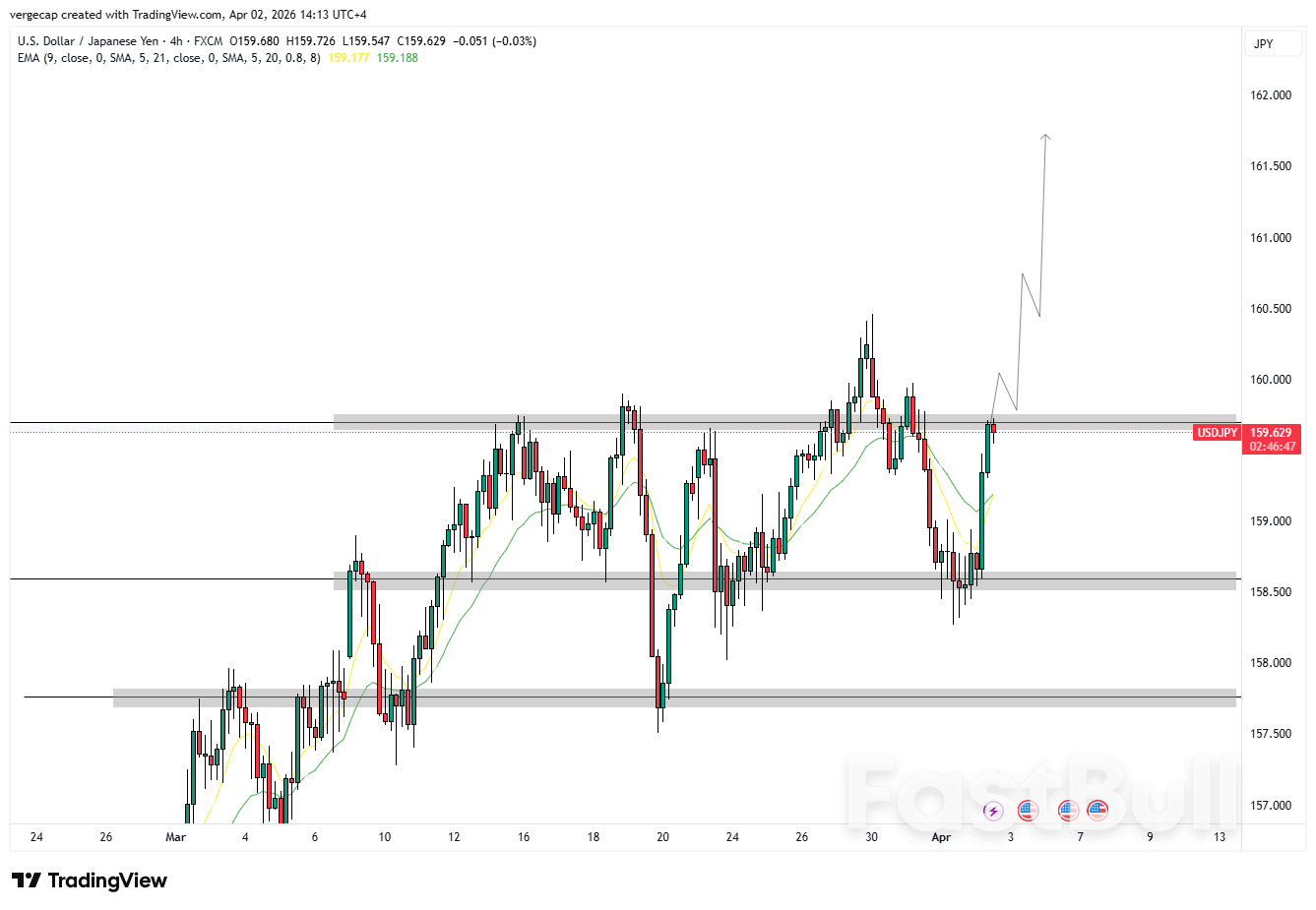
From a technical perspective, USD/JPY is navigating a pivotal inflection point on the 4-hour chart, with price currently hovering at 159.629 — sitting directly atop a well-defined and repeatedly tested horizontal resistance band between 159.60 and 159.80. This zone has functioned as both a ceiling and a floor across multiple sessions throughout March and into early April, making the current price location one of the most consequential the pair has occupied in recent weeks. The manner in which price behaves at this precise level over the coming sessions will likely determine the trajectory for the pair heading into the second week of April.
The moving average picture has turned constructively bullish following a sharp recovery from the recent lows. Both the 9-period EMA and the 21-period SMA, currently converging tightly around 159.17–159.19, have crossed bullishly beneath price and are beginning to slope upward after several sessions of compression. Price has reclaimed both averages from below with conviction following the aggressive bounce off the 158.50 support zone — a technically significant development that signals short-term momentum has decisively shifted back in favor of the bulls. The tight clustering of these two averages directly beneath current price also serves as a dynamic support cushion, meaning any shallow pullback that holds above 159.17 should be interpreted as a continuation signal rather than a reversal.
The 158.50–158.60 support band represents the most critical near-term floor on the chart. This level absorbed selling pressure on multiple occasions throughout late March and again during the early April dip, producing sharp bullish reversals on each test. A return to and hold above this zone on any corrective move would preserve the bullish structure entirely and represent a compelling area for fresh long entries. However, a decisive 4-hour close below 158.50, particularly if accompanied by bearish follow-through, would signal a more meaningful deterioration and shift attention toward the 157.70–157.80 support floor — the lowest horizontal level visible on the chart and the last meaningful buffer before a broader trend reassessment becomes necessary.
On the upside, the immediate challenge for bulls is a clean and sustained break above the 159.60–159.80 resistance ceiling. Price has attempted and failed to hold above this band on multiple occasions across the past three weeks, each time producing a reversal that underscores the significance of the supply sitting in this zone. A convincing 4-hour close above 159.80 — ideally backed by expanding candle bodies and a clear separation from the moving averages — would be the technical signal the market has been waiting for, opening the door to a test of the 160.00 psychological threshold. The 160.00 level carries weight that extends well beyond the purely technical; it is the political red line that Japanese monetary authorities have publicly warned against breaching, and a sustained move above it would dramatically intensify intervention risk.
Should 160.00 yield, the projected extension visible on the chart points toward the 160.50 area initially, with a broader measured move targeting the 161.50–162.00 zone — consistent with the swing highs registered in late March when the pair briefly pierced 160.50 before being pushed back. A breakout scenario of this magnitude, particularly if triggered on a thin-liquidity session such as the upcoming Good Friday, could produce an explosive and rapid move that catches much of the market positioned incorrectly.
The overall structure favors the bulls as long as 158.50 remains intact, with a breakout above 159.80 as the catalyst for the next meaningful leg higher.
TRADE RECOMMENDATION
BUY USD/JPY
ENTRY PRICE: 159.65
STOP LOSS: 158.30
TAKE PROFIT: 161.50


