Overall Market Outlook
USD/JPY remains elevated despite a broader weakening trend in the U.S. dollar. Current data places the pair near 159.13, while recent trading has repeatedly approached the 160.00 psychological threshold. The pair has recovered substantially from the intervention-driven decline earlier this month, demonstrating that the underlying interest-rate differential still favors the dollar.
The important change is that the dollar is no longer receiving uniform support from global markets. Reuters reports that the dollar index remains close to a three-month low as investors assess the impact of expanded U.S. sanctions against Iran and Treasury plans to buy back long-dated government debt. The market is also waiting for Federal Reserve Chair Kevin Warsh's Jackson Hole speech for further guidance on monetary policy.
At the same time, the yen has several potential catalysts behind it. Japan's July core inflation accelerated, reinforcing expectations that the Bank of Japan could raise rates at its September meeting. Reuters notes that USD/JPY was around 159.01 following the inflation release, while the BoJ is scheduled to meet on September 17–18.
This makes 159.25–160.00 a high-risk area for fresh USD/JPY longs. Even though the structural trend remains bullish, the probability of profit-taking and yen short-covering increases substantially as price approaches the intervention-sensitive zone.
Market Sentiment
Market sentiment is currently divided between strong carry-trade demand and growing concern about excessive yen weakness. The dollar-yen pair has repeatedly recovered after dips toward 158.00, showing that buyers remain active. However, the inability to establish a sustained break above 159.50 means the market has not yet converted the recovery into a clean breakout.
There is also an important positioning risk. Recent analysis from SMBC Nikko argues that the dollar's fair value could be considerably closer to 150 yen, suggesting that part of the current move toward 160 may reflect speculative positioning rather than fundamentals alone. Meanwhile, HSBC expects further BoJ tightening, which could eventually provide a more durable foundation for yen appreciation.
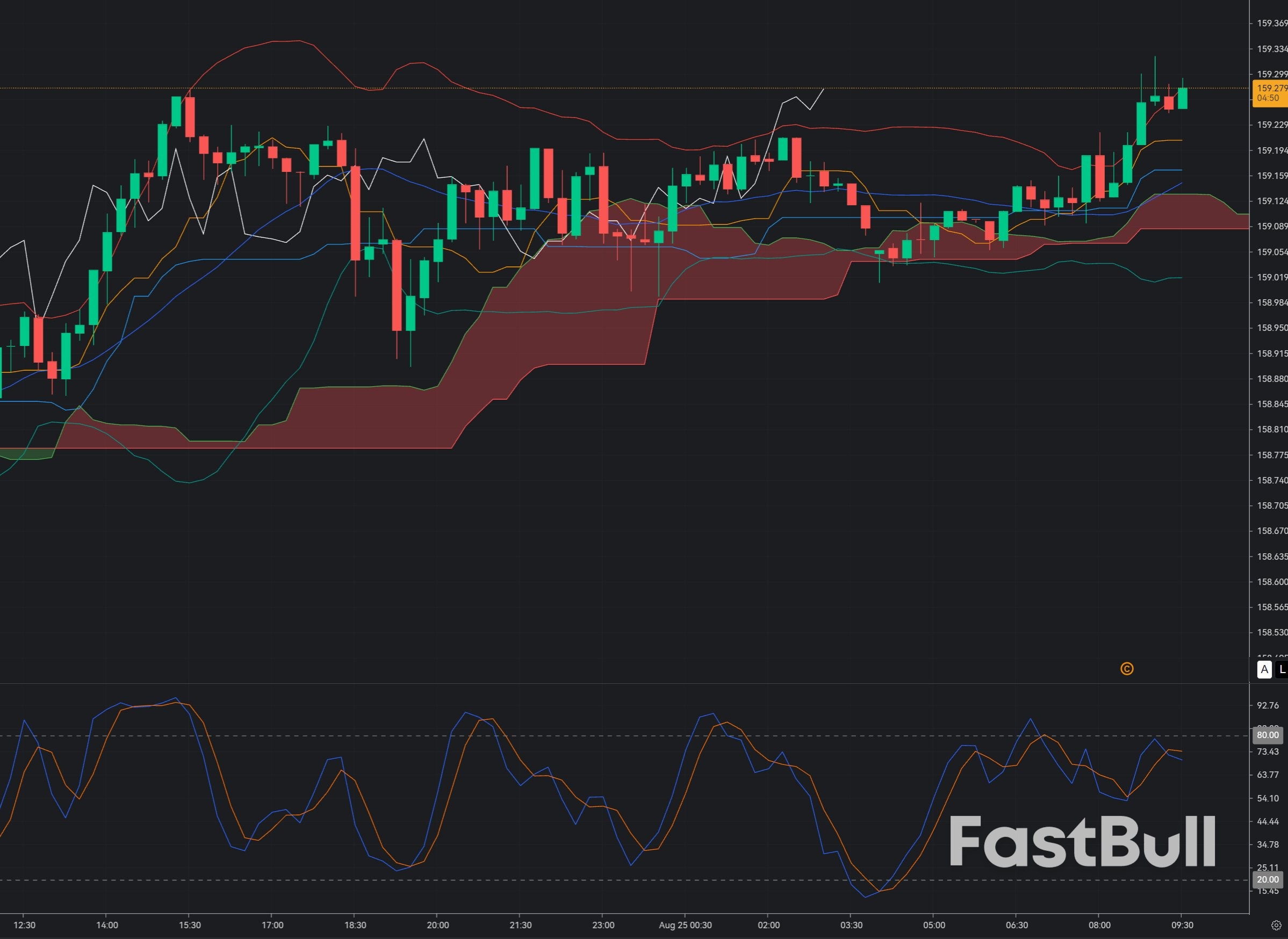
Therefore, selling 159.25 is best viewed as a mean-reversion trade against an extended rally. The setup becomes significantly stronger if M15 candles repeatedly reject 159.30–159.50 and then break below 159.00. Conversely, an M15 close above 159.60 would indicate that sellers are failing and that 160.00 is becoming the immediate target.
Using Bollinger Bands (20,0,2), Ichimoku (9,26,52) and Stochastic (5,3,3), the M15 setup favors a tactical SELL from 159.25, although the broader trend remains bullish.
Bollinger Bands are positioned around an elevated price structure, with USD/JPY trading close to the upper portion of the recent range. The pair's inability to generate a decisive expansion above 159.30–159.50 would create a classic exhaustion setup. A move back through the middle Bollinger area around 159.00 would strengthen the probability of a deeper retracement toward 158.60–158.50.
Ichimoku provides the main warning against aggressively shorting. The broader M15 structure remains bullish while price stays above the cloud, meaning the SELL should only be considered valid if price begins closing beneath Tenkan-sen and subsequently breaks the cloud. If the cloud continues rising underneath price, sellers are fighting the prevailing trend and the setup carries elevated reversal risk.
Stochastic (5/3/3) is the most useful timing indicator here. With USD/JPY approaching the upper end of its recent range, a bearish crossover from overbought territory would provide confirmation that upside momentum is fading. The strongest scenario would be rejection around 159.25–159.50 followed by Stochastic crossing downward and an M15 close below 159.00.
The major resistance is 159.50, followed by the psychological 160.00 threshold. The first downside objective is 158.70, with 158.30 becoming possible if the yen strengthens sharply. The trade should therefore be managed as a short-term reversal rather than assuming that USD/JPY has entered a major downtrend. Current technical data still shows a strong bullish bias on broader indicators, reinforcing the need for a relatively tight stop.
Trade Recommendation
Entry: 159.25
Take Profit: 158.30
Stop Loss: 159.65