The US Dollar is staging a meaningful recovery against the Swiss Franc on Thursday, with USD/CHF reclaiming the critical psychological level of 0.7960 — a two-month high — during Asian trading hours, as a potent mix of geopolitical turbulence and resetting monetary policy expectations delivers fresh legs to the Greenback.
From where I sit, this move is not a surprise. The market has been slowly coming to terms with a reality that many traders were reluctant to accept just weeks ago: the Federal Reserve is not cutting rates anytime soon, the Middle East conflict is far from over, and the Swiss National Bank is growing increasingly uncomfortable with its own currency's strength. That trifecta is a near-perfect setup for USD/CHF bulls.
The Federal Reserve left the federal funds rate steady at the 3.5%–3.75% target range for a second consecutive meeting in March 2026, as policymakers navigated a challenging environment marked by surging oil prices from the Iran conflict, persistent inflation, and signs of softening in the labor market. The decision, which came in line with broad market expectations, was accompanied by a revised economic outlook — one that leaned hawkish enough to rattle any lingering hopes of an early rate cut.
There is now a 95% probability the Fed maintains its current range at the April 30 meeting and a 77% likelihood it will hold steady in June, according to CME FedWatch — a dramatic turnaround from just a month ago when those probabilities stood at 70% and 31% respectively. The shift in rate cut expectations has been nothing short of dramatic, and it is lending crucial support to the US Dollar Index (DXY), which held onto two-day gains around the 100.00 level during Thursday's Asian session.
What's making traders especially nervous — and rightfully so — is the inflation picture. EY-Parthenon chief economist Gregory Daco told investors that, given higher headline and core PCE inflation forecasts, the baseline now shows only one rate cut in 2026, likely in December, but acknowledged it is "entirely plausible that the Fed won't deliver any rate cuts this year." Some analysts have gone even further, with Carson Group's chief macro strategist warning that the Fed may not cut rates in 2026 at all and could even begin discussing rate hikes later in the year.
That is a seismic shift in the macro narrative, and currency markets are repricing accordingly.
The other dominant driver of USD/CHF on Thursday is the murky and rapidly evolving diplomatic standoff over Iran and the Strait of Hormuz — a situation I would describe as one of the most consequential geopolitical flashpoints for global energy markets in decades.
President Trump announced on Truth Social Thursday that he is pausing the period of Iranian energy plant destruction by 10 days until Monday, April 6, 2026, at 8 P.M. Eastern Time, citing "ongoing" talks that are going "very well." He claims the extension came at Iran's request, pointing to the passage of Pakistani-flagged oil tankers through the Strait of Hormuz as a gesture of good faith from Tehran.
But here is where it gets complicated, and frankly, where the market's skepticism is entirely warranted. Iranian Foreign Minister Abbas Araghchi has stated that an exchange of messages between the two countries via mediators does not constitute negotiations with the US, while Iran has formally rejected Washington's 15-point peace proposal and countered with its own five conditions — including international recognition of Iranian sovereignty over the Strait of Hormuz. Iran and the United States appeared at a firm impasse Thursday, hardening their positions over ceasefire talks and setting the stage for another potential escalation in the Middle East as thousands more US troops neared the region. Meanwhile, Brent crude oil climbed 4.8% to settle at $101.89 a barrel as hopes dimmed for a potential normalization of the critical waterway, up sharply from roughly $70 before the war began.
In my view, the market is right to be skeptical about Trump's rosy framing of these talks. The gap between Washington's 15 points and Tehran's five counter-conditions is not a negotiating gap — it is a chasm. A senior Iranian official told Reuters that Tehran sees the 15-point plan as serving only the interests of the United States and Israel, calling it "one-sided and unfair." Until there is a credible and verifiable step toward reopening the strait, elevated oil prices and geopolitical risk premiums will continue to anchor the Dollar as a haven asset.
On the other side of this pair, the Swiss Franc — traditionally one of the world's most reliable safe-haven currencies — finds itself in an unusual bind. While geopolitical stress would ordinarily turbocharge the CHF, the Swiss National Bank has made it abundantly clear that it will not stand idly by while its currency appreciates to levels that threaten deflation.
The SNB left its benchmark rate at 0% for the third consecutive meeting on March 19, as widely anticipated, and is expected to keep rates unchanged through the year. Policymakers signaled their increasingly firm readiness to intervene in foreign exchange markets to prevent excessive currency appreciation and safeguard price stability. Annual inflation in Switzerland held at just 0.1% for the third consecutive month in February, sitting at the very bottom of the SNB's 0%–2% target band.
With inflation this low, the SNB has every incentive to talk down its own currency, and Chairman Martin Schlegel has wasted no time doing so. His explicit warning at the post-March policy meeting — that the central bank's readiness to intervene against excessive Franc appreciation has increased — is a clear signal to the market, and one that traders are taking seriously.
This creates an asymmetric dynamic for the Swiss Franc. Even in a risk-off environment where the CHF would normally shine, the ceiling on its upside is being held down by intervention threat. That leaves USD/CHF with a fundamentally supportive structure from both directions: a firmer Dollar and a capped Franc.
Over the past 52 weeks, USD/CHF has traded between 0.7629 and 0.8564, with the current rate sitting at just 29% of that range — suggesting there is still meaningful room to the upside if the bullish catalysts remain in place. During the past week alone, the pair fluctuated between a high of 0.7955 and a low of 0.7848, reinforcing the idea that bulls are firmly in control of the short-term narrative.
My view is that USD/CHF has further to run. The combination of a Fed that is on hold indefinitely, a geopolitical crisis that shows no signs of resolution before the April 6 deadline, and an SNB actively leaning against CHF strength creates a compelling case for continued Dollar outperformance. A sustained break and daily close above 0.7960 would likely open the door toward the 0.8030–0.8060 resistance zone, with the 2026 high of 0.8034 squarely in the crosshairs.
The primary risk to this outlook is a genuine diplomatic breakthrough on Iran — one that sends oil prices sharply lower and revives Fed rate-cut expectations. Until that happens, the Dollar's momentum looks intact, and the Swiss Franc's traditional safe-haven appeal is being overshadowed by its central bank's own ambitions.
Technical Analysis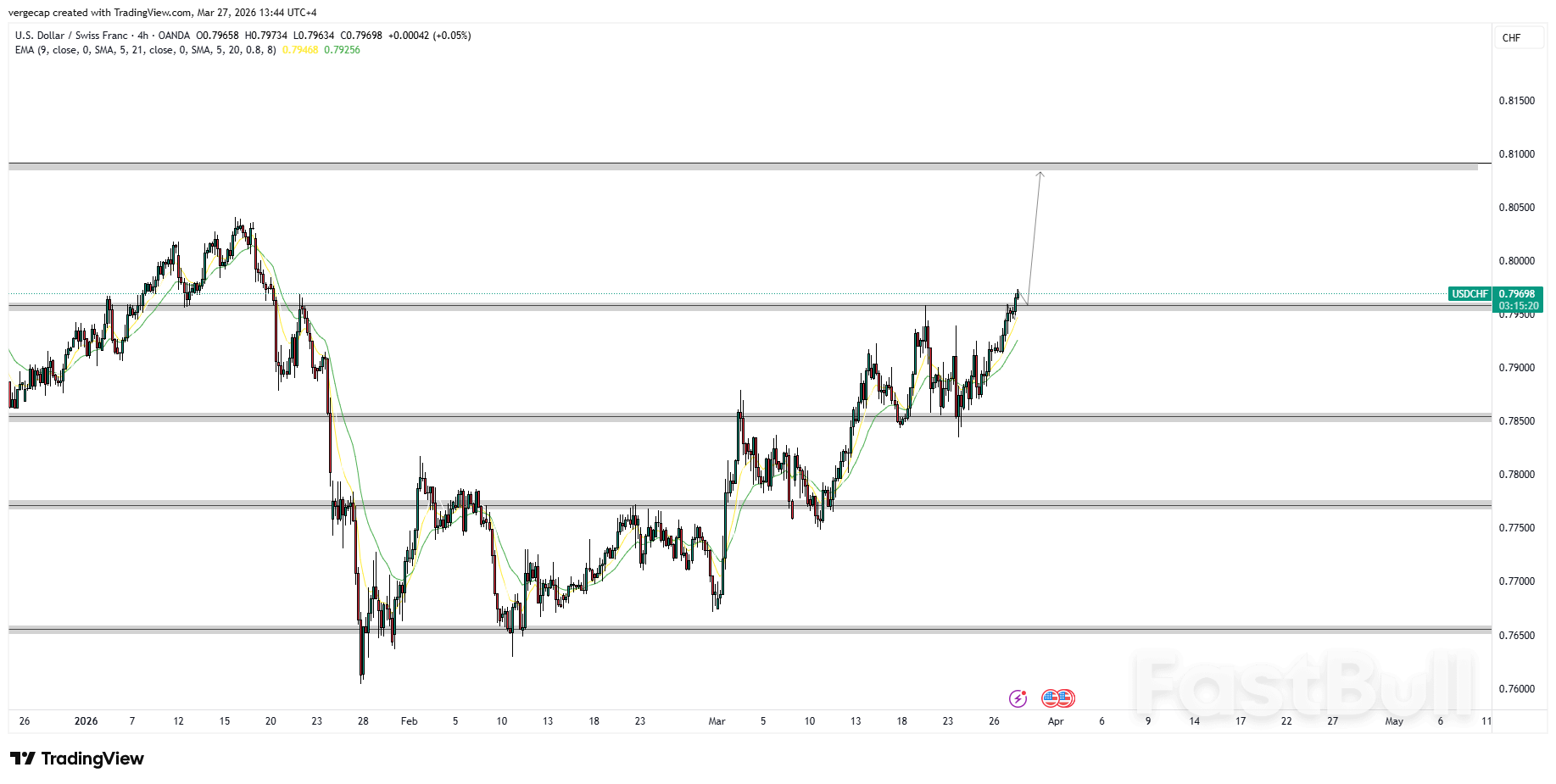
USD/CHF is firmly entrenched in a well-defined bullish structure. On the 4-hour chart, the pair has been carving out a clear sequence of higher highs and higher lows since bottoming out near the 0.7630 region in late January — a recovery that has been both steady and increasingly convincing in its momentum. Price currently trades around 0.7970, pressing against a significant horizontal resistance zone that has capped the pair on multiple prior attempts.
The 9-period Exponential Moving Average (EMA), currently sitting at 0.7947, has been acting as dynamic near-term support throughout the recent leg higher, with price consistently bouncing from or consolidating just above it before resuming its upward trajectory. The 21-period Simple Moving Average (SMA), positioned slightly lower at 0.7926, represents a more critical structural floor and continues to slope decisively upward, reinforcing the prevailing bullish bias. As long as price holds above these dynamic supports, the path of least resistance remains to the upside.
The key battleground right now is the 0.7960–0.7975 resistance band — a level that has rejected price on several occasions going back to mid-January. The current push into this zone is notable because it comes with the moving average stack fully aligned in a bullish configuration, suggesting that this time buyers may finally have the firepower to push through decisively. A clean break and four-hour close above 0.7975 would mark a significant shift in market structure, unlocking the next leg toward the 0.8000 psychological level — a milestone that carries both technical and sentiment weight. Beyond that, the 0.8050 and 0.8100 zones represent the next meaningful supply areas, with the chart's projected trajectory pointing squarely in that direction.
On the downside, an immediate pullback would likely find solid footing at the 0.7900 level, where previous resistance-turned-support converges with the rising EMA cluster. A deeper retreat toward 0.7850 or 0.7800 would test the integrity of the broader uptrend but would not in isolation constitute a trend reversal. However, a sustained break below 0.7750 — the mid-range support established during the February consolidation phase — would represent a meaningful deterioration in structure and could trigger a more significant corrective move back toward the 0.7700–0.7630 support zone.
The overall picture is one of building momentum rather than exhaustion. Price has been steadily clawing back ground since the sharp January selloff, the moving averages are constructively positioned, and the current retest of resistance is occurring from a position of strength rather than overextension. Provided geopolitical tensions and Fed rate expectations remain supportive of the Dollar — as outlined in the fundamental backdrop — the technical setup aligns cleanly with the bullish macro thesis.
TRADE RECOMMENDATION
BUY USD/CHF
ENTRY PRICE: 0.7970
STOP LOSS: 0.7880
TAKE PROFIT: 0.8080


