The Swiss Franc is losing its safe-haven luster, and the US Dollar is capitalizing on the shift. For the sixth straight trading day, the USD/CHF pair climbed higher, marking a relentless grind upward that has market participants recalibrating their positions after weeks of heightened geopolitical anxiety. At the time of writing, the pair was trading at 0.8005, up 0.12% on the session, as a potent cocktail of diplomatic maneuvering and central bank policy divergence reshaped the near-term landscape.
The catalyst for this week’s risk-on shift appears to be a significant development out of the Middle East. According to a report from the Wall Street Journal, the administration of US President Donald Trump is signaling a willingness to pivot toward a diplomatic resolution with Iran. The report suggests Washington is open to ending its military campaign, even if it means accepting a prolonged closure of the Strait of Hormuz, a critical artery for global energy flows. This potential move from a military-first posture to a diplomatic engagement has acted as a circuit breaker for markets that had been bracing for a wider regional conflict.
The immediate reaction was palpable across asset classes. S&P 500 futures surged roughly 1%, vaulting back above the psychologically significant 6,400 level, a clear indication that investors are unwinding defensive positions. For the USD/CHF pair, this risk-on environment is a double-edged sword that ultimately favors the upside. The Swiss Franc, traditionally the ultimate haven in times of European or Middle Eastern strife, is seeing its premium erode rapidly as the probability of a geopolitical shock diminishes.
Furthermore, the easing of tensions is having a direct impact on energy markets. Oil prices are correcting sharply lower as fears of supply disruptions—specifically a blockade of the Strait of Hormuz—recede. This decline in crude is more than just a headline; it has tangible implications for monetary policy. Just days ago, soaring energy costs were fueling expectations that the Federal Reserve might be forced to adopt a more aggressive hawkish stance to combat imported inflation. With oil now cooling, those inflationary pressures are beginning to subside, providing the Fed with more flexibility.
That flexibility was echoed on Monday by Fed Chair Jerome Powell, who took a decidedly measured tone during his latest public appearance. Powell dampened speculation that the central bank is preparing to resume its interest rate hiking cycle, noting that inflation pressures remain “contained for now.” While his remarks were intended to soothe the bond market, they have simultaneously acted as a governor on the US Dollar’s ascent. Treasury yields slipped following his comments, preventing the Greenback from staging a more aggressive rally against the Franc despite the favorable risk backdrop.
Yet, even with the Dollar’s upside somewhat limited by Powell’s dovish tilt, the USD/CHF pair continues to grind higher. The reason lies squarely with the Swiss National Bank. The SNB remains the primary antagonist to Swiss Franc strength. In recent communications, central bank officials have reiterated their unwavering readiness to intervene in currency markets to prevent what they view as an “excessive” appreciation of the CHF.
This stance is a critical factor for traders to consider. While other central banks are navigating the delicate balance between inflation and growth, the SNB remains singularly focused on containing the Franc’s strength to protect the nation’s export-heavy economy. As long as that interventionist threat looms, any rally in the Franc—particularly one driven by risk-off flows—is likely to be met with resistance, either verbally or via direct market action. In the current environment of cooling geopolitical risks, the Franc is left without its primary bullish catalyst, making it vulnerable against a Dollar that, while not booming, is at least stable relative to its G10 peers.
Technical Analysis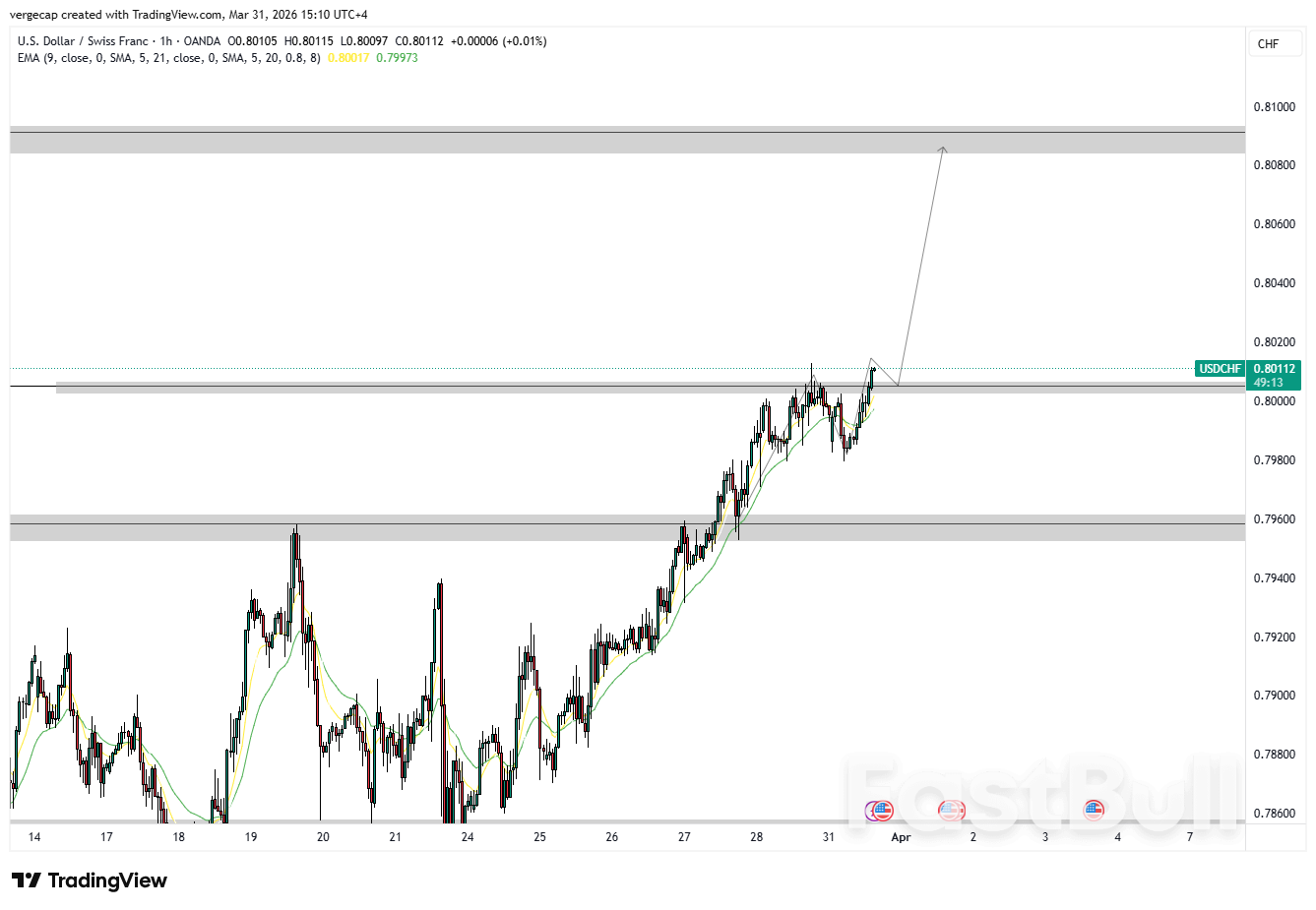
From a technical perspective, USD/CHF is carving out one of the most constructive bullish structures visible on the 1-hour chart in recent weeks, with price staging a powerful and sustained advance from the 0.7860 lows of mid-March toward the psychologically and technically significant 0.8000 round number — a level that the pair is now not merely testing but actively consolidating above, signaling that the character of this market has fundamentally shifted in favor of the US Dollar.
The rally from the 0.7860 base has been defined by exceptional technical discipline. The advance accelerated meaningfully from March 25 onward, with price breaking decisively above the 0.7960 intermediate resistance band — a level that had capped multiple intraday recovery attempts during the preceding sessions — and subsequently maintaining price action above it with conviction. This structural reclaim of 0.7960 as support was the key technical trigger that confirmed the bullish trend was not merely a corrective bounce but a genuine directional shift with momentum behind it. The measured pace and consistency of the advance, characterized by shallow pullbacks and swift recoveries, speaks to the quality and sustainability of the buying pressure driving this pair higher.
The 9-period EMA, currently tracking at 0.8002, and the 21-period SMA at 0.7997 are both rising in a tight and orderly bullish stack directly beneath the current price of 0.8011. The proximity of both averages to price at this juncture is a double-edged technical signal — on one hand, it confirms that the trend remains healthy and that dynamic support is immediately available below the market; on the other hand, it reflects the maturity of the current leg and suggests that a brief consolidation around the 0.8000 level would be entirely natural and healthy before the next directional impulse higher. Any dip that finds support at the EMA/SMA cluster near 0.7997–0.8002 and recovers promptly would represent the ideal higher-low formation and the cleanest possible re-entry signal for trend-following longs.
The 0.8000 psychological level deserves particular attention. Round numbers of this magnitude carry outsized significance in currency markets — they attract both profit-taking from existing longs and fresh short entries from counter-trend traders, which explains the modest consolidation visible in recent price action just above this threshold. However, the fact that price has not retreated meaningfully below 0.8000 despite multiple sessions of testing is itself a bullish signal. The market is absorbing the selling pressure at this level and holding — a behavior consistent with continuation rather than reversal.
A decisive hourly close above the 0.8015–0.8020 area, clearing the dotted resistance line visible on the chart, would be the technical confirmation that the 0.8000 consolidation has been resolved to the upside. Such a break would unlock a measured move extension toward the 0.8080–0.8100 major resistance ceiling — the dominant horizontal supply zone at the top of the chart that represents the next and most significant structural barrier for bulls. The projected move arrow on the chart targets this zone precisely, consistent with the width and momentum profile of the prior advance from 0.7860.
The 0.7960 horizontal band, which was previously resistance and is now established support, represents the critical defensive level for the bullish thesis on any deeper pullback. A sustained hourly close below 0.7960 would be the first genuine warning sign that the rally is losing structural integrity and could invite a more meaningful corrective move. Below 0.7960, the 0.7920–0.7930 area provides the next layer of support, aligning with mid-rally consolidation from late March. However, in the current technical environment — with both moving averages rising, price holding above the 0.8000 psychological milestone, and no visible bearish reversal patterns on the chart — a retreat of that magnitude appears a decidedly low-probability outcome.
The broader picture is unambiguously constructive. From the 0.7860 base, USD/CHF has recovered nearly 160 pips in a clean, structured, and technically sound advance that has broken above every layer of resistance in its path. The 0.8000 consolidation is a pause, not a peak — and the path of least resistance, supported by both the technical structure and the moving average configuration, points firmly higher toward 0.8080 and beyond.
TRADE RECOMMENDATION
BUY USD/CHF
ENTRY PRICE: 0.8012
STOP LOSS: 0.7950
TAKE PROFIT: 0.8085


