A familiar chill swept through global equity markets on Thursday, and as often happens when investors retreat to the sidelines, the US Dollar found its footing. The greenback is posting a firm, second consecutive day of gains against its Canadian counterpart, a dynamic that speaks volumes about the current market crosscurrents: disappointment in high-flying tech sectors, persistent questions about the underlying strength of the American economy, and a tentative de-escalation in geopolitical risk that is reshaping the commodity landscape.
As of this writing, the USD/CAD pair is trading firmly at 1.3685. While bulls have, for now, been rebuffed in their attempt to secure a decisive breakout above the psychologically significant 1.3700 handle, the price action remains distinctly bid. The Dollar’s ascent isn’t about unbridled optimism for the US economy; rather, it’s the classic "least-worst option" play. In a session where major European bourses are painted red and Wall Street futures flicker uncertainly, the world’s primary reserve currency is once again donning its safe-haven mantle.
The trigger for this risk-averse posture is clear: a sobering reality check from the temple of US corporate earnings. Alphabet Inc.’s disappointing quarterly results acted as a catalyst, triggering a rout across the mega-cap tech sector. This isn't just a Silicon Valley story; the reverberations are being felt in boardrooms and trading desks from Frankfurt to Tokyo. When the market's former darlings stumble, capital doesn't vanish—it migrates. And a significant portion is migrating towards the relative safety and liquidity of the US Dollar, providing a firm bid across the DXY index.
Beneath this flight to safety, however, lies a more nuanced and potentially more consequential narrative for currency traders: the enduring puzzle of the US labor market. Wednesday’s data dump was a tale of two surveys. The headline ISM Services PMI impressed, suggesting the consumer-driven engine of the US economy remains hot. But dig into the details, and you find the employment sub-index contracting. This dissonance was amplified by the ADP Employment report, which showed a sharp slowdown in private payroll growth. The message is conflicted: robust business activity coexisting with apparent softness in hiring. It’s this tension that has reignited fundamental doubts and left the Dollar susceptible to data-driven swings.
This brings us to the critical juncture for today’s session. All strategic positioning is on hold pending the 8:30 AM ET release of the latest US Jobless Claims and, more importantly, the JOLTS Job Openings data. The JOLTS report, in particular, is a key Federal Reserve metric. Chair Jerome Powell and his colleagues have repeatedly emphasized the need for labor market "rebalancing" to feel confident that inflationary pressures are sustainably cooling. A significant drop in job openings would be read by the market as a sign that this rebalancing is accelerating, potentially pulling forward expectations for rate cuts and applying sudden downward pressure on the Dollar. Conversely, resilient openings would suggest the Fed’s work is not yet done, potentially reinforcing the Dollar’s yield advantage.
On the other side of the pair, the Canadian Dollar is fighting an uphill battle with few domestic catalysts this week. The domestic economic docket has been light, leaving the Loonie exposed to broader sentiment and its traditional alpha and omega: crude oil. Here, the news is unhelpful. While West Texas Intermediate (WTI) has bounced from its weekly lows, it remains firmly subdued, trading over $2 below last week’s peaks near $66.00. The easing of immediate supply fears, as direct US-Iran confrontations have de-escalated, is applying a persistent headwind. For the Bank of Canada, which is similarly data-dependent and wary of sticky underlying inflation, weaker Oil prices complicate the economic outlook and arguably remove some urgency for the BoC to diverge aggressively from the Fed’s projected path.
The current USD/CAD strength is a reflex to equity market jitters, not a vote of confidence in unabated US economic superiority. The pair is caught between two powerful forces: short-term risk aversion (Dollar positive) and growing anticipation of a softening US labor market (Dollar negative). The technical failure at 1.3700 is a near-term caution flag for Dollar bulls, suggesting the rally may need fresh, fundamental fuel to extend meaningfully.
That fuel will either be provided or denied by the incoming labor data. A strong JOLTS number could be the key that unlocks a sustained move above 1.3700, targeting the next resistance zone. Conversely, a weak report could see the entire safe-haven bid unravel swiftly, sending the pair back towards recent support levels as rate cut speculation reignites. For now, in this uneasy calm, the Dollar’s haven status is winning the day—but its reign looks increasingly precarious, balanced on the edge of a data-dependent knife.
Technical Analysis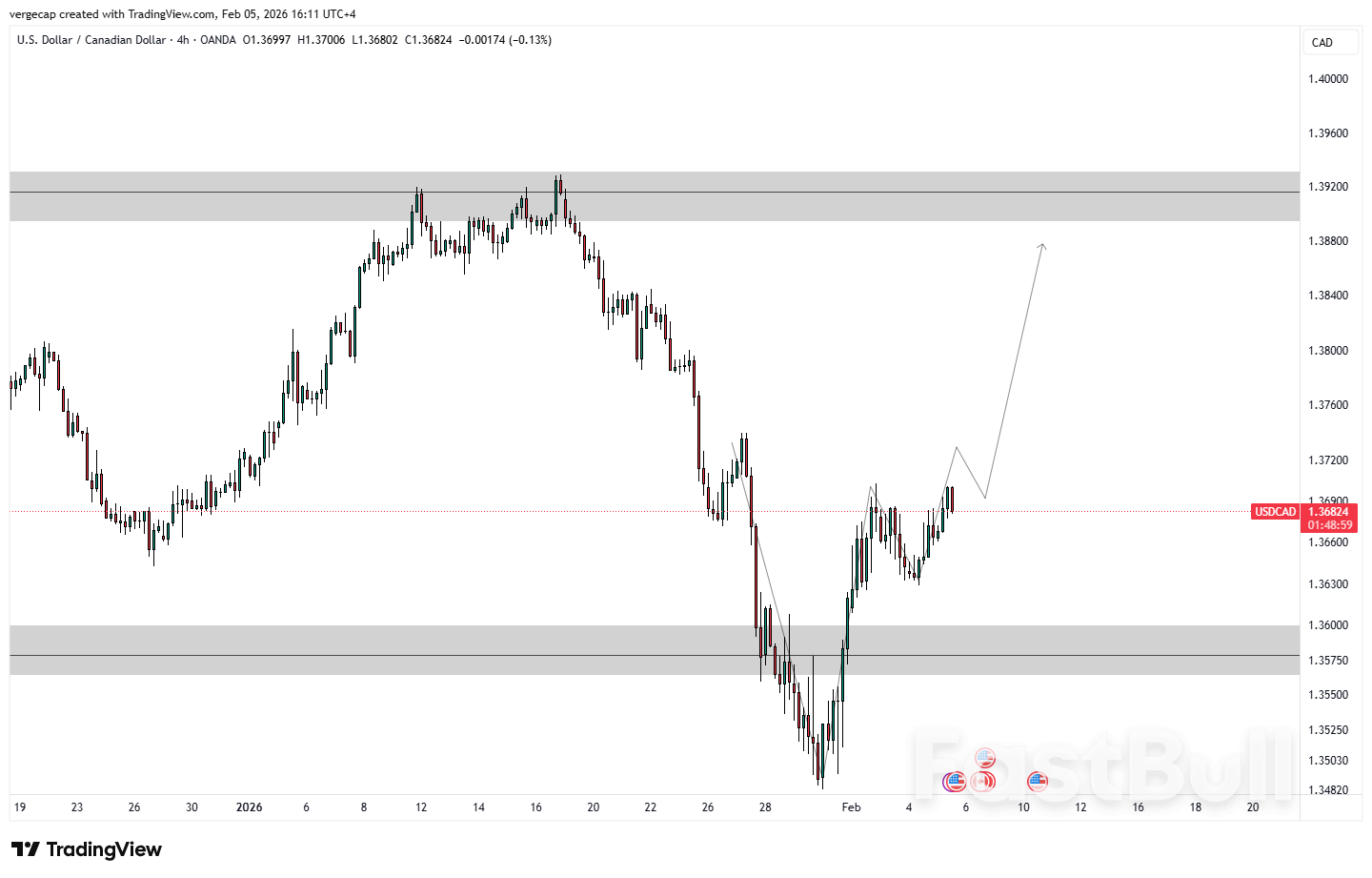
From a technical perspective, USD/CAD appears to be transitioning from a sharp bearish leg into a developing corrective recovery on the 4-hour chart, following a strong rejection from a well-defined demand zone. Price recently capitulated into the 1.3550–1.3600 support region, an area highlighted on the chart that has historically acted as a strong base. The aggressive bullish rebound from this zone suggests active demand and the likelihood that the prior selloff was a liquidity-driven move rather than the start of a sustained downtrend.
The broader structure still reflects a range environment, with major resistance visible near 1.3880–1.3920 and key support anchored around 1.3550–1.3600. After forming a swing low, price has begun printing higher lows, signaling early signs of short-term trend transition. The pair is now consolidating around the 1.3680 pivot area, which is acting as a near-term decision point for the next directional move.
In the near term, a shallow pullback toward the 1.3650–1.3700 region would be technically healthy and could provide a higher-low formation before continuation. Holding above this zone would confirm strengthening bullish momentum and support the case for a continuation move toward the 1.3880–1.3920 supply zone, which represents the next major upside target and the upper boundary of the broader range.
A decisive break above 1.3920 would mark a structural shift and open the path toward 1.4050+, signaling a full bullish range rotation. Conversely, a sustained move back below 1.3600 would invalidate the recovery narrative and expose the 1.3450–1.3500 region, indicating that the broader range rotation is not yet complete.
Overall, price action suggests a corrective pullback followed by a continuation higher, with buyers defending key demand and attempting to rotate price back toward range highs.
TRADE RECOMMENDATION
BUY USD/CAD
ENTRY PRICE: 1.3690
STOP LOSS: 1.3580
TAKE PROFIT: 1.3890


