The Canadian Dollar entered the European session on Friday displaying a curious duality: resilience against its commodity bloc peers, yet impotence against the might of the US Dollar. The USD/CAD pair is hovering near the 1.3740 level, a price point that tells a story of two competing macroeconomic forces colliding in the middle of the charts.
At first glance, the loonie’s lack of upward momentum seems paradoxical. Over the last 24 hours, the narrative surrounding oil—Canada’s lifeblood export—has shifted dramatically. West Texas Intermediate (WTI) crude oil has retraced from the psychologically significant $100 per barrel handle, settling lower as geopolitical premium is stripped from the market. The catalyst for this unwind is twofold: Israel’s recent pledge to refrain from targeting Iranian oil infrastructure has de-escalated the immediate threat to supply routes. Simultaneously, comments from US Treasury Secretary Scott Bessent suggesting a potential removal of sanctions on Iranian oil stuck in sea-borne tankers have signaled that global supply could soon see a modest, yet symbolically important, increase.
Historically, a 2% correction in oil prices would drag the Canadian Dollar down with it, given that Canada is the largest exporter of crude to the United States. Yet, the loonie is refusing to sink. This divergence suggests that the market is already pricing in the geopolitical easing, while the broader bid for the CAD is being supported by a shift in domestic monetary policy expectations.
On the monetary policy front, the narrative surrounding the Bank of Canada is undergoing a subtle but significant recalibration. Investors are rapidly pricing in a scenario where the BoC holds interest rates steady for a prolonged period. After a year of aggressive tightening to combat inflation, the central bank is now navigating a landscape where both the risks to inflation and the risks to economic growth have increased simultaneously.
This is not the typical setup for a dovish pivot. While sticky services inflation remains a concern domestically, the real wildcard is the potential for energy-driven price pressures to re-emerge if the Middle East conflict reignites. The BoC appears to be signaling that the cost of cutting too soon—and allowing inflation to re-anchor above the 2% target—is currently higher than the cost of maintaining a restrictive stance. This "higher for longer" domestic narrative is providing a sturdy floor for the CAD, decoupling it from the immediate fluctuations in the oil pit.
Across the border, the US Dollar is proving that its recent stumble was merely a flesh wound. The US Dollar Index (DXY), which tracks the greenback against six major peers, is trading 0.2% higher on the day near 99.30. This rebound comes after a volatile Thursday session that saw the index drop sharply.
That selloff was triggered by a chorus of global central bankers warning of energy-driven inflation risks. Ironically, these warnings diminished the market’s belief in a divergence between the Fed and its peers. If the European Central Bank (ECB) and the Bank of England (BoE) are also forced to keep rates higher to combat energy-induced inflation, then the Fed’s "extended pause" becomes less of a unique strength and more of a global trend. This convergence briefly undermined the dollar’s interest rate advantage.
However, the USD has stabilized today as traders refocus on the Fed’s domestic agenda. With upside inflation risks persisting in the US economy, the market has concluded that the Fed will adopt an extended pause deeper into the second half of the year than previously anticipated. Until US economic data shows a material slowdown in employment or a sharp decline in core inflation, selling the dollar remains a high-risk strategy.
Technical Analysis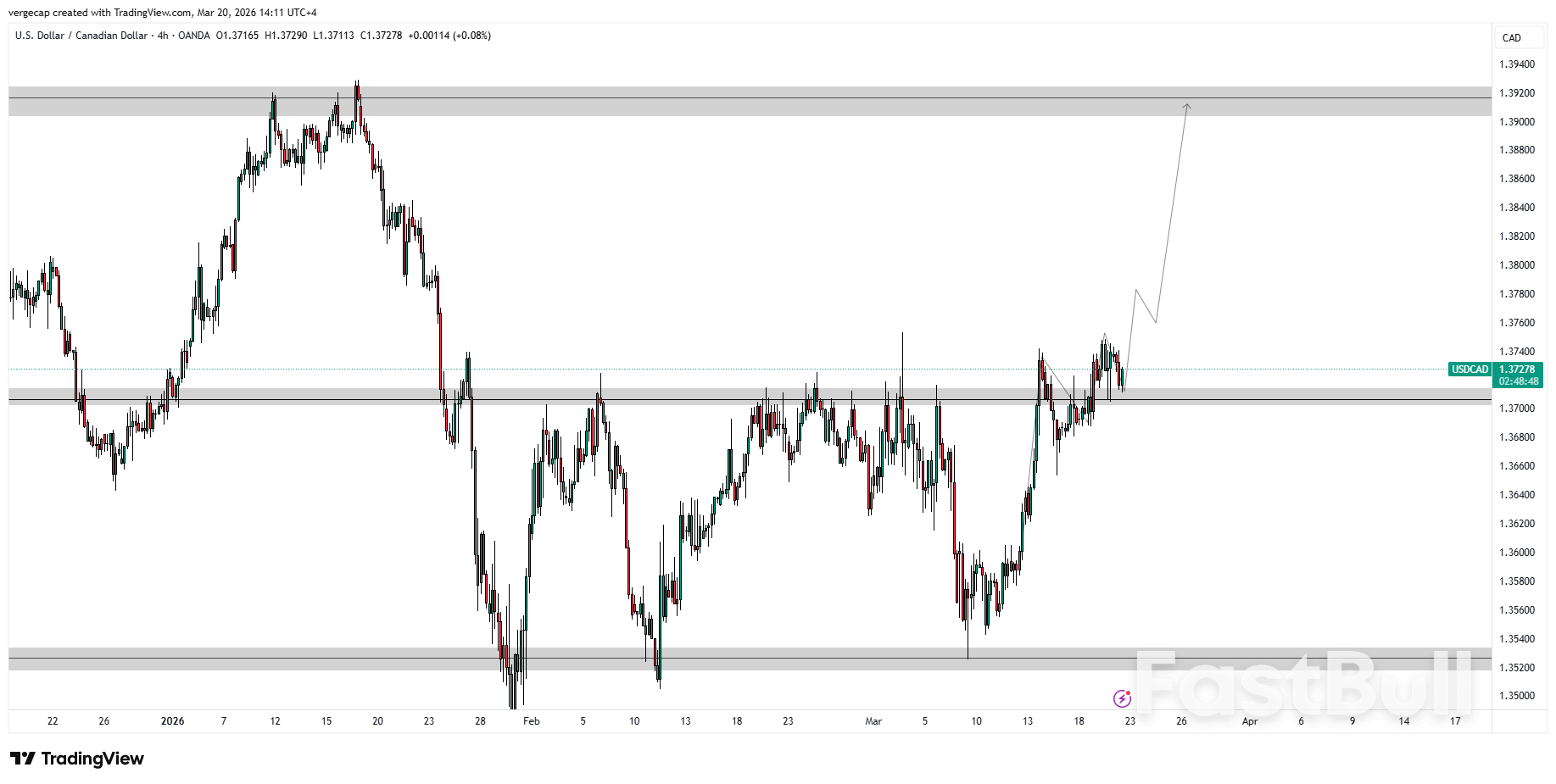
From a technical perspective, USD/CAD remains in a developing bullish structure following a range-bound consolidation phase. On the 4-hour chart, price action has recently broken above a well-defined horizontal resistance zone around 1.3700–1.3720, which had repeatedly capped upside attempts throughout March. This breakout suggests a shift in market structure from neutral to bullish, with price now attempting to establish acceptance above this former resistance-turned-support region.
In the near term, price is hovering just above this breakout zone, indicating a potential retest scenario. While minor rejection wicks are visible, they have not yet invalidated the breakout. This behavior is typical of early-stage trend continuation, where the market consolidates before the next impulsive leg higher.
Although moving averages are not explicitly shown, price structure indicates alignment with short-term bullish momentum. The recent series of higher lows and higher highs reinforces this bias, particularly after the strong impulsive move from the 1.3550–1.3600 demand zone. That region now stands as a key structural support base. A sustained move back below 1.3700, however, would weaken the breakout narrative and expose the pair to a deeper pullback toward 1.3600, with further downside risk extending to 1.3520–1.3550 if selling pressure accelerates.
On the upside, bullish continuation remains the preferred scenario as long as price holds above the breakout zone. A clean and sustained push above the recent highs near 1.3750 would confirm continuation and likely trigger momentum buying. This would open the path toward 1.3850, followed by a test of the major resistance zone near 1.3900–1.3920, which aligns with prior swing highs and represents a key target area.
Momentum-wise, price action suggests consolidation rather than exhaustion. The market is digesting recent gains after a strong bullish impulse, which typically precedes continuation if support holds. The projected path on the chart also supports a scenario of a brief pullback followed by a strong bullish expansion toward higher resistance levels.
TRADE RECOMMENDATION
BUY USD/CAD
ENTRY PRICE: 1.3725
STOP LOSS: 1.3660
TAKE PROFIT: 1.3900


