USD/CAD is testing session lows just below 1.3650 on Wednesday following Tuesday's rejection at 1.3675, drifting within a range that reflects a market too uncertain to commit to a direction and too anxious to ignore what is unfolding in the Strait of Hormuz.
Let us be clear about what is happening in the Middle East, because the diplomatic language surrounding this conflict is obscuring a dangerous operational reality. The Associated Press reported at least one Iranian attack on vessels attempting to transit the Strait of Hormuz — an act of direct military aggression that occurred while the ceasefire was technically still in force. The Islamic Revolutionary Guard Corps simultaneously threatened "crushing blows" against American assets in the region, stripping away any pretense that Tehran is engaging the peace process in good faith.
Trump responded not through mutual agreement but through a unilateral ceasefire extension, conditional on Iran delivering a unified proposal to end hostilities. Meanwhile, the US military maintains its blockade of Iranian ports — which Tehran has characterised as an act of war and a ceasefire violation. Both sides are simultaneously claiming to want peace while behaving as though conflict is inevitable. Markets have noticed.
For USD/CAD, the impact flows primarily through oil. Canada's deep structural ties to crude prices mean that Hormuz-driven energy disruption should support the Loonie — but the same geopolitical forces generating oil's risk premium are simultaneously driving safe-haven Dollar demand. The two forces cancel each other out, producing the rangebound price action the chart has been displaying all week.
Tuesday's confirmation hearing of Kevin Warsh before the Senate Banking Committee delivered the one thing markets most needed: clarity on Fed independence. Warsh stated unambiguously that he has no deal with President Trump and defended the central bank's monetary policy autonomy without hedging. For a market that had been quietly terrified about the prospect of a politically captured Federal Reserve, those assurances provided genuine relief and helped underpin the Dollar following the hearing.
The Dollar also received support from March Retail Sales data released earlier Tuesday — a 1.7% month-on-month increase that beat the 1.4% consensus and confirmed that the US consumer, despite elevated energy costs and geopolitical uncertainty, remains in robust spending form. Strong consumption plus a credibly independent incoming Fed Chair is a supportive combination for the Greenback, and it explains why USD/CAD found a floor above 1.3600 even as the broader bearish pressures from the geopolitical environment continued to weigh.
On the domestic front, Canadian CPI data released earlier this week confirmed the inflationary fingerprints of the Iran conflict but came in below market expectations — providing the Bank of Canada with the one thing it values most in an uncertain environment: time. The undershoot grants the BoC room to remain on hold and assess incoming data rather than being forced into a reactive tightening decision in response to energy-driven price pressures it cannot directly control. The Canadian Dollar registered a moderate positive response — enough to keep the Loonie supported near current levels but not enough to trigger any aggressive directional move in USD/CAD.
Technical Analysis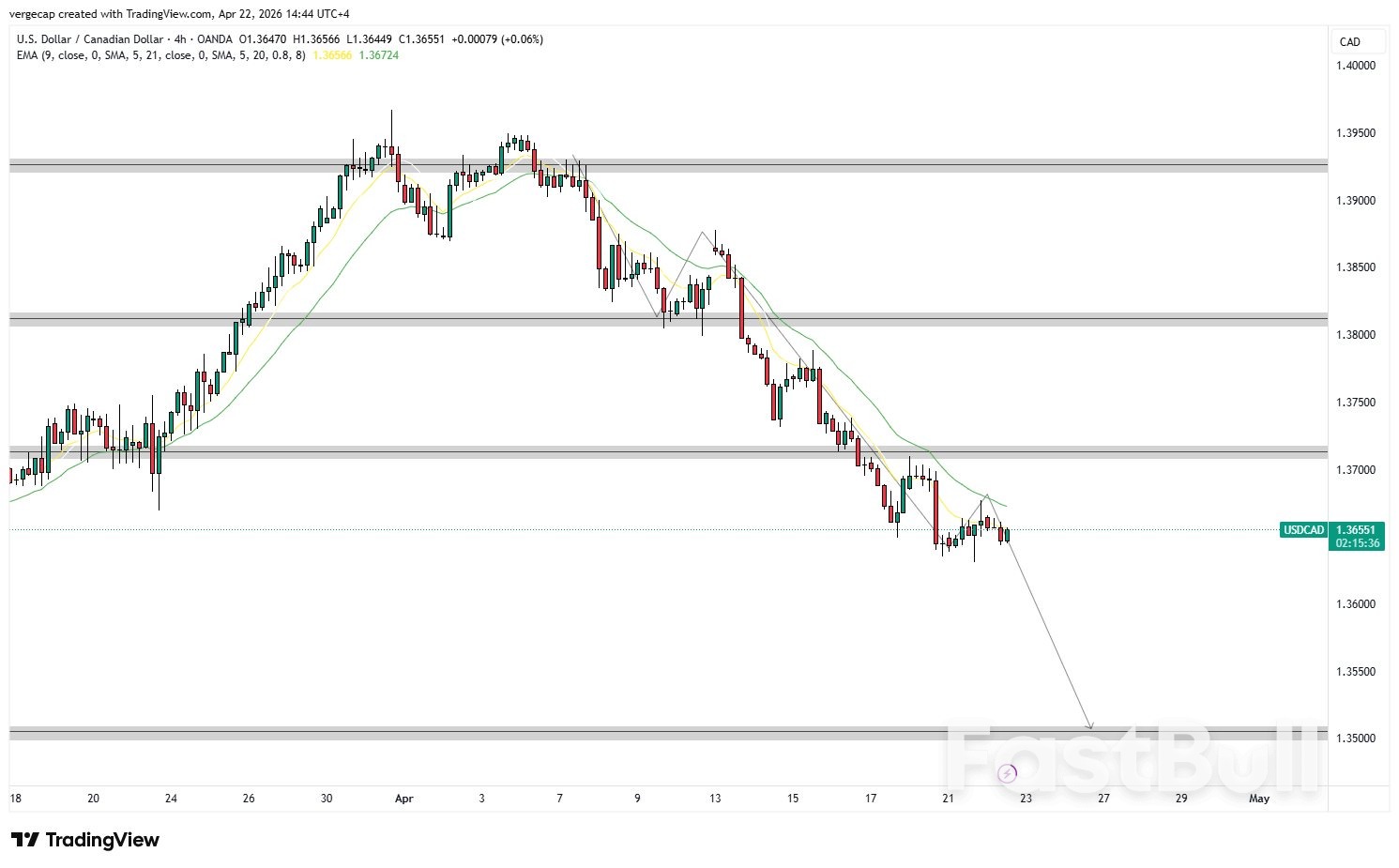
From a technical perspective, USD/CAD is deeply entrenched within a well-defined bearish structure on the 4-hour chart, and the weight of evidence accumulated since the early April highs leaves little room for debate regarding the pair's directional bias. Having peaked near the 1.3950 major resistance ceiling in late March and again in early April — a level that proved an insurmountable barrier across multiple attempts — the pair has since undergone a sustained, orderly, and increasingly confident decline that has now erased the entirety of the preceding bullish advance. Price currently trades at 1.36551, and the technical architecture of the chart strongly suggests this deterioration has further to run.
The moving averages confirm the bearish case with clinical precision. Both the 9-period EMA at 1.30566 and the 21-period SMA at 1.36724 are positioned above current price and sloping decisively lower — a bearish stack formation that has been in place since the rollover from the April highs. This configuration, where price trades beneath both short and medium-term averages while those averages converge overhead as resistance, is one of the most reliable continuation signals available on an intraday chart. Each attempted recovery during the current decline has found a ceiling precisely at these moving averages before rolling back lower — a textbook sequence of lower highs that confirms sellers are using every bounce as a fresh opportunity to extend their short exposure.
The 1.3700 level — a dotted horizontal reference visible on the chart — served as a brief consolidation zone during the mid-April corrective bounce and now represents the first meaningful resistance overhead. The pair's inability to sustain any meaningful recovery above 1.3700 on a closing basis is technically significant, confirming that the area has cemented itself as near-term supply. Any recovery attempt that stalls in the 1.3680–1.3720 zone should be treated as a continuation of the existing bearish sequence rather than evidence of genuine trend reversal.
The 1.3640–1.3650 zone represents the immediate battleground. Price has been consolidating in this region over the past several sessions, compressing into a tight range that typically precedes a directional resolution. The projected path drawn on the chart is unambiguous — a breakdown below 1.3640 would confirm the consolidation has resolved to the downside and trigger the next meaningful leg lower. The primary downside target visible on the chart projection points toward the 1.3500 major horizontal support band — a level of substantial structural significance that provided a strong floor during the mid-March period and represents a measured move consistent with the scale of the decline already in motion.
A sustained break below 1.3500 would represent a genuinely significant structural deterioration, opening the path toward the 1.3450 area and signalling that the broader bearish trend has entered a more aggressive phase. On the upside, a clean 4-hour close above the 21-period SMA near 1.3672 would be the minimum technical requirement to suggest the bearish momentum is fading — anything short of that should be treated as noise within the prevailing downtrend.
The overall structure — a rounded top formation between the 1.3800 and 1.3950 resistance bands, followed by a clean impulsive decline guided by declining moving averages — is one of the most bearish chart patterns available, and it has been executing with textbook precision since the April 7 breakdown.
TRADE RECOMMENDATION
SELL USD/CAD
ENTRY PRICE: 1.3660
STOP LOSS: 1.3740
TAKE PROFIT: 1.3500


