Fundamentals
Since today's open, the USD/CAD exchange rate has remained elevated above the 1.42 mark, trading between 1.4214 and 1.4232 and extending its solid upward momentum from the past four weeks. Driven by this rally is a stark divergence between the US and Canada in terms of economic fundamentals, monetary policy expectations, and geopolitical risks.
The Canadian dollar is experiencing a "triple squeeze." First, trade friction has intensified sharply. With the formal implementation of US import bans on Canadian goods such as alcoholic beverages and motorcycles, the shadow of collapsed bilateral trade negotiations looms over the market. S&P Global data shows that Canada’s manufacturing PMI dropped to 51.5 in September—a six-month low—with the new orders index falling below 50 for the first time since March, signaling that trade uncertainty is actively dampening demand and production momentum. Second, surging energy costs are squeezing corporate profit margins; the manufacturing input cost index reached its highest level since 2022, further eroding industrial resilience. Finally, monetary policy expectations have turned dovish. Given flat month-on-month GDP growth in July and weakening manufacturing activity, the market sees little reason for the Bank of Canada to rush into rate hikes. This cautious policy stance has widened the US-Canada yield differential, diminishing the appeal of CAD-denominated assets.
Meanwhile, the US dollar enjoys multi-faceted support. On one hand, despite expectations of a slowdown in September US non-farm payrolls, persistent inflation concerns fueled by rising energy prices have kept US Treasury yields elevated, reinforcing the greenback's yield advantage. On the other hand, the geopolitical risk premium has returned. Frequent attacks on oil tankers in the Strait of Hormuz, coupled with expectations of potential US military escalation in the Middle East, have heightened safe-haven sentiment in crude markets. While oil price volatility would theoretically benefit the Canadian dollar as a commodity currency, in the current context, geopolitical tensions are translating primarily into safe-haven flows into the US dollar. Furthermore, market skepticism over the sustainability of supply recovery makes it difficult for the Loonie to gain an effective hedge purely from a rebound in crude prices.
Overall, driven by the combined forces of trade headwinds, yield disadvantages, and geopolitical safe-haven demand, USD/CAD is poised for further gains with strong downside support in the short term.
Technical Analysis
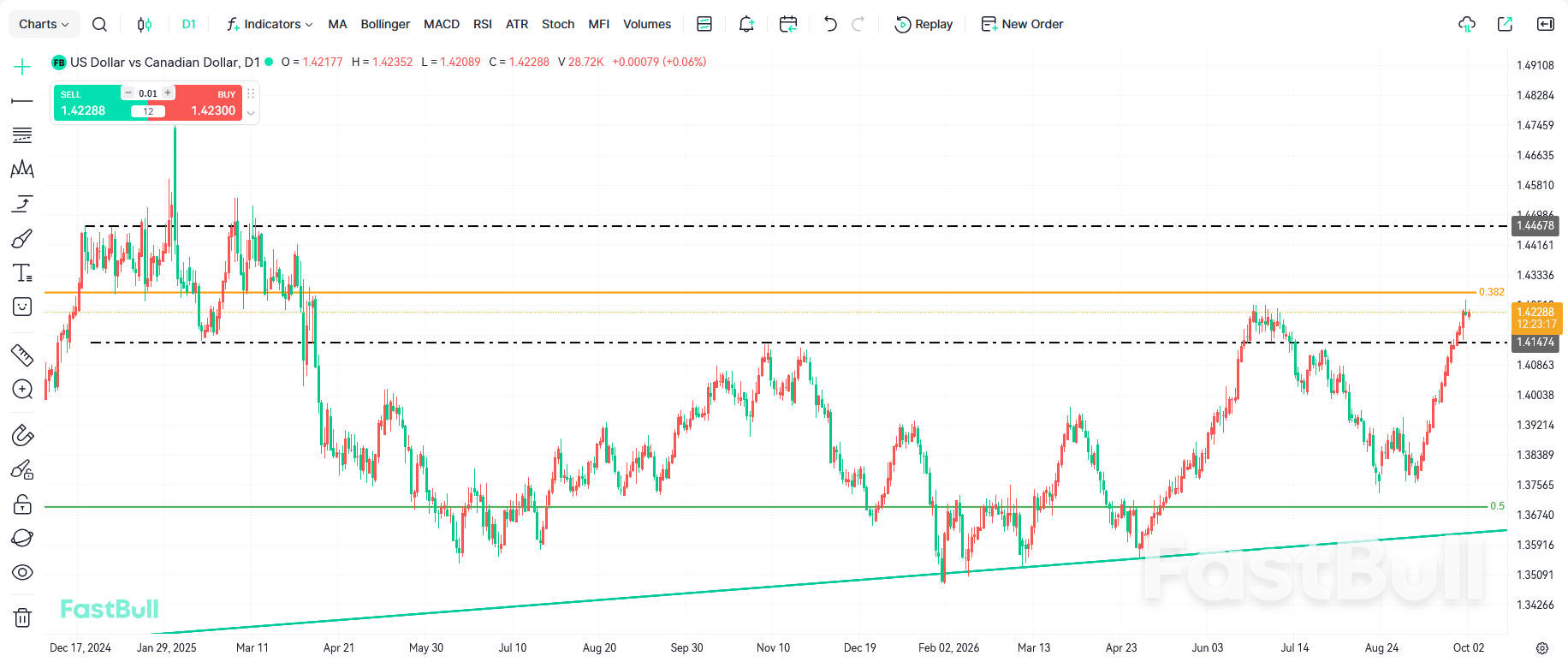
On the daily chart, USD/CAD is currently in the main bullish wave along a long-term ascending support line. After decisively breaking above the former horizontal neckline resistance at 1.41474, price action continues to move upward, currently testing the 0.382 Fibonacci retracement level (around the 1.433–1.435 zone) and the previous high resistance band, exhibiting a strong bullish offensive momentum. Below, key support is anchored by the broken resistance-turned-support level at 1.41474, along with the solid foundation formed by the 0.5 Fibonacci retracement level (near 1.36740) and the major ascending trendline. Above, key resistance lies at 1.43336 (0.382 Fibonacci level). A valid breakout above this level would open an upside channel toward the previous high of 1.44678 and beyond. USD/CAD has firmly established itself above the 1.41474 base, though further observation is required to see whether it can directly clear the 0.382 resistance zone to extend its uptrend.
In terms of indicators, the long-term ascending trendline maintains a steady upward slope, with higher lows forming in the price structure, indicating that buyers remain dominant over the medium to long term. The current price (1.42288) continues to trade in the recent high range, with long daily bullish candles extending smoothly and displaying ample upward momentum. Although the pair may face profit-taking pressure near the 1.43336 (0.382 Fibonacci) resistance level, the strong support platform now established at 1.41474 makes it highly likely that USD/CAD will stabilize after a retest of the 1.41500–1.42000 zone and align with the primary trend to push toward 1.43336 and 1.44678.
Trading Recommendations
Direction: Long
Entry: 1.41800
Target: 1.43300
Stop Loss: 1.41000
Support Levels: 1.41474, 1.36740
Resistance Levels: 1.43336, 1.44678


