The US Dollar continued to lose ground against the Canadian Dollar on Friday, with USD/CAD falling to its lowest level since September 16 during the Asian session. The pair has now declined for three consecutive trading days and remains on course for a third straight weekly loss. Although a modest retreat in crude oil prices has allowed the exchange rate to recover slightly from its lows near the mid-1.3900s, the broader pressure on the Greenback continues to favour the Canadian currency.
A combination of improving diplomatic prospects in the Middle East and falling US Treasury yields has undermined demand for the Dollar. Hopes of renewed negotiations between Washington and Tehran have gained attention following reports that US Vice President JD Vance sent a letter to Iran's Supreme National Security Council secretary, Mohsen Rezaei, seeking to restart peace discussions. Qatar has also reportedly presented Iran with a fresh draft proposal aimed at resolving the conflict. These developments have encouraged some investors to reduce their exposure to the US currency.
At the same time, concerns surrounding technology-sector earnings have contributed to demand for government bonds. Questions over whether substantial artificial intelligence investment will generate sufficient returns have unsettled equity-market sentiment, prompting investors to seek safer assets. The resulting decline in US bond yields has added another source of pressure on the Greenback, reinforcing the recent downward movement in USD/CAD.
Nevertheless, the geopolitical outlook remains uncertain. Continued hostilities involving the Iran-backed Houthi group and Saudi Arabia, alongside threats from the US and Israel to resume attacks after the US midterm elections, are keeping geopolitical risks elevated. These tensions could quickly revive demand for traditional safe-haven assets, including the US Dollar. Furthermore, expectations that the Federal Reserve will deliver another interest rate increase in December are providing some underlying support. Recent US economic figures have pointed to resilient activity and persistent inflation, while elevated oil prices continue to raise concerns about further inflationary pressure.
The Canadian Dollar, meanwhile, has received additional support from the Bank of Canada's unexpectedly hawkish shift. The central bank raised interest rates on Wednesday for the first time since July 2023, changing the monetary policy outlook and making it more difficult for traders to confidently position for a sustained recovery in USD/CAD. This policy divergence is becoming an important consideration for the pair, particularly as expectations of further Fed tightening compete with the BoC's renewed willingness to raise borrowing costs.
Attention now turns to Canada's monthly GDP report and upcoming remarks from influential Federal Open Market Committee members. Stronger Canadian growth could reinforce demand for the Loonie, while hawkish comments from Fed officials may offer the Dollar some relief. For now, the broader momentum remains tilted to the downside, although developments in crude oil prices and Middle East diplomacy could introduce fresh volatility and interrupt the pair's recent decline.
Technical Analysis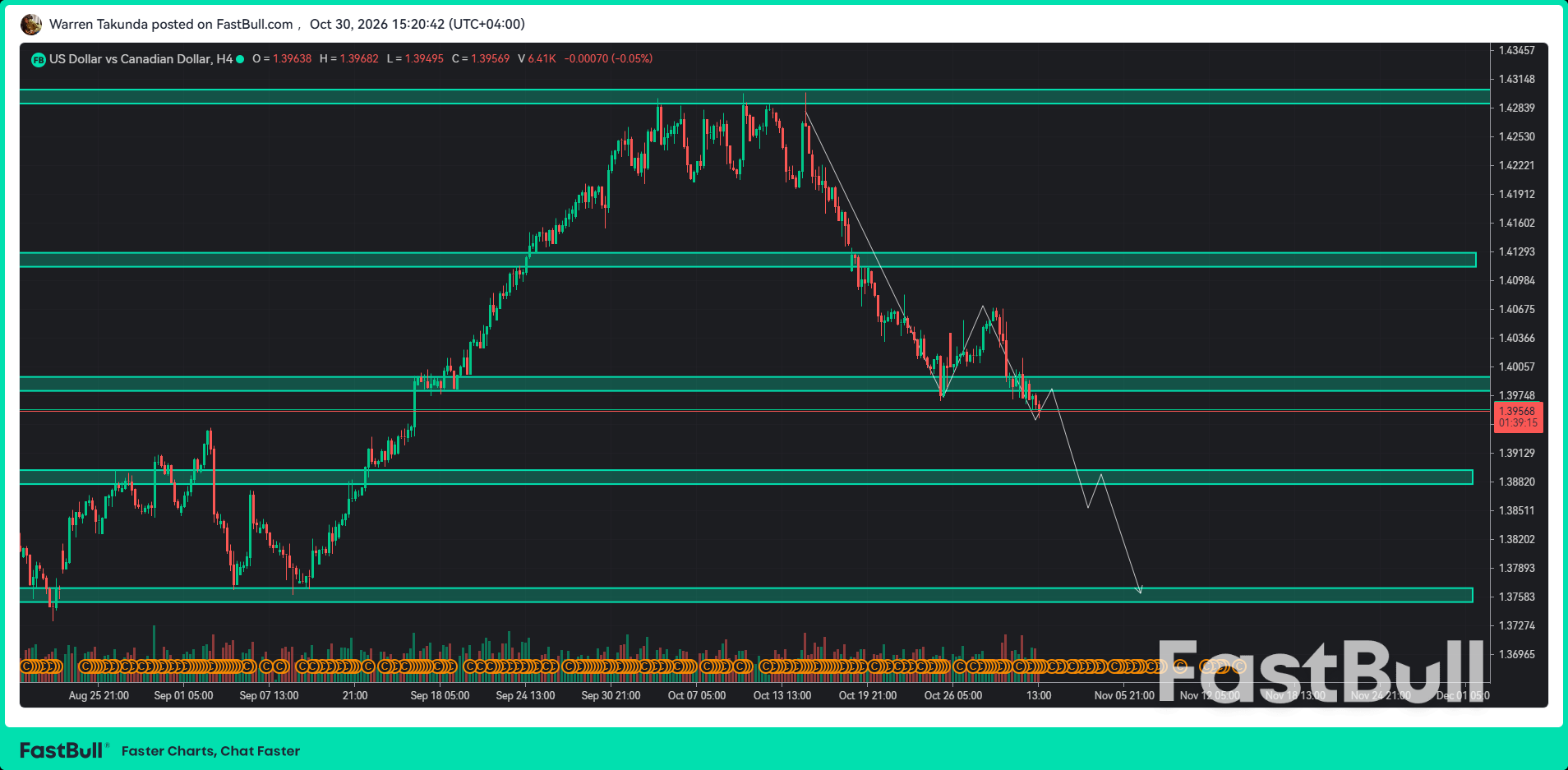
USD/CAD is trading near 1.3957 after breaking below the 1.3979-1.3994 demand zone and the 1.3973 swing low, its weakest level since mid-September. The pair has fallen about 350 pips from the 1.4293-1.4302 triple top in under three weeks, in a steady sequence of lower highs (1.4128, 1.4068) and lower lows. The bounce from 1.3973 to 1.4068 retraced less than a third of the prior leg, which is typical of trend continuation. The break also takes price through the 61.8% retracement of the September-October rally (about 1.3970), which held on the first test.
The immediate focus is on the 1.3979-1.3994 zone, which should now act as supply. A decisive H4 close below 1.3979, or a failure to reclaim it, could strengthen bearish momentum and open the door toward the 1.3895-1.3879 zone, which also matches the 78.6% retracement of the rally (about 1.3882). If sellers maintain control, the pair could extend toward the 1.3767-1.3752 zone, the origin of the September rally, in line with your projected path.
However, the pair remains vulnerable to a squeeze if it reclaims the broken zone. A move back above 1.3994 could trigger a rebound toward 1.4010-1.4068, while a deeper correction could bring the 1.4112-1.4128 zone into focus. A close above 1.4015 would weaken the bearish scenario, and a break above 1.4068, the last lower high, would invalidate it.
Overall, USD/CAD has a cautiously bearish short-term outlook, with a sustained break below 1.3950 needed to confirm further downside toward 1.3895-1.3879 and then 1.3767. Until that breakdown occurs, the pair could still stage a corrective retest of the broken zone within the broader pullback from the 1.4301 top.
TRADE RECOMMENDATION
SELL USD/CAD
ENTRY PRICE: 1.39580
STOP LOSS: 1.4100
TAKE PROFIT: 1.3895


