The U.S. dollar continued to strengthen against the Canadian dollar on Thursday, extending its advance for a fifth consecutive session and pushing USD/CAD to its highest level in nearly four weeks around 1.3888. The move reflects a convergence of macroeconomic caution, commodity-market weakness and relative policy expectations that have tilted the balance firmly in favor of the greenback in the short term.
A mild risk-off tone across global markets has underpinned demand for the U.S. dollar as a safe-haven currency, while the Canadian dollar has struggled to find support amid persistent softness in crude oil prices. As a major oil exporter, Canada remains particularly sensitive to energy market dynamics, and this week’s price action has done little to alleviate pressure on the Loonie. Although benchmark WTI crude rebounded modestly from Wednesday’s lows, it remains almost one percent lower on the week, reinforcing the negative terms-of-trade impulse for Canada.
Adding to oil’s headwinds, fresh concerns have emerged over potential supply increases at a time when global demand growth remains uncertain. U.S. President Donald Trump’s announcement that Venezuela is set to deliver between 30 million and 50 million barrels of oil to the United States has revived fears of excess supply. In a macro environment already characterized by slower global growth and fragile demand expectations, such developments have weighed heavily on crude prices, indirectly amplifying downside risks for the Canadian dollar.
On the U.S. side, recent macroeconomic signals have been mixed but broadly supportive of the dollar relative to its peers. Employment data released earlier this week pointed to a labor market that is no longer accelerating, with hiring momentum appearing to stall. At the same time, activity in the U.S. services sector surprised to the upside, indicating that domestic demand remained resilient toward the end of 2025. This combination suggests that while the U.S. economy may be cooling at the margin, it is still outperforming many developed-market counterparts, including Canada.
Despite the dollar’s recent strength, investors have shown reluctance to take aggressive directional positions ahead of Friday’s closely watched U.S. Nonfarm Payrolls report. The data will be scrutinized for clues on both the timing and depth of the Federal Reserve’s anticipated easing cycle. A clear deterioration in labor market conditions would strengthen the case for earlier rate cuts, potentially capping further upside in the dollar. Conversely, another display of resilience could allow USD/CAD to consolidate or extend gains, particularly if risk sentiment remains fragile.
Canada’s economic calendar has offered fewer catalysts this week, leaving the currency largely at the mercy of external drivers such as oil prices and U.S. dollar flows. International Merchandise Trade data may provide some short-term guidance, but the main focus will be Friday’s Canadian employment report. Expectations are already subdued, with forecasts pointing to a decline in net job creation and a slight uptick in the unemployment rate. Such an outcome would reinforce the view that the Canadian economy is losing momentum, increasing the likelihood that the Bank of Canada will remain cautious and potentially dovish in the months ahead. From a risk-reward perspective, the balance of risks appears skewed toward further CAD weakness if the data underwhelm.
Technical Analysis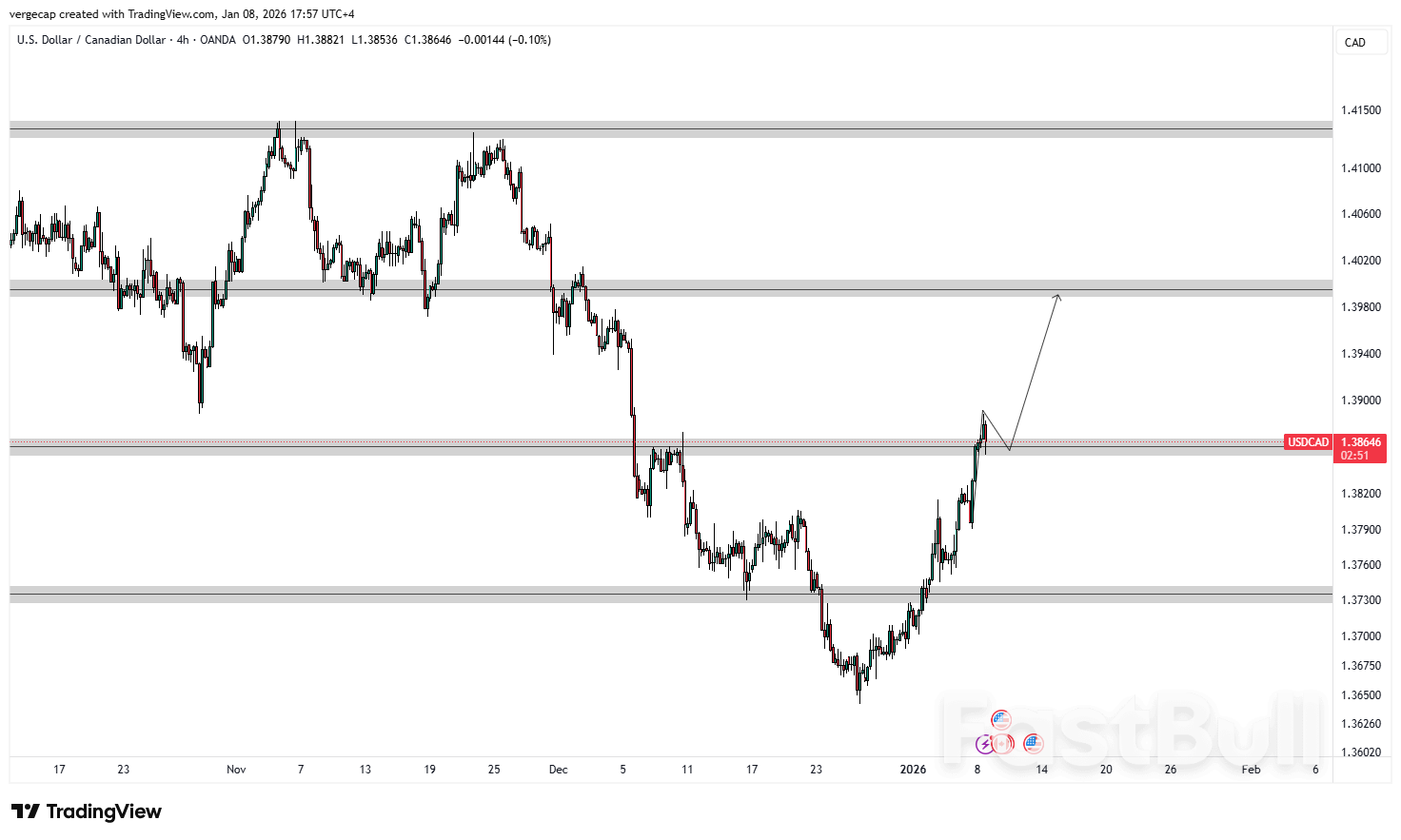
From a technical standpoint, USD/CAD’s price action continues to favor the bulls, at least in the near term. The pair has extended its gains during intraday trading, pressing above the previously identified resistance area around 1.3865, which had been highlighted as a key upside target in earlier analyses. Sustained trading above the 50-period exponential moving average confirms the presence of dynamic support, while the broader short-term structure remains defined by a corrective bullish wave. Momentum indicators are flashing positive signals despite approaching overbought territory, suggesting that upside pressure remains intact, though increasingly vulnerable to corrective pullbacks.
Looking ahead, the next technical hurdles are clustered around the psychological 1.3900 level, followed by resistance near 1.3990 and a more significant ceiling in the 1.4140 region. A decisive break above 1.3900 would strengthen the bullish case and potentially open the door for a move toward the upper end of this range.
TRADE RECOMMENDATION
BUY USDCAD
ENTRY PRICE: 1.3860
STOP LOSS: 1.3790
TAKE PROFIT: 1.4140


