The US Dollar Index (DXY) edged modestly higher during a subdued year-end trading session on Wednesday, but the tentative uptick did little to alter the broader bearish narrative that has defined the greenback’s performance throughout 2025. After briefly touching an intraday high of 98.44, the index surrendered most of its gains and was last seen hovering near 98.25 as the US session got underway, reflecting thin liquidity and cautious positioning into the final trading days of the year.
Measured against a basket of six major currencies, the dollar remains firmly below its November peak of 100.40, marking a decline of roughly 2% from that high. More strikingly, the index is on course for an almost 10% annual loss, its worst yearly performance in eight years. That underperformance places the US Dollar among the weakest currencies in the G8 complex in 2025, a notable reversal from the resilience it displayed during previous tightening cycles.
Investor sentiment toward the greenback has steadily deteriorated over the course of the year, driven by a convergence of political, economic, and monetary policy concerns. Markets have increasingly priced in the negative implications of President Donald Trump’s unpredictable trade stance, which has reintroduced uncertainty around tariffs, global supply chains, and the outlook for US growth. At the same time, mounting evidence of a slowing domestic economy has encouraged traders to add to short dollar positions, particularly against currencies backed by more stable policy frameworks.
Adding to the pressure has been the growing perception of political interference in US monetary policy. Repeated and highly publicized calls for lower interest rates have raised uncomfortable questions about the Federal Reserve’s independence. For global investors, this erosion of institutional credibility has been more than a domestic issue—it has fed into broader doubts about the long-term appeal of the US Dollar as the world’s dominant reserve currency. While such a status is unlikely to be challenged abruptly, even incremental shifts in confidence can have material consequences in FX markets.
From a policy standpoint, the Federal Reserve finds itself in an increasingly awkward position. The central bank is still navigating the middle phase of its easing cycle at a time when many of its global peers appear to have reached, or are very close to, terminal rates. This divergence has deprived the dollar of a key source of support, as narrowing yield differentials reduce the incentive for international capital to flow into US assets. In my view, this dynamic represents one of the most persistent headwinds for the greenback and suggests that any meaningful recovery will be difficult to sustain into 2026 unless US growth materially re-accelerates.
Liquidity conditions remain thin in the final sessions of the year, limiting the scope for large directional moves. Nevertheless, the upcoming US weekly Jobless Claims data could provide a final catalyst for FX markets. Initial claims are expected to rise to around 220,000 for the week ending December 16, up from 214,000 previously. While not alarming in isolation, a softer labor signal would reinforce the narrative of economic cooling and could further tilt risks to the downside for the dollar.
Technical Analysis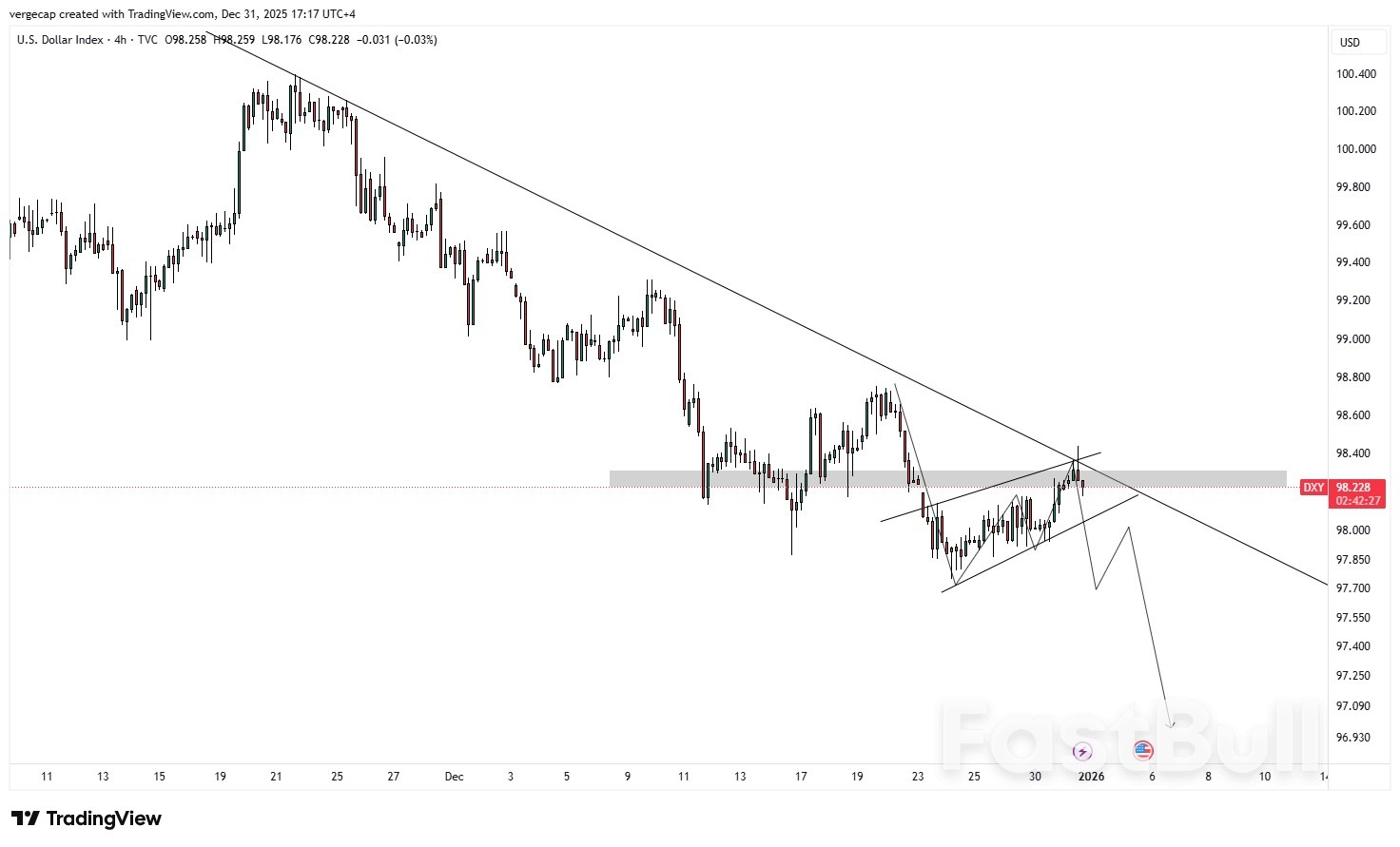
From a technical perspective, the DXY remains entrenched in a bearish structure. The index has respected a descending resistance line, failing to reclaim key premium levels after buy-side liquidity was already cleared. This price behavior favors continuation lower, with attention turning toward areas of resting sell-side liquidity beneath current levels. The index is currently reacting near the pivot at 98.16, which now acts as pullback resistance and raises the risk of a reversal toward the first support zone at 97.54. Initial resistance is seen at 98.62, a level that would need to be decisively cleared to challenge the prevailing downtrend.
Looking ahead, even in the event of a corrective bounce, the broader technical landscape remains hostile for dollar bulls. A reverse trendline—now acting as resistance—stands as a formidable barrier, and a sustained move beyond it would be required to reopen the path toward the December highs and beyond. Until then, rallies are likely to be viewed as selling opportunities rather than the start of a durable recovery.
TRADE RECOMMENDATION
SELL DXY
ENTRY PRICE: 98.20
STOP LOSS: 98.62
TAKE PROFIT: 97.54


