The Australian Dollar is under fierce selling pressure this Thursday, sliding 0.75% to trade near the 0.6875 handle against the US Dollar during the European session, as a dramatic overnight reversal in geopolitical sentiment stripped away any lingering hopes of a swift end to the Middle East conflict and sent investors scrambling for the safety of the US Dollar and other haven assets.
The mood across financial markets turned decisively sour in the early hours of Asian trading after US President Donald Trump delivered a stark and combative address to the nation, threatening to dramatically escalate military operations against Iran within the next two to three weeks. In characteristically blunt language, Trump warned of obliterating Iranian electricity infrastructure if a diplomatic agreement fails to materialize, declaring to a watching world: "We are going to hit them extremely hard over the next two to three weeks, and bring them back to the stone ages." The remarks landed like a wrecking ball on market sentiment, which had only just begun to stabilize following encouraging signals out of Tehran on Wednesday.
Indeed, just 24 hours earlier, global markets had breathed a cautious sigh of relief after Iran — for the first time since hostilities broke out — signaled a readiness to explore talks aimed at ending the war. That rare moment of diplomatic openness had briefly revived risk appetite, lifted equities, and nudged the Australian Dollar off its lows. But Thursday's presidential broadside has emphatically reversed those gains, reminding traders of a painful truth that has defined this conflict from the outset: in this geopolitical environment, optimism has a very short shelf life.
As a financial reporter who has watched this saga unfold session by session, what strikes me most is not the volatility itself — markets have long priced in the uncertainty — but the speed at which sentiment can pivot from cautious hope to outright fear. Wednesday's ceasefire whispers gave risk assets just enough oxygen to rally, only for Thursday's war drums to snatch it away. This kind of whiplash is deeply unsettling for institutional positioning, and the consequences are playing out clearly across asset classes.
S&P 500 futures have dropped more than 1% in European trade, reflecting a broad-based retreat from risk-sensitive exposures. For the Australian Dollar — a currency that has long served as a liquid proxy for global risk appetite and commodity demand — the implications are particularly acute. The AUD is structurally vulnerable in this environment: it offers little in the way of safe-haven characteristics, it is deeply sensitive to swings in global growth expectations, and Australia's commodity-driven export base faces headwinds as energy price volatility clouds the demand outlook from key trading partners.
The US Dollar, meanwhile, is surging with renewed purpose. The US Dollar Index (DXY), which measures the Greenback against a basket of six major currencies, climbed 0.6% to trade near 100.15 during the session — a move that reflects not just safe-haven demand but also a recalibration of Federal Reserve rate expectations. A stronger Dollar environment, fueled by geopolitical fear premiums and risk-off capital flows, acts as a structural headwind for the AUD/USD pair and limits the scope for any meaningful near-term recovery without a fundamental shift in the conflict narrative.
Looking ahead, the focus for global currency and equity markets will pivot sharply to Friday's release of the US Nonfarm Payrolls report for March — arguably the single most important piece of economic data on the calendar right now. With Federal Reserve policymakers navigating the twin pressures of sticky inflation and softening labor market signals, the NFP print carries outsized significance for the interest rate outlook. A robust jobs number could reinforce the Fed's patient, data-dependent stance, providing further lift to the Dollar and extending the pain for risk currencies like the Australian Dollar. Conversely, a weak reading would reignite rate cut speculation, potentially triggering a sharp short-covering rally in AUD/USD — though even that scenario may be tempered by geopolitical headwinds that show no sign of abating.
Technical Analysis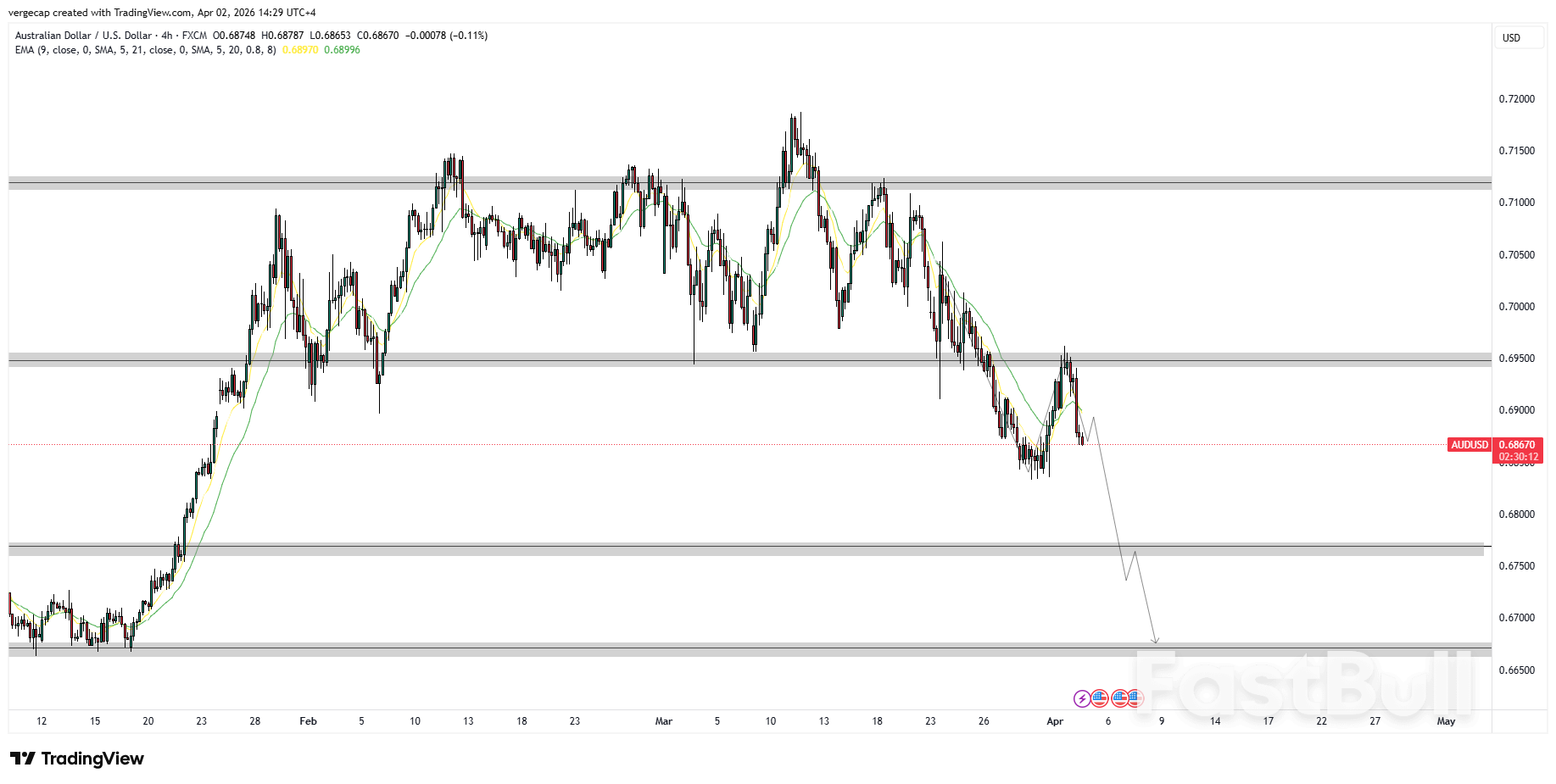
From a technical perspective, AUD/USD has undergone a decisive bearish structural shift on the 4-hour chart, and the price action over recent sessions leaves little room for bullish interpretation under current conditions. After staging an impressive rally from the 0.6650 lows in mid-January all the way to the 0.7150–0.7200 resistance ceiling by mid-March — a recovery of approximately 550 pips — the pair has since entered a sustained and accelerating downtrend that has now erased the majority of those gains.
The 9-period EMA, currently plotted at 0.6897, and the 21-period SMA, sitting at 0.6900, have both crossed above the current price and are now acting as dynamic resistance rather than support — a clear inversion of their prior supportive role during the January-to-March uptrend. Both averages are sloping downward, and price is trading comfortably beneath this combined resistance layer, confirming that the short and medium-term momentum structure is firmly bearish. Any attempted recovery that stalls beneath the 0.6897–0.6900 region should be treated as a re-entry opportunity for fresh short positions rather than evidence of trend reversal.
The 0.6950 zone — a former key support level that propped up the pair during multiple tests in late March — has now been convincingly broken to the downside and converted into resistance. This structural flip is technically significant: it establishes a clear ceiling for any near-term bounce and reinforces the sequence of lower highs that has characterized the pair's decline from the 0.7150 peak. A recovery attempt toward 0.6950 that produces a lower high and bearish rejection candle would represent a textbook shorting opportunity within the prevailing downtrend.
Immediate downside support is found at the 0.6865–0.6875 region, where price is currently consolidating. This level has provided a modest floor in recent sessions, but it does not appear to be a structurally robust zone — it lacks the historical significance of deeper support levels and is likely to give way under sustained selling pressure. A confirmed 4-hour close below 0.6865 would open up a test of the 0.6750 horizontal support band, which corresponds to a prior consolidation zone from February 2026. Below that, the measured move projection drawn on the chart — consistent with the depth of the prior breakdown — points toward the 0.6650–0.6665 region, the pair's January 2026 multi-month low and the most critical long-term support level on the chart. A sustained break below 0.6650 would represent a significant technical deterioration and signal that the entire January-to-March recovery has been fully retraced.
The moving average configuration leaves no ambiguity about the prevailing trend. With both the 9 EMA and 21 SMA above price, trending downward, and offering no dynamic support to the current decline, the path of least resistance remains unambiguously to the downside. There is no bullish divergence visible in the price action, no meaningful accumulation pattern forming at current levels, and no technical reason to position against the prevailing trend in the absence of a fundamental shift in either the geopolitical narrative or the US Dollar outlook.
TRADE RECOMMENDATION
SELL AUD/USD
ENTRY PRICE: 0.6865
STOP LOSS: 0.6965
TAKE PROFIT: 0.6660


