European officials have warned about the possibility of increased Russian drone and missile operations, as well as sabotage and cyber activities targeting NATO countries that continue to support Ukraine in the coming months. The latest warning came on Friday from French President Emmanuel Macron, who stated that the hybrid threat posed by Russia to both France and Europe has intensified in recent months.
Meanwhile, geopolitical tensions in the Middle East remain elevated. Iran-backed Houthi forces in Yemen claimed on Saturday that they had launched missile and drone attacks against sensitive sites in Riyadh, the capital of Saudi Arabia. At the same time, Iran outlined seven conditions for resuming negotiations with the United States, highlighting the continued uncertainty surrounding the region.
In Europe, the European Central Bank (ECB) warned that inflationary pressures could persist for longer than previously expected, reinforcing expectations that monetary policy may need to remain restrictive for an extended period.
ECB President Christine Lagarde reiterated that future interest rate decisions will remain dependent on incoming economic data and will continue to be assessed on a meeting-by-meeting basis rather than following a predefined path.
Political developments in Germany also remained in focus. The far-right continued to gain ground after securing victory in Mecklenburg-Vorpommern against the center-right CDU. While the Alternative for Germany (AfD) dealt a significant setback to Chancellor Friedrich Merz’s political bloc, it failed to secure a victory in Berlin, where the left-wing party Die Linke emerged as the leading force for the first time.
In Canada, the Bank of Canada left its benchmark interest rate unchanged at 2.25% during its September meeting, a decision that was widely expected by markets. However, policymakers emphasized that inflation risks have increased, while newly introduced tariffs have made the economic growth outlook more uncertain. Financial markets currently assign nearly a 60% probability to a Bank of Canada rate increase at its next policy meeting on October 28.
Oil prices have struggled to extend recent gains after reports indicated that Saudi Arabia expects to restore part of the capacity of its East-West pipeline within days following recent drone attacks on the infrastructure. Given Canada's role as a major oil exporter, developments in the energy market continue to play an important role in shaping expectations for the Canadian dollar.
Technical Analysis
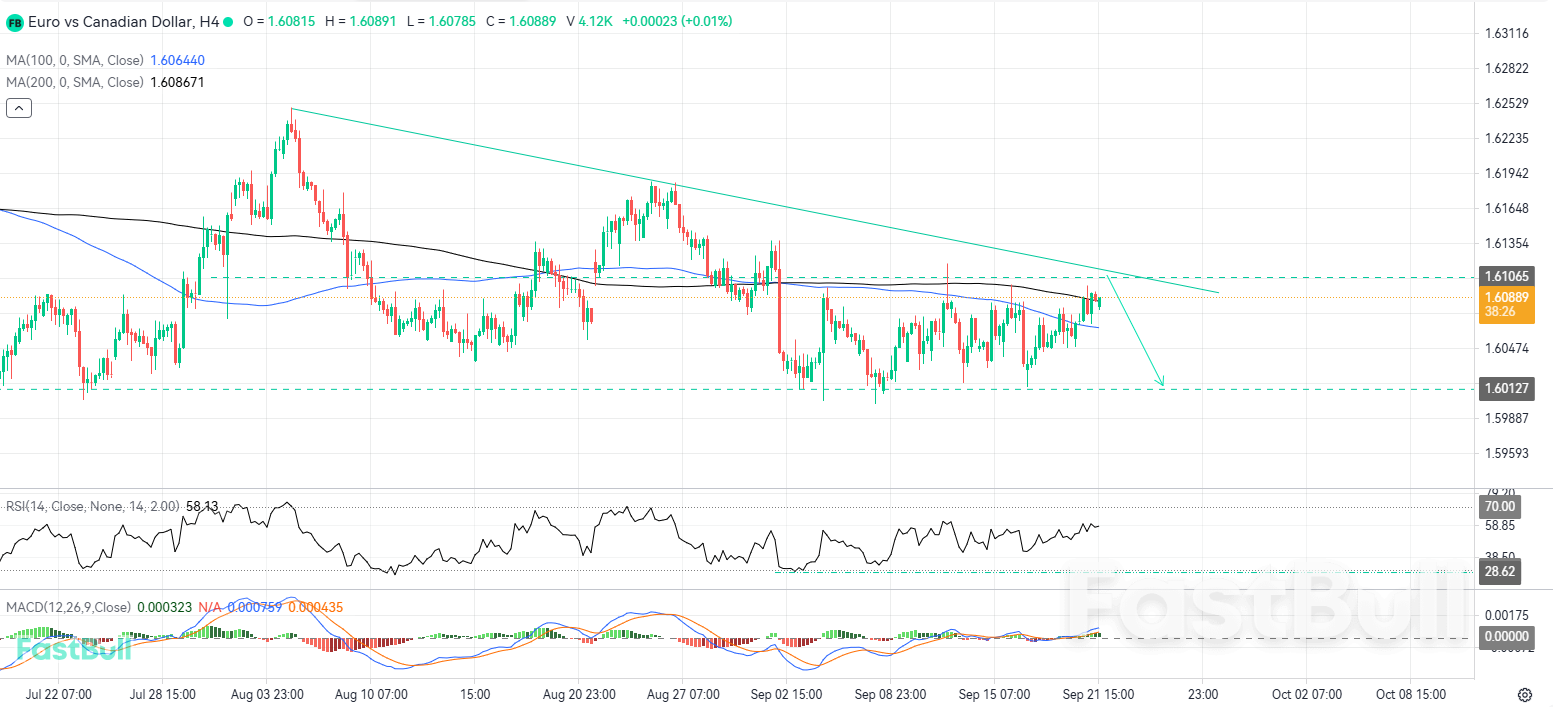
EURCAD remains in a recovery phase after rebounding from the local support level at 1.6012. The pair is now moving toward the descending trendline that has guided the broader bearish structure since August 4, when price reached the high at 1.6247. As the market approaches this trendline, attention is increasingly shifting toward the possibility of a bearish reaction from resistance.
If price encounters selling pressure near the resistance area around 1.6105, a rejection from the descending trendline could trigger a renewed move lower and potentially return the pair toward the support level at 1.6012. Such a scenario would reinforce the broader bearish structure and confirm that sellers continue to defend the trendline effectively.
Adding further significance to this area, the 100-period and 200-period moving averages are currently positioned at 1.6064 and 1.6086 respectively. Both averages remain embedded within the triangle formation that has developed in recent weeks, increasing the technical relevance of the current resistance zone and adding weight to the consolidation pattern that remains in play.
Looking at momentum indicators, the Relative Strength Index (RSI) is currently positioned near 57, already within bullish territory. While this suggests that buyers have regained some control in the short term, the indicator still has sufficient room to move higher before approaching overbought conditions. As a result, the preferred area for evaluating potential selling opportunities remains near the descending trendline rather than at current levels.
Meanwhile, the MACD continues to display a histogram with very limited depth, indicating that bullish momentum remains relatively modest. The signal lines have moved slightly into positive territory, but momentum remains far from decisive. If price produces a solid bearish reaction from the trendline resistance area, both the MACD histogram and signal lines could quickly rotate back toward bearish territory. For that reason, the market’s reaction near the descending trendline is likely to be a key factor in determining whether new downside opportunities begin to develop.
Trading Recommendations
Trading direction: Sell
Entry price: 1.6106
Target price: 1.6012
Stop loss: 1.6150
Validity: Oct 02, 2026 15:00:00


