It has been 72 hours since the Strait of Hormuz effectively went dark, and the realization sweeping through the trading floors of London, Singapore, and New York is no longer about whether we will see a price spike, but rather how long this new reality will persist. The war in the Middle East has deepened beyond the point of diplomatic quick fixes, and the energy markets are finally—violently—repricing for a future where a quarter of the world’s seaborne crude remains bottled up for months.
On March 19, the benchmarks told only part of the story. Brent crude and West Texas Intermediate surged toward the $120 per barrel handle, a psychological threshold that had traders recalling the volatility of past geopolitical conflagrations. Yet, as anyone dealing in physical cargoes will tell you, the paper prices are already lagging behind reality. While the futures market flirted with triple digits, physical Dubai crude—the lifeblood of Asian refiners—was changing hands at levels between $150 and $166 a barrel. That is not a market adjusting to fear; that is a market adjusting to absence.
We are now in the midst of a supply shock that is no longer theoretical. Earlier assessments suggested that even if the Strait were to be reopened imminently, it would take months to untangle the logistical knots and restore flows to pre-war levels. That timeline has now been shattered. Given the intensification of attacks on energy assets and the continued closure of the world’s most critical chokepoint, I now expect the Strait of Hormuz to remain effectively sealed through the end of April. A full closure lasting into the spring will have compounding effects that stretch far beyond the immediate halt in loadings.
Shipping will return slowly—cautiously. The insurance market is in disarray, vessel operators are rerouting around the Cape of Good Hope, and the intricate just-in-time delivery system that feeds global refineries has been severed. Consequently, I do not foresee crude oil and refined product flows recovering to even 80% of pre-war levels until August. That is five months of constrained supply, drawing down inventories at a rate that makes the post-pandemic demand surge look like a footnote.
Technical Analysis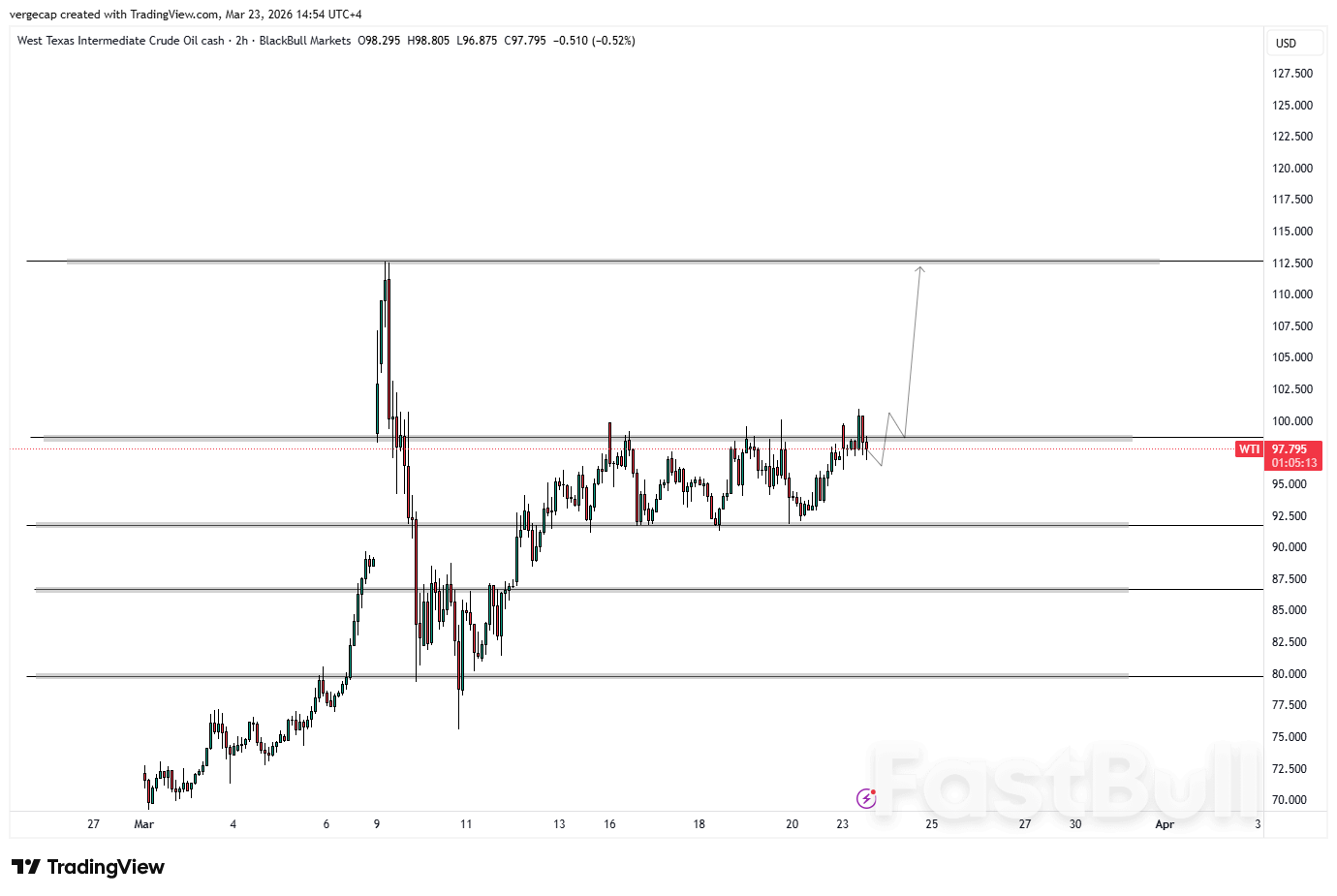
From a technical perspective, WTI crude oil is consolidating within a broader recovery structure following a sharp corrective decline earlier in the month. On the 2-hour chart, price action has transitioned into a range-bound formation between approximately $92.50 and $100.00, with repeated tests of both support and resistance zones signaling a market in equilibrium. The recent push toward the upper boundary near $100.00 highlights building bullish pressure, although follow-through remains limited as sellers continue to defend this region.
The ascending recovery from the $80.00–$82.00 base remains intact, with higher lows forming consistently, suggesting underlying demand remains supportive. However, the inability to secure a sustained breakout above the $100.00 psychological barrier indicates that bullish momentum is not yet strong enough to trigger a continuation toward higher levels. This zone now represents a critical inflection point for the next directional move.
On the downside, the $92.50 level serves as immediate support and aligns with the lower boundary of the current consolidation range. A decisive break below this level would weaken the near-term structure and expose the $88.00–$90.00 region, where prior accumulation occurred. A deeper move below that zone could open the door toward the $80.00 handle, effectively invalidating the current recovery phase and signaling a broader bearish shift.
Conversely, a sustained breakout above $100.00 would confirm bullish continuation and likely attract momentum-driven buying. Such a move would expose the $105.00 region initially, with a more extended upside target near $112.50, where a major resistance zone is clearly defined on the chart. This area represents a longer-term ceiling and would likely act as a strong supply zone if reached.
Momentum dynamics appear neutral-to-slightly bullish. Price compression near resistance suggests energy is building for a breakout, but the lack of impulsive candles indicates hesitation. This aligns with a consolidation phase rather than exhaustion, keeping both breakout scenarios viable in the near term.
TRADE RECOMMENDATION
BUY WTI
ENTRY PRICE: 100.00
STOP LOSS: 92.00
TAKE PROFIT: 105.00


