U.S. economic indicators reflected a robust domestic landscape in March, as Retail Sales ascended by 1.7% month-over-month, significantly outperforming the 1.4% market consensus and improving upon February's 0.7% print. This surge was primarily driven by elevated gasoline expenditures, which bolstered station receipts, alongside seasonal tax refunds providing a structural tailwind for consumer spending. On an annualized basis, sales growth remained resilient at 4%, mirroring the previous month's performance.
Concurrent with consumer strength, the labor market exhibited continued vitality. The ADP Employment Change four-week average trended upward from 39,000 to 54,800, reinforcing the narrative of a tight and resilient labor landscape.
However, this domestic optimism is increasingly overshadowed by a deteriorating geopolitical environment. Uncertainty regarding the resumption of diplomatic negotiations between Washington and Tehran has reached a fever pitch following renewed hostilities in the Strait of Hormuz. Current reports suggest that neither party has dispatched negotiation teams; J.D. Vance’s schedule remains focused on high-level meetings in Washington, causing hopes for a ceasefire extension to evaporate before tomorrow’s expiration. While Iranian state-affiliated channels have denied these claims, the absence of an official delegation suggests a diplomatic stalemate.
In Washington, Fed Chair nominee Kevin Warsh utilized his Senate testimony to advocate for a profound "regime change" in the conduct of monetary policy. Warsh emphasized the necessity of a modernized inflationary framework to navigate current systemic shifts. This comes as Federal Reserve officials have formally entered their "blackout period" ahead of the April 28–29 meeting.
Market participants broadly anticipate that the central bank will maintain the current interest rate range; however, expectations for year-end easing have been aggressively recalibrated. Markets had previously priced in approximately 14 basis points of relaxation toward the close of 2026—a projection now under intense scrutiny. This shift follows a cooling but resilient U.S. landscape where Initial Jobless Claims outperformed expectations at 207,000, despite Industrial Production recording a sharp 0.5% contraction in March, primarily led by declines in the automotive and utility sectors.
Across the Pacific, RBA Deputy Governor Andrew Hauser issued a cautionary outlook, signaling that the coming months may prove exceptionally intricate for the Australian economy. Hauser highlighted a challenging nexus of energy-driven shocks and persistent inflationary pressures, noting that the domestic economy is struggling to absorb these exogenous shocks due to entrenched supply-side constraints.
This deteriorating sentiment was mirrored in April’s consumer data, as the Westpac Consumer Confidence index recorded a sharp 12.5% collapse. This reflects heightened household anxieties regarding soaring energy costs and broader global economic uncertainty. Looking ahead, investors are pivoting their focus toward high-impact catalysts: the upcoming Australian employment report and China’s GDP figures.
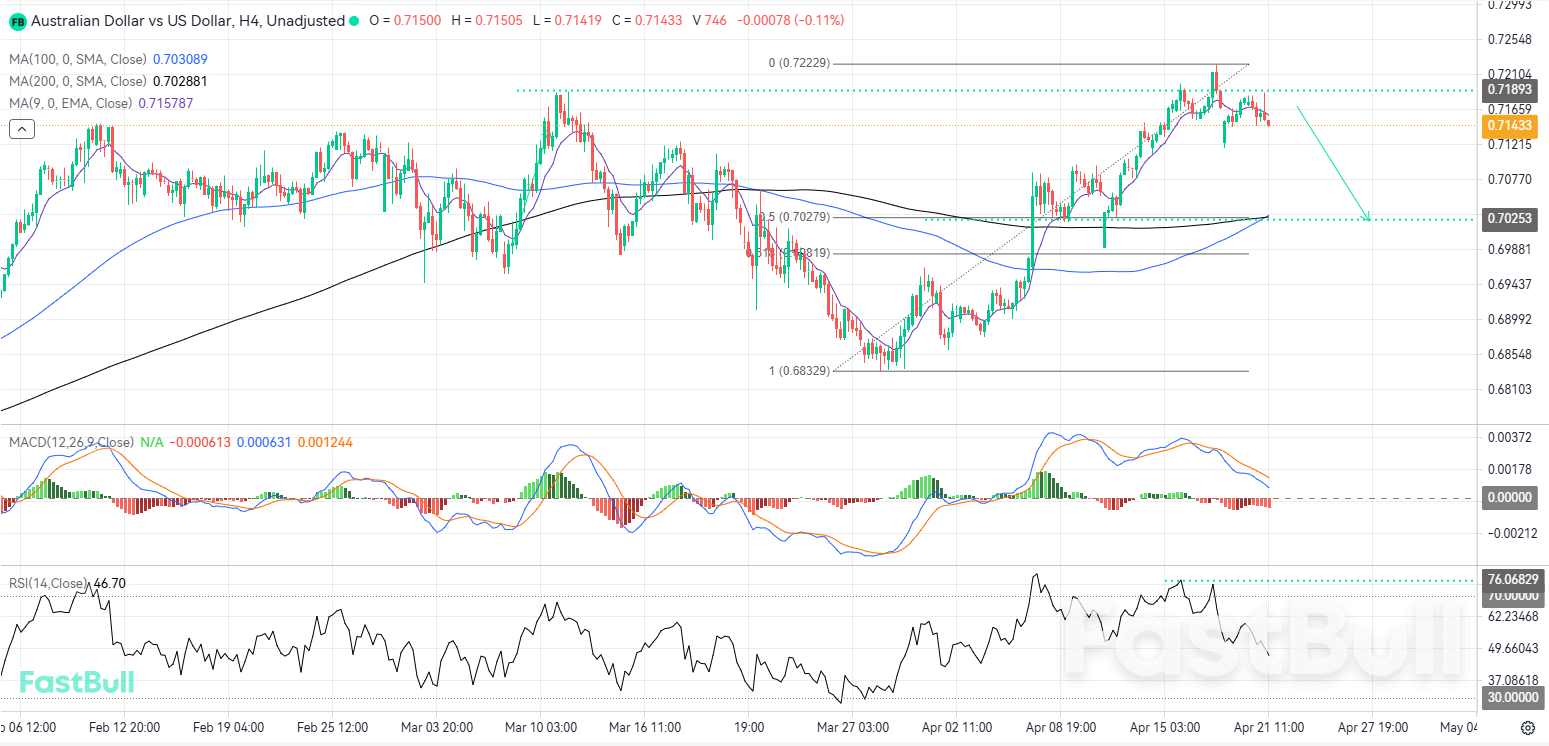
Technical Analysis
From a technical perspective, AUDUSD has exhibited a decisive bearish rejection upon testing the primary resistance handle at 0.7189. Critically, the pair has achieved a close beneath the 9-period Exponential Moving Average (EMA), which often serves as an early harbinger for emerging trend development.
The path of least resistance currently appears to favor a corrective downward move. Our primary downside objective is situated at the 0.7025 level. This target carries high technical confluence, as it aligns perfectly with the 0.50 Fibonacci retracement level and sits just beneath the 100 and 200-period Moving Averages (MAs), currently tracking at 0.7030 and 0.7028, respectively. The tight convergence of these averages highlights a significant structural zone that will likely act as a magnet for a mean-reversion move.
Our analysis of momentum oscillators provides further validation for a corrective bias. The Relative Strength Index (RSI) recently struck a peak of 76 before retreating to the 49 level, suggesting that while the overbought extreme has cooled, the pair retains ample "runway" for further depreciation.
Also, the MACD is printing a bearish histogram that is actively gaining negative depth. The signal lines are currently trending toward a bearish crossover; a decisive move into the negative quadrant would provide the final technical confirmation required for a sustained downward expansion. Under the current configuration, sell-side opportunities near local resistance are technically favored.
Trading Recommendations
Trading direction: Sell
Entry price: 0.7189
Target price: 0.7025
Stop loss: 0.7250
Validity: Apr 30, 2026 15:00:00


