Recent data from the Australian Bureau of Statistics (ABS) reveals that the nation's trade surplus narrowed significantly to AUD 2.936 billion in November, a sharp decline from the AUD 4 billion recorded in the previous month. This contraction was primarily driven by a 2.9% monthly drop in exports, reversing October’s gains, while imports experienced a marginal increase. These figures have sparked growing concerns regarding the net contribution of foreign trade to Australia's overall economic growth as the year comes to a close.
Furthermore, softer-than-expected inflation data released earlier this week has placed additional downward pressure on the Australian Dollar. The Consumer Price Index (CPI) recorded a 3.4% year-over-year increase in November, undershooting market expectations and marking a deceleration from the prior month. While inflation remains stubbornly above the Reserve Bank of Australia’s (RBA) target range, this slowdown introduces fresh uncertainty regarding the future path of monetary policy. RBA Deputy Governor Andrew Hauser noted that the figures were largely in line with internal forecasts, reiterating that immediate rate cuts remain unlikely as the central bank maintains a strictly data-dependent stance.
In the United States, the latest ADP Employment Change report showed that private payrolls expanded by 41,000 in December. Although this figure missed the consensus forecast of 47,000, it represents a substantial recovery compared to the 29,000 jobs lost in November, suggesting a tentative stabilization in hiring as the year closed. In tandem, the U.S. Department of Labor’s JOLTS report showed that job openings retreated to 7.146 million in November, down from October’s 7.449 million, signaling a gradual cooling in broad labor demand.
Providing a counterweight to the softening labor data, the Institute for Supply Management (ISM) reported a notable surge in the Services PMI, which climbed from 52.6 to 54.4 in December, easily beating the 52.3 estimate. A granular look at the data shows the Employment index returning to expansion at 52, while the Prices Paid component saw a slight moderation. This blend of resilient service sector activity and cooling labor metrics keeps the Federal Reserve in a cautious "wait-and-see" posture ahead of their late-January meeting. While service strength discourages aggressive monetary easing, the labor slowdown continues to build a fundamental case for gradual rate reductions.
Finally, market participants largely overlooked the dovish commentary from Fed Governor Stephen Miran, as traders had already priced in two rate cuts according to Prime Market Terminal data. Meanwhile, U.S. Treasury Secretary Scott Bessent exerted pressure on Federal Reserve officials, arguing that interest rate cuts should not be delayed if the goal is to successfully stimulate economic growth.
Technical Analysis
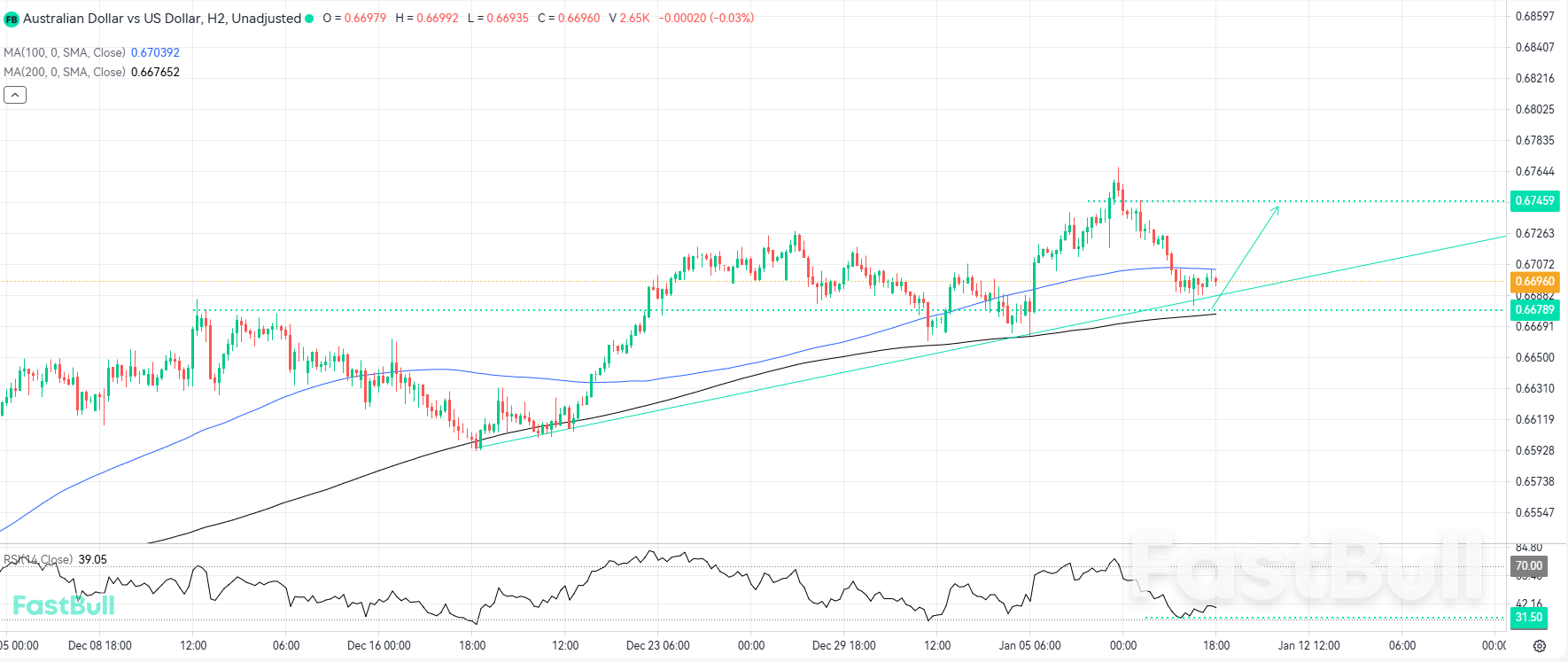
The AUD/USD remains locked in a clear primary uptrend; however, it is currently undergoing a corrective retracement phase. The price is approaching a critical confluence of technical indicators that could serve as a launchpad for the next bullish leg.
Historically, the pair has found significant buying interest whenever it approaches the 200-period Moving Average (MA), which currently sits at 0.6676 on the 2-hour chart. Meanwhile, the 100-period MA is positioned slightly higher at 0.6703. Should the price repeat its previous behavior, we could witness a strong bullish reversal as it tests the 200-period MA.
This zone is further reinforced by a significant horizontal support level at 0.6678. This area previously functioned as a firm resistance ceiling; its transformation into a support floor—a classic support-resistance flip—adds substantial weight to the bullish thesis.
Additionally, the Relative Strength Index (RSI) is rapidly approaching oversold territory. This extreme reading is likely to attract institutional and retail buyers looking to capitalize on the technical convergence of the horizontal support, the 200-period MA, and the primary ascending trendline. If these levels hold, the stage is set for a decisive extension of the bullish trend.
Trading Recommendations
Trading direction: Buy
Entry price: 0.6680
Target price: 0.6740
Stop loss: 0.6650
Validity: Jan 16, 2025 15:00:00


