Fundamentals
The Japanese financial markets are poised for a reassessment following Prime Minister Takaichi Sanae's decisive victory in Sunday's election. This outcome, regarded as the Liberal Democratic Party's most significant parliamentary triumph since 1996, not only solidifies Takaichi Sanae's administration but also grants her a clearer policy mandate. Market participants are now focused on whether this robust political standing will precipitate an escalation in fiscal stimulus or, conversely, allow for a more measured, balanced approach between stimulus and fiscal prudence. The "Takaichi trade" dominated market narratives since her premiership began last October, characterized by record highs in Japanese equities, a depreciating yen, and outflows from Japanese government bonds (JGBs). A staunch proponent of former Prime Minister Abe Shinzō's "Abenomics," Takaichi Sanae has historically advocated for aggressive fiscal policy through bond issuance. Previously, subdued LDP poll numbers necessitated compromises with opposition parties, leading to restraint on fiscal stimulus. This election result fundamentally alters that dynamic. Chris Scicluna of Daiwa Capital Markets notes a growing conviction in Takaichi's economic stewardship, viewing her electoral success as a short-term positive for the Japanese stock market. Naoya Hasegawa, Chief Bond Strategist at Okasan Securities, anticipates a potential revival of the "Takaichi trade," which could exert upward pressure on JGB yields, particularly amid rapid yen depreciation. However, recent JGB market stability suggests investor confidence in Takaichi's commitment to "responsible stimulus." Despite elevated yields, robust demand at the last four JGB auctions, coupled with a decline of over 30 basis points from the January peak of 3.88% in the 30-year JGB yield, indicates a more tempered outlook. Some analysts believe Takaichi will continue to navigate the delicate balance between leveraging inflationary fiscal space and averting uncontrolled yield increases.
U.S. Treasury Secretary Scott Bessent recently shared insights on several key issues, addressing both U.S.-Japan relations and offering significant commentary on the Federal Reserve's future balance sheet policies. Following the Japanese ruling coalition's decisive electoral victory on Sunday, Bessent, in an interview with Fox News Channel's "Sunday Morning Futures," lauded Japanese Prime Minister Takaichi Sanae, describing her as a "great ally" and noting her endorsement by U.S. President Donald Trump. Bessent stated that Takaichi maintains a strong relationship with Trump, emphasizing that "when Japan is strong, the U.S. is stronger in Asia," which holds considerable importance for U.S.-Japan cooperation in the Asia-Pacific region. During the same interview, Bessent also discussed the outlook for Federal Reserve policies. He indicated that even with Kevin Warsh, a former critic of the Fed's large-scale asset purchase programs, potentially leading the Fed, a swift reduction in its balance sheet is unlikely. Bessent suggested that the Federal Reserve might require up to a year to thoroughly evaluate and deliberate on its balance sheet policies before determining future directions. He underscored that the management of the balance sheet falls entirely within the Federal Reserve's purview, with no Treasury Department intervention. Bessent posited that if the Fed opts to continue or shift towards an "ample reserves" policy framework, it inherently necessitates maintaining a substantial balance sheet, thereby diminishing the likelihood of rapid balance sheet reduction. In such a scenario, the Fed would likely adopt a cautious, wait-and-see approach, dedicating at least a year to clarify its long-term policy stance. He also noted that Warsh, if appointed Fed Chair, would be a highly independent leader, with the Federal Reserve's decisions on monetary policy and balance sheet management continuing to center on its own judgment.
Technical Analysis
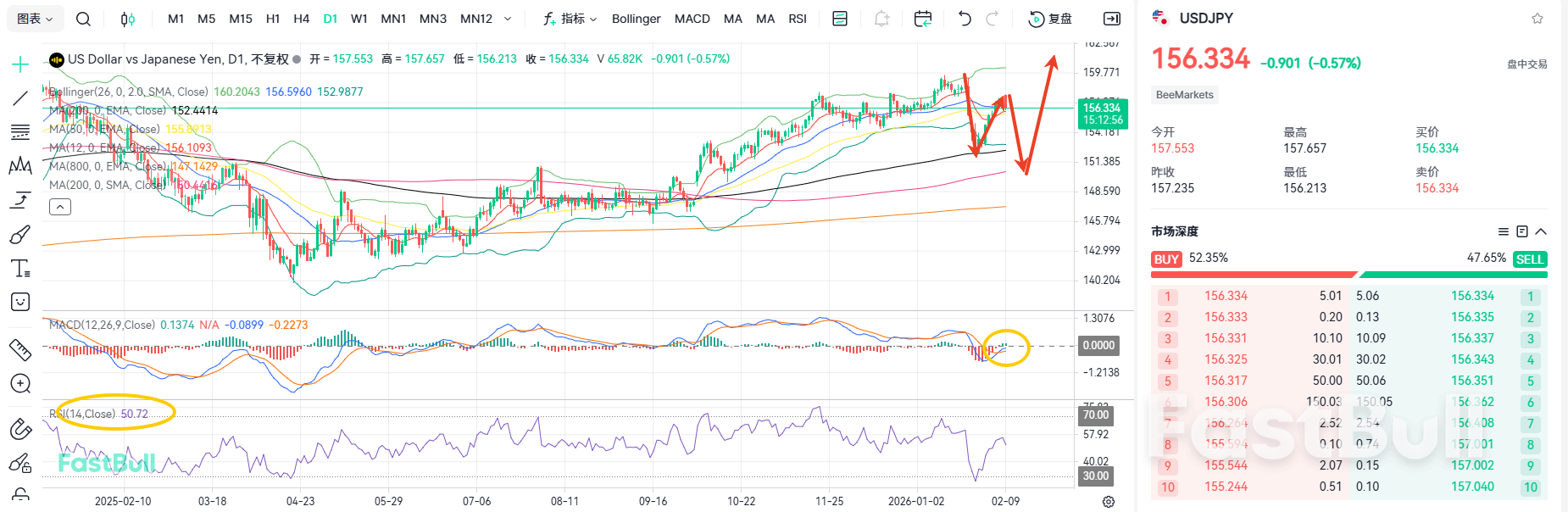
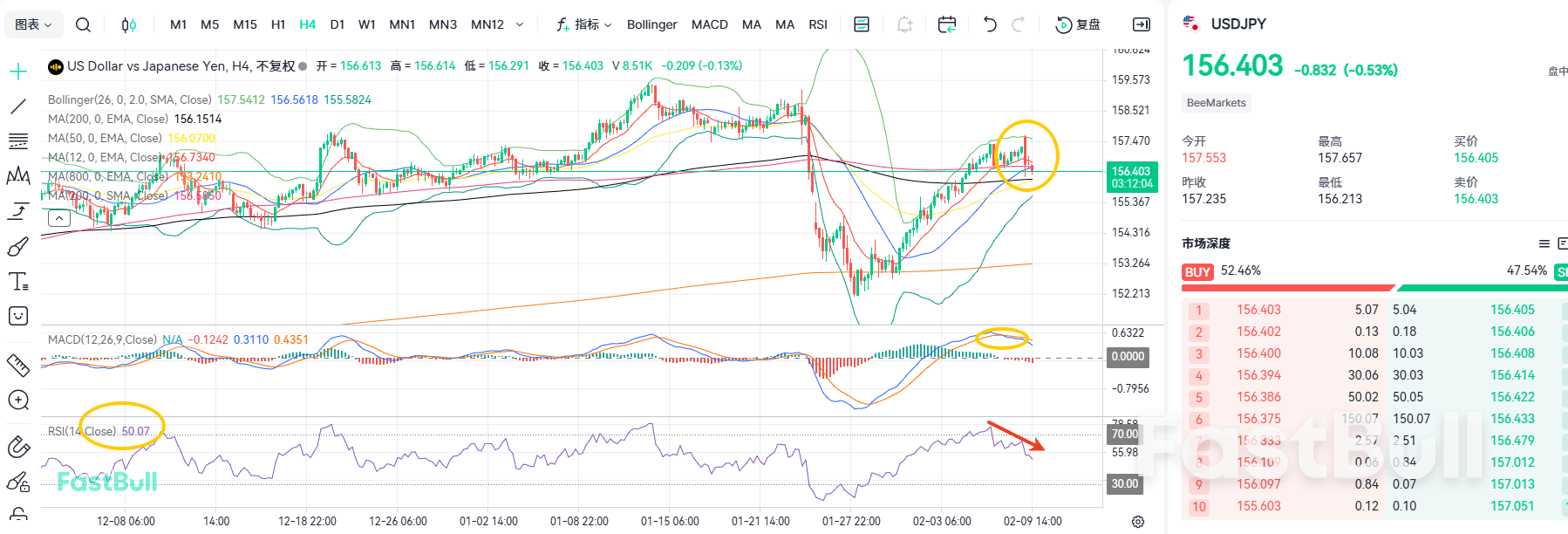
In the 1D timeframe, the USDJPY exhibits narrowing Bollinger Bands, flattened moving averages, and price oscillation around the middle Bollinger Band. Following a MACD golden cross, the MACD line and signal line are pulling back towards the zero-axis, indicating potential trend reversal. In the short term, prices are merely undergoing correction and are likely to retest the EMA200 and lower Bollinger Band, situated at 152.4 and 152.9 respectively. The RSI is at 50 with lower highs, suggesting investor caution. In the 4H timeframe, prices are consolidating near the EMA200. A MACD death cross has formed, with the MACD line and signal line approaching the zero-axis from a considerable distance, implying the downtrend is not yet complete. The RSI is at 50, reflecting a wait-and-see market sentiment. Sustained price action above the EMA200 could lead to an upward movement towards 160; conversely, failure to hold this level may result in a decline towards 150. It is recommended to go short at the highs.
Trading Recommendations
Trading Direction: Sell
Entry Price: 156.4
Target Price: 151
Stop Loss: 160
Support: 152, 150, 149.5
Resistance: 160, 161, 162


