The latest inflationary prints from New Zealand reveal a notable overshoot, with the Consumer Price Index (CPI) ascending by 0.9% quarter-over-quarter (QoQ) in the first quarter of 2026. This figure not only surpassed market expectations of 0.8% but also marked a significant acceleration from the 0.6% increase recorded in the preceding quarter. On an annualized basis, inflation remained stubbornly anchored at 3.1%, exceeding the 2.9% forecast and confirming that underlying price pressures remain deeply entrenched within the domestic economy.
These figures effectively keep inflation hovering just above the Reserve Bank of New Zealand’s (RBNZ) mandated 1% to 3% target range, significantly bolstering speculation regarding a further tightening of monetary policy in the coming months. Market participants have reacted swiftly to this data, with several analysts now anticipating a potential interest rate hike as early as the May meeting. This hawkish recalibration is currently providing a vital short-term tailwind for the Kiwi (NZD).
Concurrently, the geopolitical landscape in the Middle East has entered a phase of renewed volatility. Diplomatic negotiations between the United States and Iran have reached a standstill, exacerbated by the U.S. maritime blockade of Iranian-flagged vessels. In a strategic escalation, the Islamic Revolutionary Guard Corps (IRGC) recently seized three cargo vessels in the Strait of Hormuz, demanding the immediate termination of American economic restrictions. While U.S. President Donald Trump has extended the current ceasefire while awaiting a counter-proposal from Tehran, reports suggest burgeoning fractures within the Iranian leadership.
In the United States, the Atlanta Fed’s GDPNow model—which provides a real-time estimate of economic activity—currently projects that the domestic economy will expand at a rate of 1.2% in the first quarter of 2026. This cautious growth outlook arrives as Federal Reserve Chair nominee Kevin Warsh provided high-stakes testimony before the Senate. Warsh advocated for a modernized "new approach" at the Fed, explicitly distancing himself from the use of forward guidance and emphasizing the paramount importance of central bank independence. Crucially, Warsh affirmed that he has faced no pressure from the White House regarding interest rate decisions.
This institutional commentary follows a week of robust domestic data, where U.S. Retail Sales surged by 1.7% month-over-month, significantly outperforming the 1.4% consensus. This expansion was largely fueled by elevated gasoline expenditures and the arrival of seasonal tax refunds, which provided a structural fiscal tailwind for consumer spending. Simultaneously, the U.S. labor market continues to exhibit remarkable vitality, with the ADP Employment Change four-week average ascending from 39,000 to 54,800, reinforcing the narrative of a tight and resilient labor landscape.
Technical Analysis
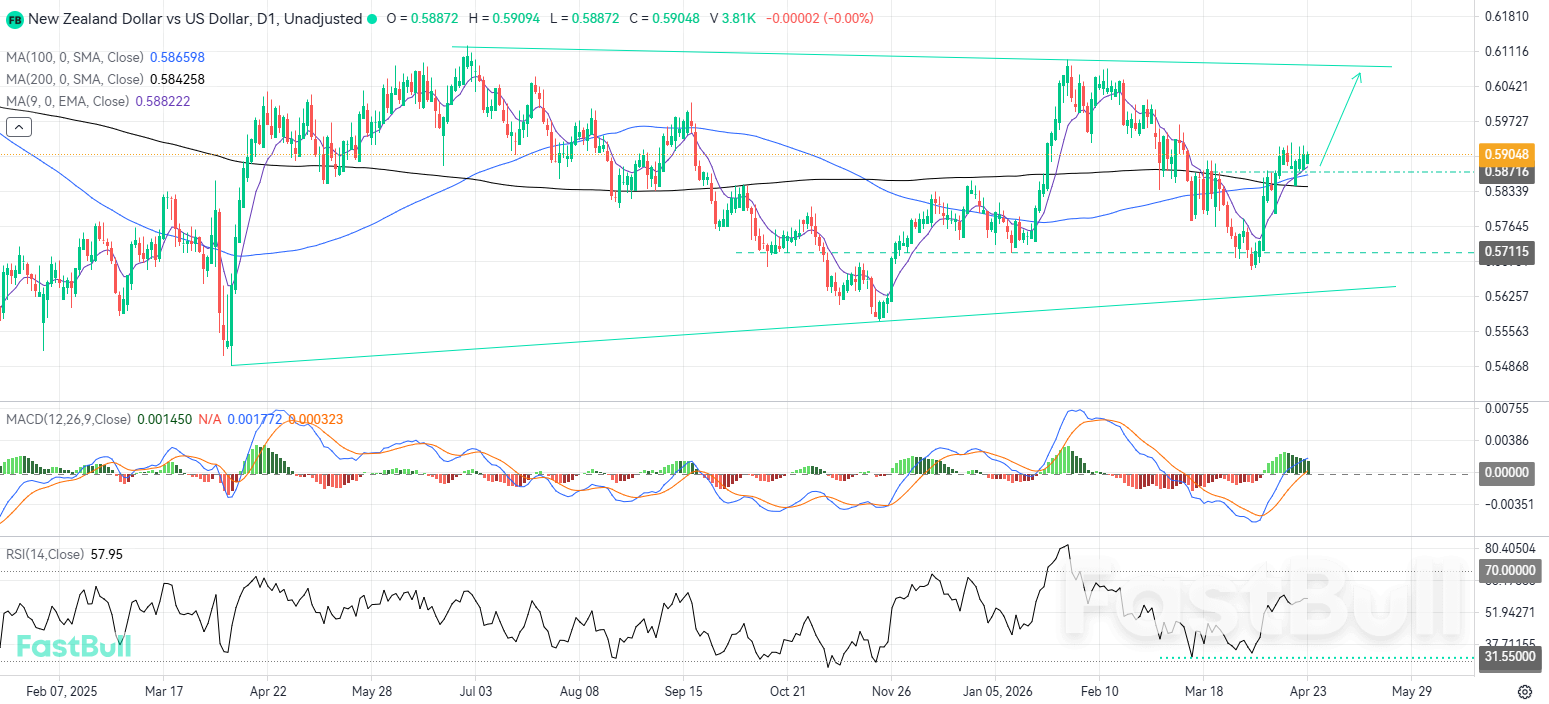
From a technical perspective, NZD/USD has executed a powerful recovery since the beginning of the month, rapidly reclaiming the primary support floor at 0.5711. This rebound reignited bullish pressure, leading to a decisive breakout above the local resistance handle at 0.5871. Price action has since stabilized above this level, confirming the breach as a solid structural shift that clears the path for a sustained upward impulse toward the upper boundary of the ascending channel, situated near the 0.6070 mark.
The pair currently benefits from a high-confluence cluster of dynamic indicators. The 100 and 200-period Moving Averages (MAs) are tracking at 0.5865 and 0.5842, respectively. These averages have functioned as reliable dynamic support in recent sessions; provided price action does not achieve a decisive daily close beneath this cluster, the path of least resistance remains skewed to the upside.
Our analysis of momentum oscillators provides further validation for a bullish continuation. The Relative Strength Index (RSI) is currently tracking at the 57 level, positioned comfortably above technical neutrality but retaining ample "runway" for further expansion before reaching overbought extremes. This follows a significant reset after the RSI struck an oversold low of 31 earlier in the month.
Meanwhile, the MACD is printing a bullish histogram, though it has begun to lose a marginal amount of depth. However, the signal lines are actively executing a bullish crossover into the upper quadrant above the neutral threshold. Should the histogram regain positive depth in the coming candles, we anticipate an acceleration of the current trend toward the 0.6070 objective.
Trading Recommendations
Trading direction: Buy
Entry price: 0.5903
Target price: 0.6060
Stop loss: 0.5735
Validity: May 01, 2026 15:00:00


