The Eurozone’s economic landscape presents a stark dichotomy as we navigate the second quarter. The HCOB Manufacturing PMI recently surged to a near four-year peak of 52.2, ascending from March’s 51.6 reading. However, this industrial resilience was swiftly overshadowed by a severe contraction within the services sector, which plummeted to 47.4 from its previous 50.2 handle. Consequently, the Composite PMI retreated into contractionary territory at 48.6 in April, signaling a perceptible stalling of aggregate economic activity across the bloc.
This softening of activity is mirrored in the preliminary Consumer Confidence data for April, which collapsed to -20.6, a significant deterioration from the prior -16.3. This erosion of household sentiment is largely attributed to entrenched geopolitical anxieties and the escalating costs of energy, both of which continue to exert a heavy toll on the regional outlook. In this high-stakes environment, the broader macroeconomic trajectory remains exceptionally challenging; current projections suggest inflation will average 3.1% in 2026 before moderating toward 2.5% in 2027. On a cumulative basis, this represents a substantial 1.7 percentage point overshoot relative to pre-conflict forecasts. Simultaneously, economic expansion is projected to decelerate to a tepid 0.6% this year, with only a marginal recovery to 0.9% anticipated by 2027.
Regarding monetary policy, the internal debate within the European Central Bank (ECB) remains largely unsettled. Gediminas Šimkus, Governing Council member and Governor of the Bank of Lithuania, noted during Wednesday’s session that a rate hike later this year cannot be entirely dismissed. Nevertheless, he maintained that the prevailing preference remains to hold interest rates steady during the upcoming policy decision scheduled for April 30.
Across the Atlantic, Canadian inflation experienced a sharp and notable acceleration in March, primarily catalyzed by surging energy expenditures. Official data from Statistics Canada revealed that the Consumer Price Index (CPI) ascended by 0.9% month-over-month, a significant leap from February’s 0.5%, though it remained marginally beneath the 1.1% market consensus. On an annualized basis, headline CPI surged to 2.4% from its previous 1.8% print.
The Bank of Canada’s (BoC) preferred underlying metrics presented a more nuanced narrative. While the monthly core CPI moderated to 0.2%, the annual core rate climbed to 2.5%. This inflationary backdrop reinforces expectations that the BoC will maintain a high degree of institutional caution during its upcoming deliberations. However, RBC Economics observed that the deceleration in core price growth provides the central bank with essential flexibility to navigate a fragile economic environment characterized by an stubbornly elevated unemployment rate.
Technical Analysis
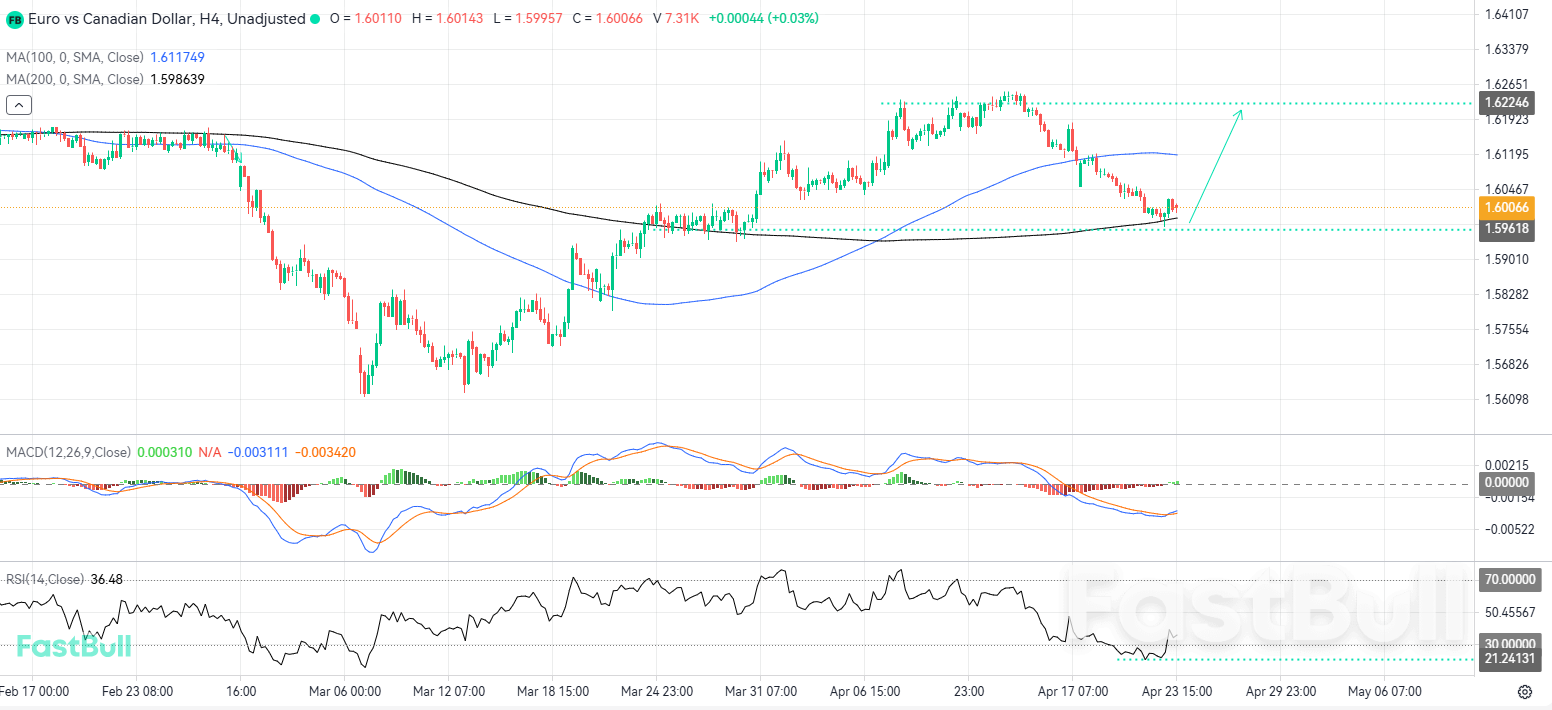
From a technical perspective, EUR/CAD has exhibited a decisive bullish rejection after testing the 200-period Moving Average (MA) on the 4-hour chart, currently situated at 1.5986. The 100-period MA tracks higher at 1.6117. This rebound occurred in close proximity to the primary local support floor at 1.5961, suggesting that the recent corrective phase—following a powerful bullish impulse—is reaching a point of technical exhaustion. Such retracements are viewed as a "healthy" reset within a developing trend, providing the necessary liquidity for a potential move back toward the recent cycle high of 1.6224.
Our analysis of momentum oscillators provides compelling evidence for a bullish pivot. The Relative Strength Index (RSI) recently plummeted to the 21 level, moving deeply into extreme oversold territory. This technical extreme often serves as a precursor to a sharp reversal, especially when aligned with structural support.
Simultaneously, the MACD has already completed a bullish histogram transition. Should this impulse gain further depth, we anticipate the signal lines—which are currently ascending from depressed levels—to execute a decisive crossover above the neutral threshold. Such a move would provide the final technical confirmation required for a sustained and prolonged bullish expansion toward the 1.6224 resistance handle.
Trading Recommendations
Trading direction: Buy
Entry price: 1.6008
Target price: 1.6220
Stop loss: 1.5890
Validity: May 06, 2026 15:00:00


