Market participants are pivoting their focus toward the European Central Bank’s (ECB) upcoming monetary policy deliberations scheduled for Thursday. The prevailing consensus suggests that the governing council will maintain interest rates at 2.0%, marking a notable seventh consecutive meeting of policy inertia. Within this context, the recent appreciation in crude oil prices remains a high-impact factor, particularly given the Eurozone’s structural energy dependency. Investors are closely monitoring how the ECB intends to calibrate the delicate balance between entrenched inflationary pressures and an economic expansion that is visibly losing traction, searching for any subtle guidance regarding a potential tightening cycle in the coming months.
On the data front, Germany’s Harmonized Index of Consumer Prices (HICP) recorded a marginal uptick to 2.9% year-over-year, ascending from its prior 2.8% print, yet falling short of the 3.0% market forecast. On a monthly basis, inflation exhibited a more pronounced deceleration, with the HICP retreating to 0.5% from 1.2%, significantly beneath the anticipated 0.8% expansion.
The industrial landscape offered a striking dichotomy. The HCOB Manufacturing PMI surged to a near four-year peak of 52.2, improving upon March’s 51.6 reading. However, this industrial resilience was aggressively offset by a severe deterioration in the tertiary sector, with the Services PMI plummeting to 47.4 from its previous 50.2 handle. Consequently, the Composite PMI retreated into contractionary territory at 48.6 in April, reflecting a pervasive loss of economic dynamism across the bloc.
This weakening trend is further corroborated by April’s preliminary Consumer Confidence reading, which collapsed to -20.6 from -16.3. This decline underscores the mounting pressure on household sentiment, driven by persistent geopolitical uncertainty and soaring energy expenditures. In this high-stakes environment, the macroeconomic outlook remains arduous: inflation is projected to average 3.1% in 2026 before moderating toward 2.5% in 2027—a cumulative overshoot of approximately 1.7 percentage points relative to pre-conflict expectations. Simultaneously, economic growth is forecast to decelerate to a tepid 0.6% this year, with only a marginal recovery to 0.9% anticipated by 2027.
Across the border, Swiss National Bank (SNB) Chairman Martin Schlegel reiterated during the April assembly the bank's steadfast readiness to intervene in the foreign exchange market through foreign currency acquisitions. The primary objective remains to deliberately weaken the Swiss Franc (CHF) and safeguard domestic price stability. Furthermore, Schlegel underscored that the current monetary posture remains expansive, framed within an environment of "profound uncertainty," specifically aimed at sustaining broader economic activity.
Technical Analysis
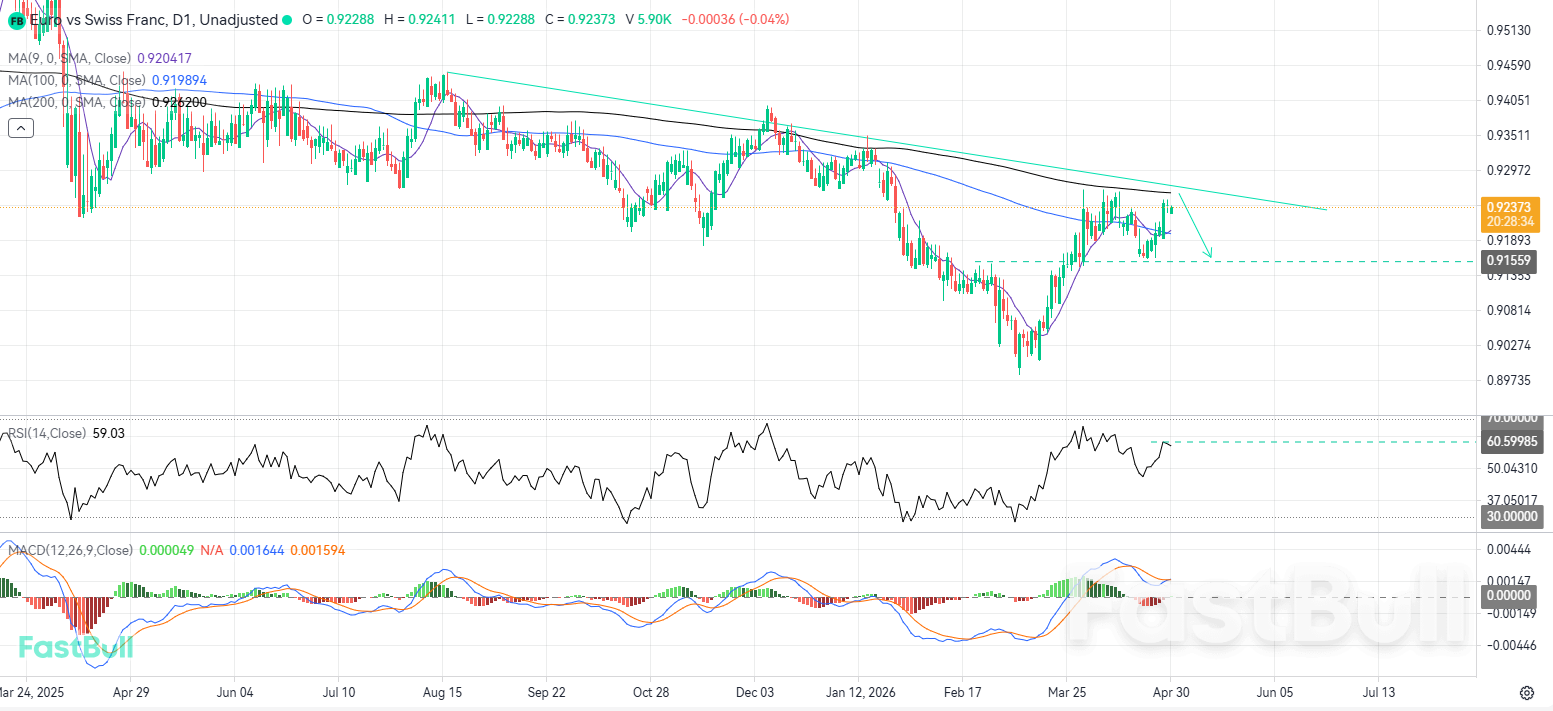
From a technical perspective, EUR/CHF is currently entrenched in a powerful bullish impulse that is fast approaching the 200-period Moving Average (MA). This specific indicator has functioned as a formidable dynamic resistance since last September, consistently capping recovery attempts during the broader bearish trend. If price action exhibits a decisive bearish rejection upon reaching this level again, it could offer a high-conviction opportunity for traders to capture a corrective move to the downside.
The technical setup is further bolstered by a primary downward trendline that aligns perfectly with the 200-period MA, currently situated at the 0.9262 handle. Meanwhile, the 100-period MA tracks the current price action from below at 0.9198, highlighting this entire region as a zone of significant structural interest.
Our analysis of momentum oscillators provides a nuanced view of the current expansion. The Relative Strength Index (RSI) is currently tracking at the 60 level, signaling that while the pair is approaching overbought extremes, it retains a marginal "runway" for further appreciation before technical exhaustion is fully realized.
Simultaneously, the MACD is printing a bearish histogram that is visibly losing depth, while the signal lines remain firmly entrenched above the neutral threshold. Following a test of the trendline confluence, a bearish transition in the histogram could catalyze a corrective leg toward the 0.9155 support floor, which represents the next major local horizontal objective.
Trading Recommendations
Trading direction: Sell
Entry price: 0.9265
Target price: 0.9155
Stop loss: 0.9310
Validity: May 12, 2026 15:00:00


