On Wednesday, Swiss National Bank (SNB) Chairman Martin Schlegel underscored that uncertainty surrounding the medium-term inflationary outlook remains significantly elevated. He highlighted that the Swiss economy, given its systemic exposure to exogenous shocks, continues to face profound challenges in the calibration of monetary policy. Within this high-stakes environment, Schlegel issued a stern warning: should second-round inflationary effects begin to materialize, central banks must be prepared to respond with both promptness and institutional resolve.
This cautious stance was echoed in the recently released minutes from the SNB’s March assembly. Policymakers noted that while Swiss inflation may experience a transitory spike in the near term—primarily driven by surging energy expenditures—the trajectory is expected to remain largely consistent with the bank's mandate of price stability.
Across the Atlantic, the nascent optimism regarding a potential diplomatic rapprochement between Washington and Tehran recently catalyzed a wave of positive sentiment across Wall Street, propelling all three major indices to close in green territory. However, the momentum of these discussions appears to have moderated as both delegations pivot toward the intricate drafting of a memorandum intended to prevent further regional escalation. According to high-level sources, the United States and Iran have successfully narrowed several critical gaps, particularly regarding maritime security protocols in the Strait of Hormuz. Nevertheless, a significant point of friction remains: Tehran continues to demand the release of frozen Iranian assets as a non-negotiable prerequisite for ensuring unhindered maritime transit through Omani waters.
On the broader geopolitical front, U.S. President Donald Trump announced on Thursday that Israel and Lebanon have agreed to a temporary 10-day ceasefire, effective as of 5:00 PM EST (21:00 GMT). This tactical pause is specifically aimed at containing the volatility between Israel and Hezbollah within the context of the wider regional friction involving Iran.
Simultaneously, Federal Reserve officials have reaffirmed their restrictive policy orientation. New York Fed President John Williams warned that ongoing tensions involving Iran are generating additional inflationary headwinds, maintaining that the central bank's current posture remains appropriate for the inflationary environment. In a slightly more tempered but still cautious tone, Governor Stephen Miran indicated that he now anticipates only three interest rate cuts in 2026, rather than four, citing an inflationary trajectory that has proven less favorable than previously forecasted.
The latest U.S. domestic data reflects a cooling but resilient economic landscape. Initial Jobless Claims descended to 207,000 for the week ending April 11, outperforming market expectations. However, secondary labor indicators, such as JOLTS job openings, continue to paint a picture of tepid hiring demand. Furthermore, U.S. Industrial Production recorded a monthly contraction of -0.5% in March, a sharp reversal from the prior 0.7% growth, with the most pronounced declines concentrated in the automotive and utility sectors.
Technical Analysis
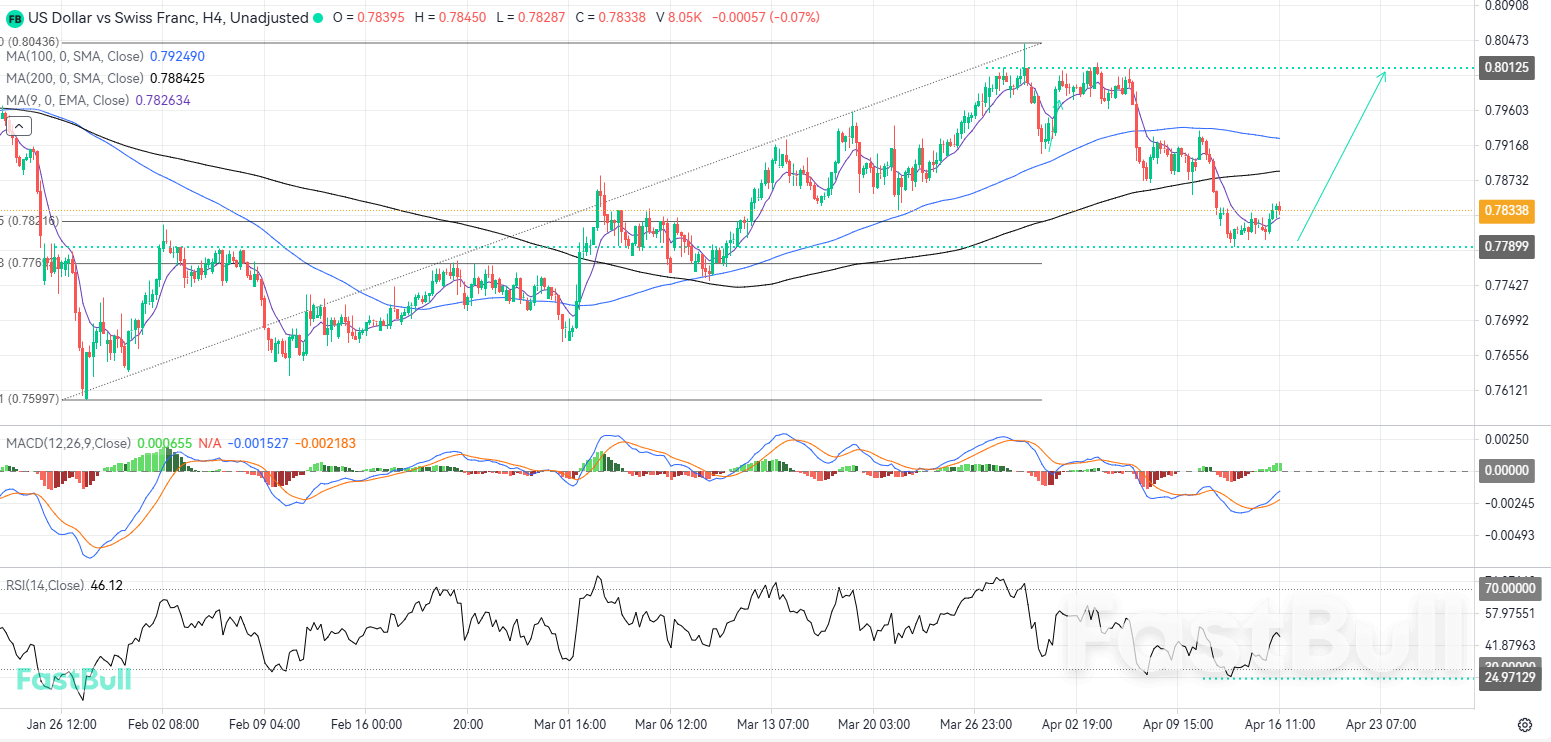
From a technical perspective, USD/CHF has been entrenched in a formidable bullish impulse, originating from the 0.7599 floor on January 27 and ascending to a multi-month peak of 0.8043 on March 31. Following this expansion, the pair entered a corrective phase, recently descending to test a local support level at 0.7789 on April 14.
This specific level is of high technical interest as it sits within the "golden pocket" defined by the 0.50 and 0.618 Fibonacci retracement levels. Provided the pair fails to achieve a decisive daily close beneath the 0.618 Fibonacci support at 0.7769, the structural integrity of the bullish trend remains intact. In such a scenario, we anticipate a resurgent upward move targeting the horizontal resistance at 0.8012, as bulls look to reclaim the primary trend.
Our analysis of momentum oscillators provides a compelling case for a bullish pivot. The Relative Strength Index (RSI) recently plummeted to the 24.97 level, moving deeply into oversold territory. This reflects extreme technical exhaustion for sellers and suggests that the recent correction may have reached its limit.
Simultaneously, the MACD is printing a bullish histogram that is steadily gaining depth, signaling that the technical foundation for an upside move is currently being established. While the signal lines remain positioned beneath the neutral threshold for now, a decisive bullish crossover and a move into the upper quadrant would provide the final confirmation required for a sustained and renewed rally.
Trading Recommendations
Trading direction: Buy
Entry price: 0.7834
Target price: 0.8012
Stop loss: 0.7740
Validity: Apr 29, 2026 15:00:00


