The European Central Bank (ECB) elected to maintain its benchmark interest rates during its February policy deliberations, a decision that aligned seamlessly with broad market expectations. However, the accompanying rhetoric possessed a notably more hawkish undertone, as the governing council emphasized the underlying resilience of economic growth within the Eurozone. President Christine Lagarde appeared dismissive of the significance of recent inflationary moderation and brushed aside mounting concerns regarding the Euro's recent appreciation. She asserted that the common currency remains well-situated within its historical average range, signaling that currency volatility is not currently a primary concern for monetary policymakers.
Regarding broader economic activity, current estimates suggest that Eurozone GDP is on track to expand between 0.2% and 0.3% on a quarter-over-quarter basis, bolstered largely by robust domestic demand and a resilient services sector. Recent Purchasing Managers' Index (PMI) data indicates a narrowing performance gap between the Eurozone's core and periphery economies. While the manufacturing sector and industrial production continue to grapple with persistent structural weakness—exacerbated by periods of heightened volatility—analysts expect that fourth-quarter GDP figures will avoid downward revisions, despite the lackluster industrial output recorded in December.
Furthermore, final Composite PMI data for January suggests a marginal deceleration at the start of the fiscal year. Nevertheless, growth projections for the first quarter remain stable at approximately 0.2% inter-quarterly. Simultaneously, investor sentiment within the region experienced a remarkable recovery in February. The Sentix Investor Confidence Index surged to 4.2, up from -1.8 in January. This represents the third consecutive monthly advance, marking the highest confidence level recorded since July 2025 and reflecting a significant shift toward regional optimism.
Across the Atlantic, reports surfaced early this week suggesting that President Donald Trump may be privately evaluating a potential withdrawal from the USMCA trade agreement. While these reports have injected a fresh wave of uncertainty into the markets, it is important to note that no official announcement has been made to confirm such intentions. Nonetheless, this protectionist rhetoric continues to weigh on Canada’s economic outlook. Adding to the tension, market participants are closely watching the U.S. Supreme Court, which is scheduled to release its initial opinions on February 20 regarding a high-stakes case questioning the legality of tariffs imposed during the Trump administration.
In the commodities space, the softening of crude oil prices has exerted additional downward pressure on the Canadian Dollar (CAD). As a premier exporter of energy, Canada’s fiscal health and currency demand are inextricably linked to crude valuations. West Texas Intermediate (WTI) is currently trading near $62.56, retracing significantly after failing to sustain a two-week peak of approximately $65.64 reached earlier in the session.
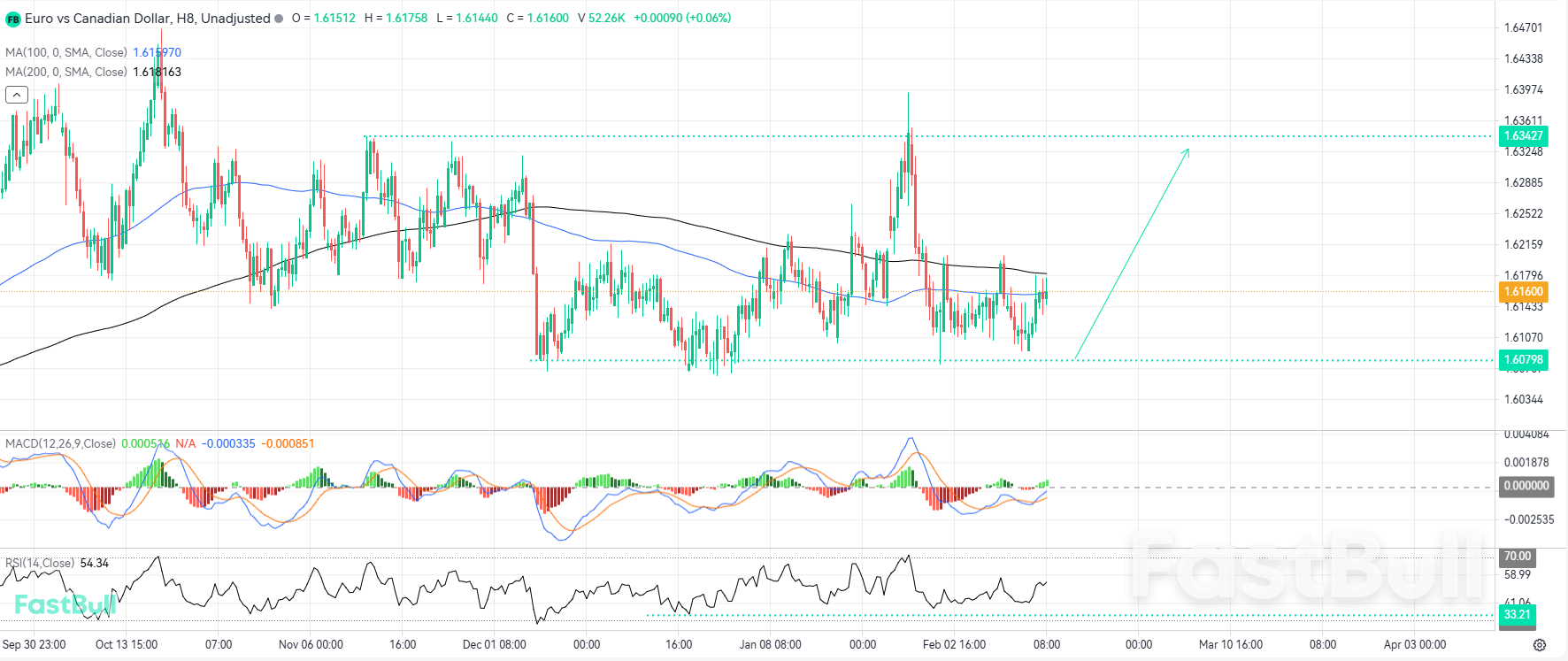
Technical Analysis
EURCAD remains entrenched in a robust horizontal corridor that has dictated price action since November 13. This range is defined by a primary support floor at 1.6079 and a formidable resistance ceiling at 1.6342.
The pair has demonstrated remarkable structural integrity at the base of this range, with the 1.6079 level acting as a "springboard" for previous bullish impulses. Recently, the price has once again rejected the lower boundary, suggesting that a move toward the upper resistance is currently in development. On the 8-hour chart, the 100 and 200-period Moving Averages are situated at 1.6159 and 1.6181, respectively. A decisive close above this moving average confluence would likely act as a catalyst to accelerate the bullish momentum.
Our momentum oscillators further reinforce the bullish thesis. The Relative Strength Index (RSI) has maintained its composure above the 33 level—a floor established on December 29—confirming that the pair is consolidating rather than breaking down. Simultaneously, the MACD is signaling a transition in control; bearish histogram bars are steadily shrinking, giving way to burgeoning bullish bars that are gaining structural depth.
Should the price revisit the 1.6107 value area, long positions remain highly favored, targeting the range resistance. However, traders should exercise caution: a forceful break below the primary support level would invalidate this range-bound setup and open the door for a deeper structural correction.
Trading Recommendations
Trading direction: Buy
Entry price: 1.6110
Target price: 1.6340
Stop loss: 1.6040
Validity: Feb 26, 2026 15:00:00


