Fundamentals
At its first meeting of 2026 last week, the Bank of England held interest rates steady at 3.75%. The central bank signaled that a near-term rate cut is highly likely, adding that monetary policy will be set to ensure inflation not only reaches 2% but remains sustainably at that level over the medium term. "We continue to expect the next rate cut in March. After that, we think the BOE will deliver a prolonged pause before resuming policy normalisation in early 2027 (we see a terminal rate of 3.00% by mid-2027)," said Danny Stoylova, UK and European economist at BNP Paribas Market 360. Rumors are circulating that UK Prime Minister Keir Starmer may resign on Monday, which could exert further downward pressure on the GBP/USD exchange rate. The aftermath of the Mandelson-Epstein affair, along with rising discontent within the Labour Party, has intensified the pressure on Starmer. He is expected to attend a Labour parliamentary group meeting on Monday and hold further consultations with party factions. The UK housing market has shown a significant rebound, though the foundation remains fragile. Data from major mortgage lender Halifax shows that UK house prices rose 0.7% month-on-month in January 2026, marking the largest monthly increase since November 2024. Year-on-year gains also widened to 1.0%, with the national average house price surpassing the £300,000 (approx. $407,000) milestone for the first time. This positive shift is largely attributed to the budget announced by Chancellor Rachel Reeves in late November 2025, which removed some policy uncertainty. Analysts note that continued wage growth outpacing house price increases is gradually improving affordability for homebuyers.
Traders are closely watching the delayed release of the US January jobs report, due Wednesday, for fresh market momentum. The US economy is expected to have added 70,000 jobs in January, with the unemployment rate projected to remain unchanged at 4.4%. A weaker-than-expected report could weigh on the dollar and limit downside room for major currency pairs. San Francisco Fed President Mary Daly said on Friday that, given labor market softness and workers being in a "precarious" position, the Federal Reserve may need to cut interest rates once or twice more. She noted that rising prices have eroded wage gains, and new job opportunities are scarce. In an interview with Reuters, Daly expressed openness about future monetary policy moves. This was her first public comment since the FOMC voted 10–2 to hold the benchmark rate steady in the 3.50%–3.75% range at its January meeting. "I was supportive of that decision, but frankly, I thought you could make a case for going ahead and taking a little more off," she said. She emphasized that any rate cuts would require strong confidence that tariff effects fade and inflation continues to decline. Although inflation, as measured by the Fed's preferred gauge, hovered around 3% last year, above the 2% target, many analysts expect goods inflation to ease by mid-year. Daly believes another key condition for initiating rate cuts is a genuine concern that the labor market faces greater challenges than data currently suggest. She assessed that risks to the Fed's dual mandate—price stability and full employment—are "relatively balanced," but vulnerabilities lean more toward the labor side. "I'm a little more worried about the labour market than I am about inflation," she said, warning that if businesses' demand expectations fail to materialize, the current low-layoff environment could quickly shift to partial layoffs. She also flagged leading indicators of instability, such as widespread reports from parents about difficulties their children face in finding work, and recent data showing higher unemployment among recent graduates compared to the overall rate. Based on these observations, Daly indicated a bias toward further monetary easing, although whether one or two cuts will be appropriate remains uncertain. Although Daly does not have a voting seat on the FOMC this year, she will attend all policy meetings.
Technical Analysis
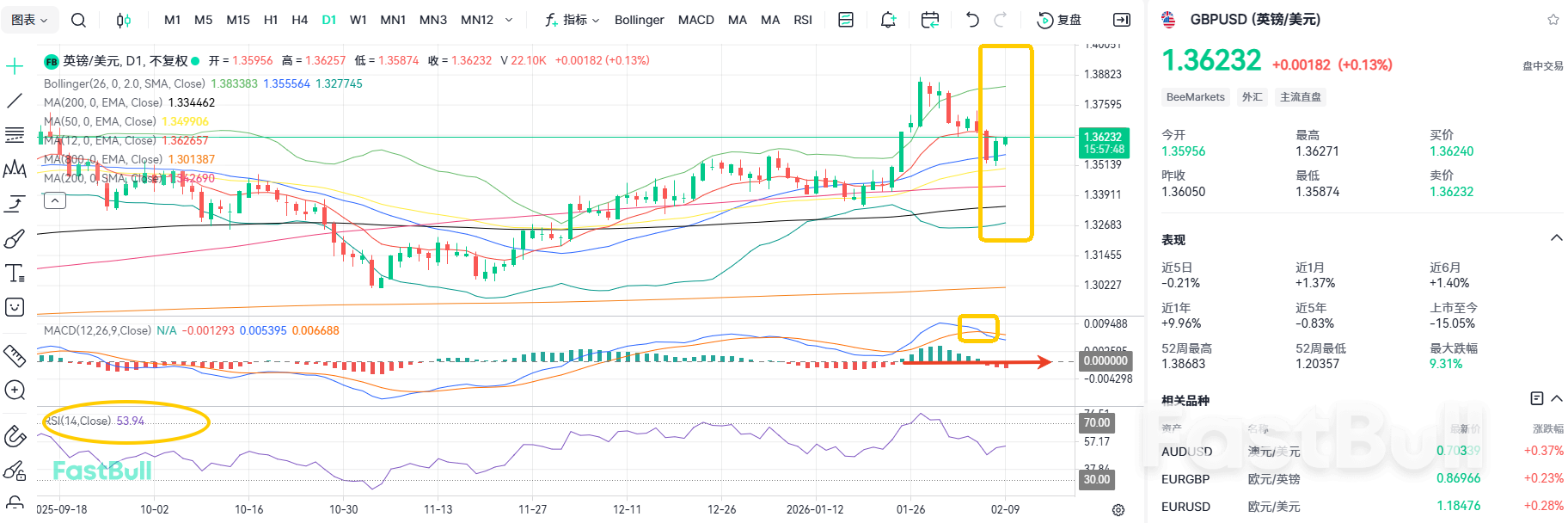
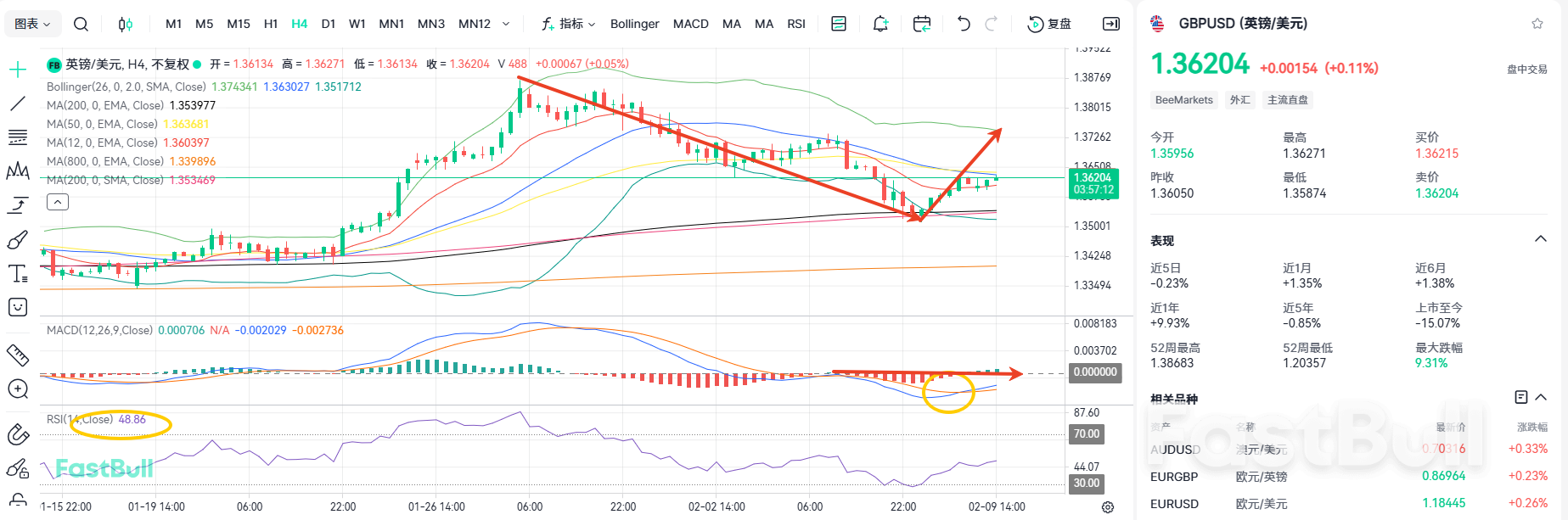
Based on the daily chart, GBP/USD found support at the Bollinger Middle Band and rebounded. If the pair can maintain its position above the mid-band, it may attempt to break back above 1.37. Otherwise, it could fall further toward the EMA50 or EMA200. The narrowing of the Bollinger Bands and flattening of moving averages suggest a potential trend reversal is imminent. After forming a death cross, the MACD and signal lines are pulling back toward the zero line, but they are still far from it, indicating that the correction is not yet complete. RSI stands at 53, signaling a predominantly wait-and-see investor sentiment. On a four-hour perspective, the Bollinger Bands are also contracting and moving averages are flat, with price oscillating around the EMA12 and the Bollinger Middle Band. If the price breaks above the Bollinger Middle Band, it is likely to rise toward recent highs and the upper band, near 1.386 and 1.374, respectively. Following a golden cross, the MACD and signal lines are retracing toward the zero line, suggesting the rebound is not yet complete. RSI is at 48, indicating a neutral, watchful market. Therefore, it is better to buy now and sell later.
Trading Recommendations:
Trading direction: Buy
Entry Price: 1.354
Target Price: 1.4
Stop Loss: 1.33
Support: 1.34/1.3/1.28
Resistance: 1.38/1.4/1.41


