The British pound is enduring a fresh bout of selling pressure against the common currency during Thursday’s European trading session, with the EUR/GBP cross advancing to the 0.8745 handle. The move is a clear reflection of rapidly shifting monetary policy expectations on either side of the Channel, as markets digest a surprisingly cool UK inflation print that has effectively rolled out the red carpet for another Bank of England rate cut.
Traders are repositioning portfolios ahead of a critical end to the week, with the UK Retail Sales report and the Eurozone’s preliminary Gross Domestic Product (GDP) figures looming large on Friday’s docket. However, today’s price action is being dictated by the lingering scent of disinflation emanating from Westminster.
The catalyst for the pound’s latest leg lower was Wednesday’s release from the Office for National Statistics, which revealed that the UK Consumer Price Index (CPI) rose just 3.0% year-on-year in January. While still above the BoE’s target, this marks a significant cooldown from December’s 3.4% reading and represents the lowest annual rate since March of last year. Crucially, the print matched consensus forecasts, validating market expectations rather than delivering a shock.
More telling was the core reading. Stripping out the often-volatile components of food and energy, Core CPI climbed 3.1% year-on-year, a slight deceleration from the previous 3.2% and precisely in line with analyst expectations. For a central bank that has been laser-focused on underlying wage and price pressures, this data suggests that the tightness in the domestic economy is finally beginning to ease.
The immediate reaction in the rates market was decisive. According to Reuters data, interest rate futures now imply roughly a 90% probability that the BoE will enact a rate cut at its March policy meeting. This is a significant jump from the 80% odds assigned just prior to the data release.
It is worth recalling that the BoE held the Bank Rate at 3.75% at its February gathering, striking a cautious tone. However, the combination of cooling labor market indicators and now this confirmation of softer headline and core inflation provides Governor Andrew Bailey and the Monetary Policy Committee with the evidence they need to pivot toward accommodation. The argument is simple: if price pressures are dissipating faster than anticipated, keeping policy restrictive for too long risks doing unnecessary damage to an already sluggish growth outlook.
The pound, as the currency of a nation with a dovish-leaning central bank, is naturally bearing the brunt of these expectations. The yield advantage that sterling once offered is slowly being eroded, making the EUR/GBP cross an attractive vehicle for expressing a bearish view on the UK economy.
On the other side of the trade, the euro is finding some footing, though it is not entirely without its own headline risks. A subtle but notable undercurrent of political speculation is wafting through the Brussels bubble. Rumors, however unconfirmed, are circulating regarding the potential for European Central Bank President Christine Lagarde to depart from her role before her term officially concludes in October 2027.
While the ECB has firmly stated that no such decision has been made, the chatter is persistent enough to warrant attention. The speculation posits that an early exit would allow French President Emmanuel Macron and the likely incoming German Chancellor, Friedrich Merz, to exert influence over the selection of her successor. Such a move would inevitably inject a dose of political horse-trading into the upper echelons of Eurozone monetary policy, a dynamic markets are not particularly fond of. For now, it remains noise, but it is a reminder that political timelines in Paris and Berlin do not always align with the bureaucratic calendar in Frankfurt.
Technical Analysis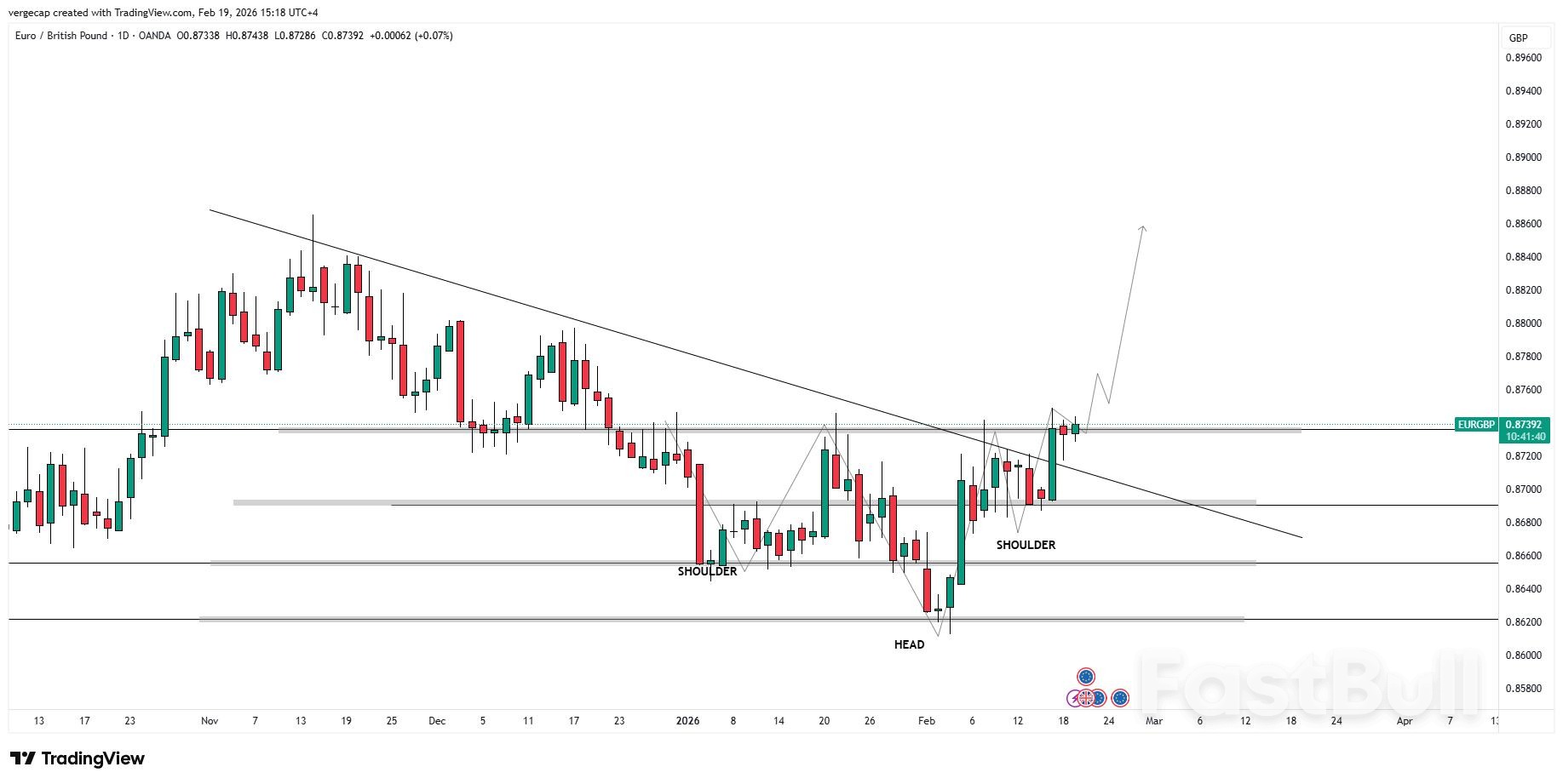
From a technical perspective, the EUR/GBP currency pair shows signs of a potential bullish reversal. On the daily chart, the pair has been consolidating within a well-defined inverse head and shoulders pattern, which is typically a bullish formation. The left and right shoulders are marked by similar lows around the 0.8680-0.8700 zone, while the head is formed by the dip to approximately 0.8640 in December 2025. This pattern suggests that a break above the neckline, which sits around the 0.8730 level, could signal the continuation of the uptrend.
Currently, the price is testing the neckline, and the pair is seeing a moderate upward movement, indicating that a breakout could occur soon. The 50-period Simple Moving Average (SMA) is also sloping upward and coincides with the neckline area, which further confirms the potential for resistance at this level. However, as the price is already challenging this zone, the likelihood of a breakout to the upside increases.
A successful break above the 0.8730 neckline could pave the way for a retest of the 0.8800 level, which has previously acted as a significant area of resistance. Above that, the next key target would be the 0.8840 region, where further resistance is anticipated.
On the downside, if the price fails to break above the neckline and instead moves lower, the pair could revisit the 0.8680-0.8700 support zone. A decisive break below this support would invalidate the bullish setup and could lead to a deeper corrective move toward the 0.8600 zone, where previous consolidation has taken place.
Momentum indicators are currently showing mixed signals. The Relative Strength Index (RSI) is hovering around 50, suggesting that there is no significant overbought or oversold condition, indicating neutral momentum at this point. However, the Moving Average Convergence Divergence (MACD) has recently crossed above the zero line, which supports the bullish bias and reinforces the idea of a potential upward move.
TRADE RECOMMENDATION
BUY EUR/GBP
ENTRY PRICE: 0.8740
STOP LOSS: 0.8680
TAKE PROFIT: 0.8800


