The British pound is reeling at the start of the trading week, caught in the crosshairs of a brutal risk-off assault as geopolitical tensions in the Middle East reach a boiling point. The pound fell sharply against a resurgent US dollar on Monday, with the GBP/USD pair tumbling 0.6% to hover near the $1.3260 level during European morning hours.
This isn’t just a simple bout of profit-taking. This is capital preservation in its purest form. The escalating confrontation between Iran and the United States has lit a fuse under safe-haven assets, and the Greenback—along with its status as the world’s reserve currency—is the primary beneficiary.
The catalyst for the carnage is as stark as it is unsettling. According to reports circulating throughout trading desks, President Donald Trump has issued a 48-hour ultimatum to Tehran. The warning is explicit: if Iran does not agree to reopen the Strait of Hormuz—a critical chokepoint through which roughly 20% of the world’s oil flows—the administration is prepared to launch strikes on Iranian power plants with the stated intention of obliterating them. Iran has already vowed to retaliate, leaving markets bracing for a potential military confrontation that could send energy prices spiraling out of control.
The market’s response has been swift and visceral. The US Dollar Index (DXY), which measures the currency against six major peers, surged 0.6% to reclaim the psychologically significant 100.00 level. Meanwhile, investors are dumping risk assets indiscriminately. S&P 500 futures are down nearly 1% in European trading, extending the pain from Friday’s brutal 1.5% selloff. The correlation is clear: when geopolitical risks spike, the dollar rises, and the pound—a traditionally risk-sensitive currency—gets crushed.
While the geopolitical drama is driving the price action today, the fundamental picture for the pound is growing increasingly murky. Domestically, all eyes are on the UK economic calendar this week, with the preliminary S&P Global Purchasing Managers’ Index (PMI) for March due on Tuesday, followed by the critical Consumer Price Index (CPI) data for February on Wednesday.
However, my read of the situation is that this data—while important—may ultimately take a backseat to the larger macro forces at play. Here is my opinion: the Bank of England’s monetary policy outlook is no longer purely a domestic affair. The surge in energy prices triggered by the threat of a broader Middle East conflict is exporting inflation to the UK’s shores.
We got a preview of this dilemma last week. When the BoE held interest rates steady at 3.75%, they didn’t sound like a central bank ready to ease. Instead, they delivered a stark warning. The Bank raised its Q3 CPI projections to 3.5%—a massive revision from the previous estimate of just 2.1%. The culprit was explicitly cited as the global energy price shock.
This puts traders in a precarious position. Typically, a spike in geopolitical risk would lead to expectations of central bank easing to cushion an economic slowdown. But with inflation expected to re-accelerate due to energy costs, the BoE is boxed in. They cannot cut rates into a fresh inflation wave without risking sterling stability.
Technical Analysis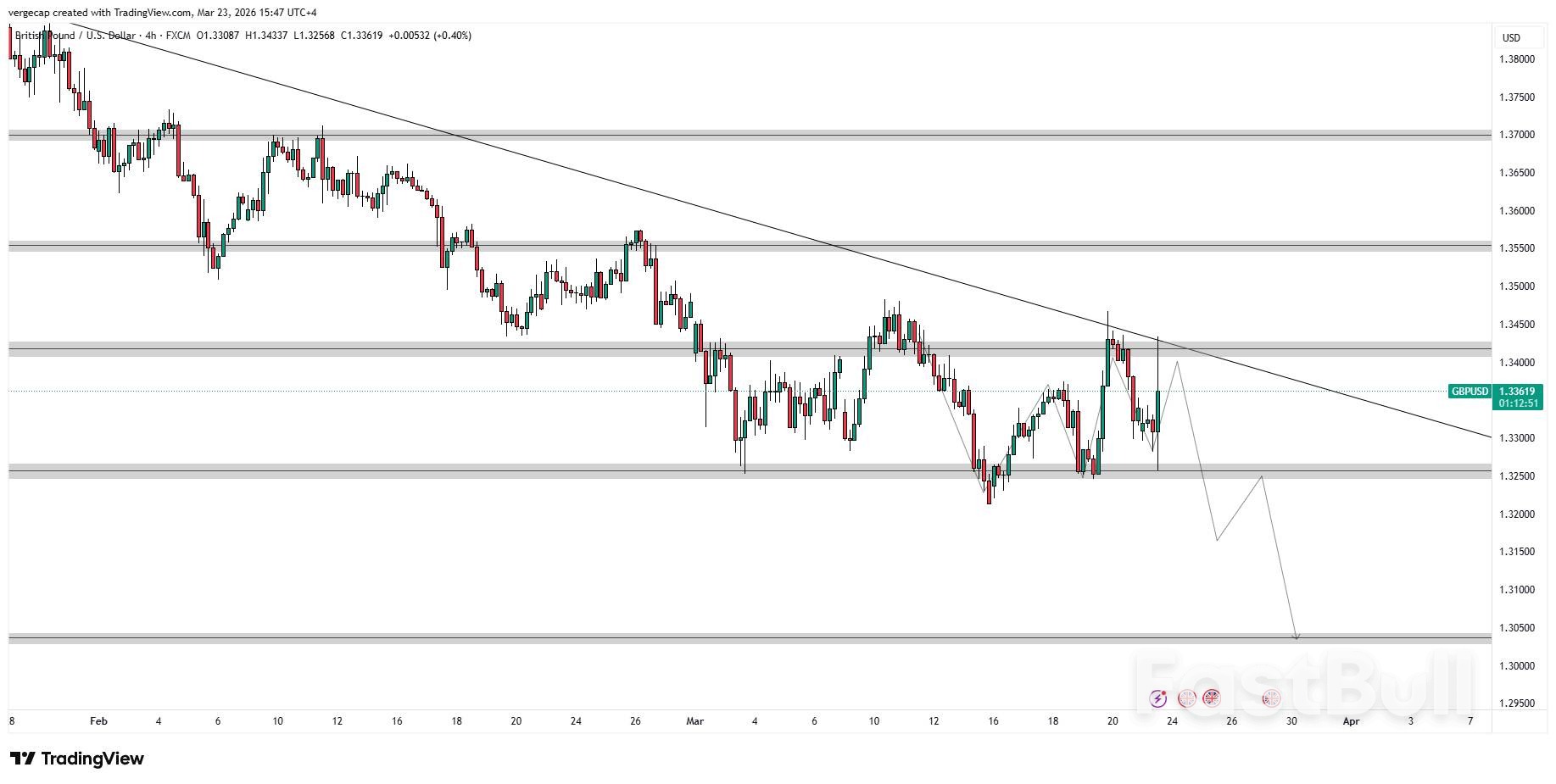
From a technical perspective, GBP/USD remains entrenched in a broader bearish structure, with price action continuing to respect a well-defined descending trendline that has consistently capped upside attempts. On the 4-hour chart, the pair is currently consolidating just below a key resistance zone around 1.3400–1.3450, which aligns closely with the descending trendline. This confluence has acted as a strong barrier, limiting bullish follow-through despite recent rebound attempts.
The overall structure continues to favor sellers, as the sequence of lower highs and lower lows remains intact. The recent bounce from the 1.3250 support zone reflects short-term demand; however, the inability to break and sustain above the 1.3450 resistance area suggests that bullish momentum remains corrective rather than impulsive. Price is effectively trapped within a tightening range, indicating a buildup toward a potential breakout.
On the downside, the 1.3250 level represents immediate support and has been tested multiple times, weakening its structural integrity. A decisive break below this level would confirm a continuation of the broader downtrend and expose the 1.3050 region, which stands as the next significant support zone. A sustained move below 1.3050 would likely accelerate bearish momentum, opening the door toward deeper declines.
Conversely, a sustained breakout above the descending trendline and the 1.3450 resistance zone would be required to shift the near-term bias. Such a move would invalidate the current bearish structure and potentially trigger a corrective rally toward 1.3550, followed by the more significant 1.3700 resistance level.
Momentum indicators point toward consolidation with a bearish tilt. Price action shows repeated rejection near resistance and increasingly shallow recoveries, suggesting weakening buying pressure. This aligns with a market that is pausing before a likely continuation move rather than reversing trend direction.
TRADE RECOMMENDATION
SELL GBP/USD
ENTRY PRICE: 1.3360
STOP LOSS: 1.3450
TAKE PROFIT: 1.3050


