In a dramatic trading session that shredded the technical landscape for precious metals, silver prices collapsed by nearly 6.5% on Thursday, plummeting toward the $70 per ounce mark. It is the kind of violent repricing that happens when the market collectively realizes it has been betting on the wrong outcome—and the Federal Reserve just spent 48 hours correcting that misconception.
The white metal was last seen changing hands near $70.40 during European hours, extending its losing streak to a brutal third consecutive session. For traders who have been conditioned over the past year to buy every dip, this feels different. This feels structural.
At the heart of this meltdown is a stark reality check from the Federal Reserve. Following Wednesday’s monetary policy announcement—where the Fed held rates steady in the 3.50%-3.75% range for the second straight meeting—Chair Jerome Powell delivered a message that silver bulls simply did not want to hear .
"If inflation progress stalls, rate cuts will not follow," Powell stated flatly during his post-meeting press conference .
The market heard that loud and clear. According to the CME FedWatch tool, traders are now pricing in a 57.5% probability that the Fed not only remains on hold through the end of the year but could actually be forced to hike again by December . Let that sink in. Just weeks ago, the conversation was about how many cuts we would see in 2026. Now, we are talking about the remote but real possibility of additional tightening.
What changed? The Fed’s latest Summary of Economic Projections tells the story. Policymakers now see PCE inflation ending the year at 2.7%, a significant upward revision from the 2.4% forecast in December . Core inflation is expected to run even hotter at 3.3% . For a metal like silver that pays no dividend or interest, this is existential. When real yields rise—or even when the market stops pricing in their decline—the opportunity cost of holding bullion becomes prohibitive.
Powell was candid about the dual pressures the Fed is now navigating. "The higher inflation projections also are due to stickier tariff-driven inflation slowing progress towards the Fed's 2% inflation goal," he acknowledged . Translation: the disinflationary forces that markets were banking on have hit a wall.
Perhaps the most telling aspect of Thursday’s price action is what didn't happen. In any normal geopolitical environment, the current situation in the Middle East would have silver spiking. Israeli airstrikes on Wednesday targeted gas storage tanks at Iran’s South Pars field, halting production at two refineries with a combined daily capacity of around 100 million cubic meters . This is a major escalation by any measure.
Yet silver is getting obliterated.
President Donald Trump indicated he had prior knowledge of the strike and supported it as a signal to Tehran over its blockade of the Strait of Hormuz . Crucially, however, Trump now believes Iran has "gotten the message" and is reportedly opposed to further strikes on Iranian energy infrastructure—for now . The administration's position appears conditional on Tehran's behavior in the strait, but the immediate fear of an escalating energy war has subsided.
This is the tell. When a geopolitical crisis fails to ignite safe-haven demand, it signals that macro forces—specifically monetary policy—are completely dominating the narrative. Traders aren't buying insurance against conflict because they are too busy liquidating positions to cover losses and meet margin calls.
Technical Analysis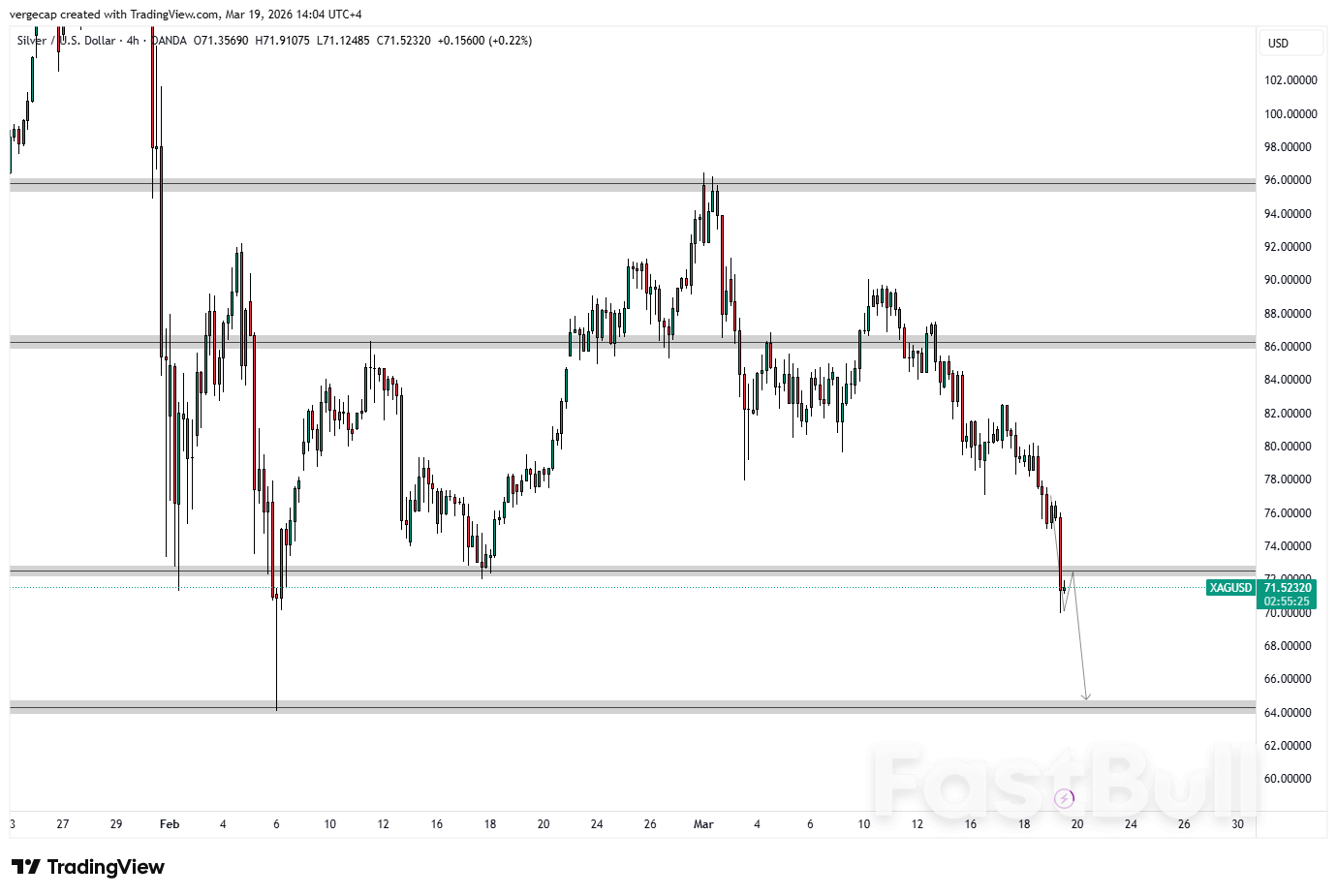
n the 4-hour chart, price action has shifted from range-bound behavior into a sequence of lower highs and lower lows, confirming a change in market character. The recent sharp sell-off has driven prices into a key horizontal support zone around $71.00–$72.00, where a brief pause is currently unfolding. While this zone may offer temporary relief, it has so far failed to generate any meaningful bullish reversal signals.
The breakdown below the $74.00–$75.00 region, which previously acted as a strong support base, is technically significant and now serves as a near-term resistance zone. As long as price remains below this area, the broader bias remains firmly tilted to the downside. Any corrective bounce into this region is likely to attract fresh selling pressure, reinforcing the prevailing bearish trend.
A sustained move below the $70.00 psychological level would mark a continuation of the current momentum and open the door for a deeper decline toward the $64.00–$65.00 support zone, which represents the next major historical demand area visible on the chart. A break beneath this region would signal an extended bearish leg rather than a standard pullback, potentially exposing even lower levels.
On the upside, bulls would need to reclaim the $75.00–$76.00 resistance zone to invalidate the immediate bearish outlook. A sustained move above this level could trigger short covering and shift focus back toward the $80.00 handle. However, given the current structure and momentum, such a scenario appears less probable in the near term.
Momentum indicators favor continued downside pressure. The Relative Strength Index (RSI) is likely hovering in the lower range, near 40 or below, reflecting sustained bearish momentum without yet reaching extreme oversold conditions. This suggests there is still room for further downside before exhaustion sets in. Meanwhile, the Moving Average Convergence Divergence (MACD) remains below the zero line and continues to trend downward, reinforcing the strength of the bearish momentum and supporting the case for continuation.
TRADE RECOMMENDATION
SELL SILVER
ENTRY PRICE: 71.50
STOP LOSS: 74.50
TAKE PROFIT: 65.00


