Silver is enduring one of its ugliest sessions in recent memory on Thursday. XAG/USD has plunged nearly 2.3% to around $76.00 during European trading — not because of a single isolated catalyst but because three separate and mutually reinforcing bearish forces have converged on the white metal simultaneously, leaving bulls with nowhere to hide.
The trigger is oil. The transmission mechanism is inflation. The final blow is the Dollar. And at the centre of all three is the Strait of Hormuz, which remains firmly closed and shows no credible signs of reopening.
WTI Crude has now risen for three consecutive sessions, reaching approximately $95.80 per barrel on Thursday — its highest level in a week. The driver is unchanged: the Strait of Hormuz, through which roughly 20% of the world's seaborne energy supply transits, remains completely closed to commercial traffic despite the ceasefire extension. Tehran has been unambiguous — the Strait stays shut until Washington lifts the blockade on Iranian sea ports, a blockade that has effectively frozen Iranian maritime trade and which the US Treasury Secretary confirmed will remain in place until a deal is signed.
The arithmetic is simple and brutal. Remove 20% of global seaborne energy supply for an extended period with no credible resolution timeline, and oil prices rise. Keep them elevated, and the inflationary consequences ripple outward into every corner of the global economy — from household energy bills to corporate input costs to central bank policy deliberations.
For silver, the oil surge is not a tailwind. It is a headwind dressed as an inflation story. The metal's reputation as an inflation hedge only holds in environments where central banks are tolerating rising prices. When oil-driven inflation forces central banks to maintain or raise interest rates — as is clearly happening now — the calculus inverts entirely. Higher rates mean a higher opportunity cost for holding non-yielding assets, and that cost is being priced into silver in real time.
The most structurally damaging development for silver on Thursday is not the oil price itself — it is what the oil price has done to Federal Reserve rate expectations. According to the CME FedWatch tool, the probability of the Fed holding interest rates steady in the 3.50%–3.75% range at the December meeting stands at 76.8%. Markets have effectively priced out rate cuts for the remainder of 2026.
Just weeks ago, a meaningful probability of Fed easing before year-end was providing silver with a critical fundamental support. That support has been systematically dismantled by the Hormuz closure and its inflationary consequences. A Fed on hold through December means the interest rate differential between yield-bearing US assets and non-yielding silver stays wide — giving institutional capital a powerful incentive to remain in Treasuries and money markets rather than rotating into precious metals.
The US Dollar Index is the visible expression of this repricing, posting a fresh weekly high near 98.70 on Thursday. A stronger Dollar mechanically pressures dollar-denominated commodities by raising effective purchase costs for holders of other currencies — a headwind that compounds the fundamental selling pressure silver is already absorbing from the rate story.
Technical Analysis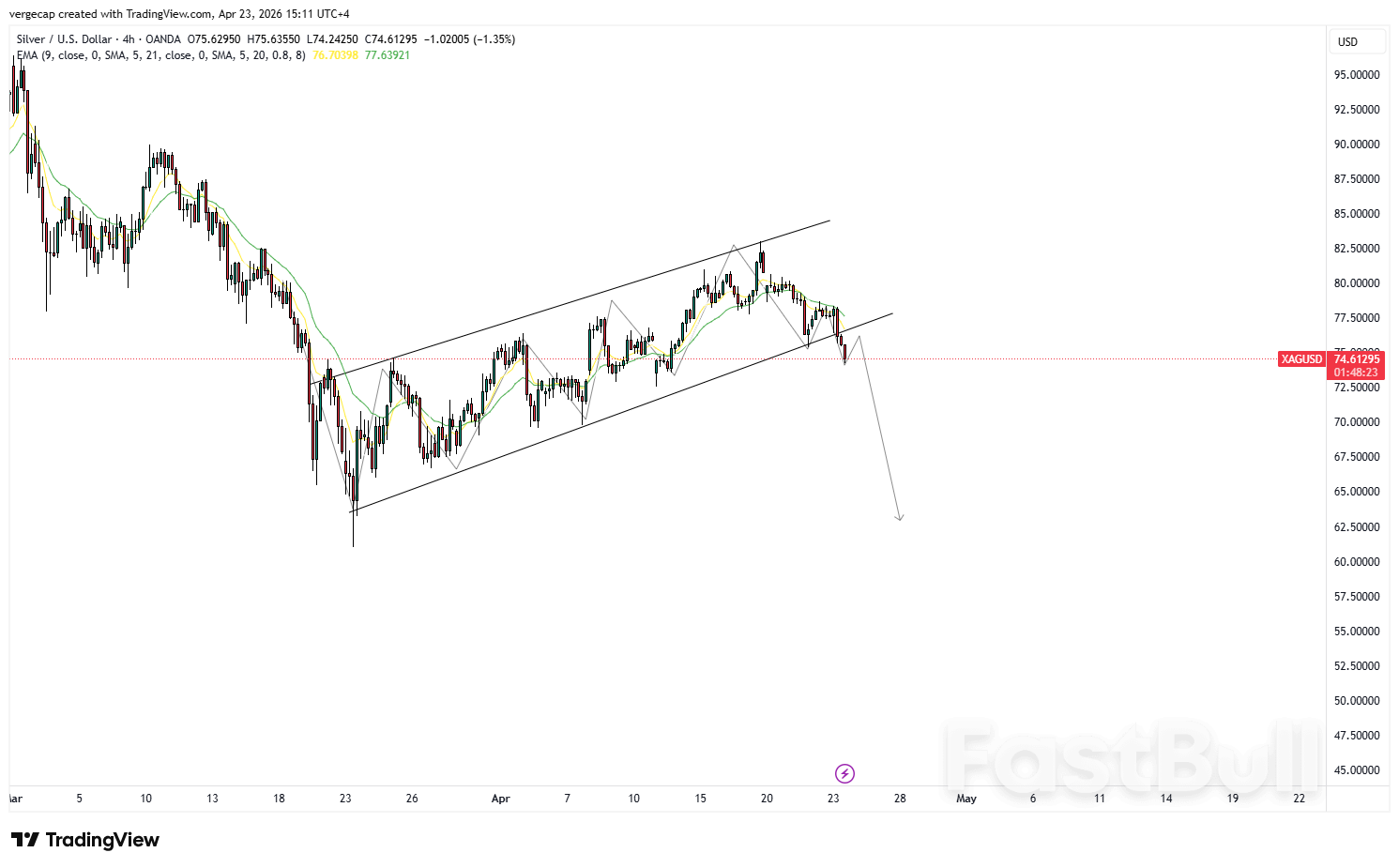
Silver has undergone a decisive and structurally significant breakdown on the 4-hour chart, with price shattering the lower boundary of the ascending channel that had defined its recovery from the late March lows near $62.50. The breakdown is not ambiguous — it is confirmed, aggressive, and accompanied by the kind of large bearish candle body that signals genuine institutional selling rather than a routine technical deviation. Price currently trades at $74.61, and the chart's projected path leaves little doubt about where the bears are targeting next.
The ascending channel that guided Silver higher from late March through mid-April was one of the cleaner bullish structures visible on the 4-hour timeframe — well-proportioned, consistently respected on both boundaries, and validated on multiple occasions as dynamic support provided reliable launch points for fresh advances. At its peak near $82.50–$83.00, the channel represented a recovery of nearly $20.00 from the March lows — an impressive rally that, in hindsight, was building toward an exhaustion rather than a continuation. The failure to sustain above the upper channel boundary around $82.50–$83.00 in mid-April was the first warning sign. The subsequent series of lower highs within the channel was the second. The decisive breakdown below the lower boundary that is now unfolding is the confirmation.
The 9-period EMA at $76.70 and the 21-period SMA at $77.64 have both flipped decisively above current price and are sloping sharply lower — a bearish stack formation that has inverted from the supportive alignment that characterised the rally phase. These moving averages now represent the first meaningful resistance overhead, and any attempted recovery that reaches but fails to close above $77.64 should be treated as a continuation of the existing bearish sequence rather than a genuine reversal signal. The gap between current price and the moving averages — approximately $3.00 — reflects the velocity and conviction of the breakdown and is consistent with a momentum-driven move that typically produces follow-through rather than immediate stabilisation.
The dotted horizontal support level near $75.00 — which had briefly arrested the initial selling pressure and provided a temporary floor — has now been violated with Thursday's aggressive decline to $74.24 intraday lows. This breach is technically significant because it removes the last meaningful near-term support layer between current price and the more substantial horizontal support band near $72.50, which is clearly visible on the chart as the next logical resting point. A sustained 4-hour close below $72.50 would confirm the full extension of the breakdown and open the projected path toward the $63.00–$64.00 major support zone — a target that aligns with the measured move derived from the channel's width applied to the breakdown point and coincides with the significant lows recorded in late March.
The $63.00–$64.00 target visible on the chart's projected path is not an aggressive or unreasonable projection. It represents a retracement of the entire channel advance — a complete unwinding of the recovery that, given the fundamental headwinds now bearing down on Silver simultaneously, is technically plausible and fundamentally supported. The channel breakdown, combined with a Fed on hold through December, a surging Dollar at weekly highs, and oil prices driving inflationary expectations higher, creates a fundamental backdrop that provides no obvious reason for buyers to step in aggressively at current levels.
The only scenario that would invalidate the bearish thesis is a swift and sustained recovery back above the broken channel floor — currently near the $76.50–$77.00 area — accompanied by a reclaim of both moving averages on a closing basis. Without that reclamation, the structure of the chart demands the bearish case be treated as the primary scenario.
TRADE RECOMMENDATION
SELL XAG/USD (SILVER)
ENTRY PRICE: $75.50
STOP LOSS: $78.00
TAKE PROFIT: $63.50


