St. Louis Federal Reserve President Alberto Musalem stated that interest rates will likely need to move higher in order to contain inflationary pressures driven by both demand and supply factors. He warned that without additional monetary tightening, inflation is more likely to remain meaningfully above the Federal Reserve’s 2% target over the next 18 months. Musalem also argued that it is preferable to implement rate increases earlier and gradually rather than delaying action and being forced to adopt larger adjustments later.
Boston Federal Reserve President Susan Collins also indicated that the renewed escalation of hostilities in the Middle East was an important factor behind her support for last week’s increase in the federal funds rate. Her comments reinforced concerns that geopolitical developments could continue adding pressure to inflation through higher energy costs and broader supply-side disruptions.
Meanwhile, Chicago Fed President Austan Goolsbee stated on Monday that he remains optimistic about the Federal Reserve’s ability to guide inflation back toward the 2% target, provided there is no additional evidence of excessive demand within the economy. He added that he would be comfortable with lower interest rates in the future if there is convincing evidence that inflation is returning sustainably toward target levels.
Oil prices have recently come under pressure amid signs of diplomatic efforts surrounding the conflict in the Middle East and improvements in energy supply flows from Saudi Arabia.
U.S. President Donald Trump stated that he would “probably” be willing to meet with Iranian President Masoud Pezeshkian on the sidelines of this week's United Nations General Assembly. Trump also suggested that discussions with other Persian Gulf leaders could take place during the event.
At the same time, Iranian security official Mohsen Rezaei stated that Tehran has delivered its conditions to the United States through international mediators. However, he also warned that Iran would respond forcefully if the United States launched another military strike. Meanwhile, clashes between Iran-backed Houthi forces and Saudi-backed forces continue, maintaining a level of geopolitical uncertainty in the region.
In Switzerland, inflation remains close to the lower end of the Swiss National Bank’s price stability range, supporting the argument for keeping the policy rate unchanged at 0%. Markets widely expect the SNB to leave rates unchanged when it announces its monetary policy decision on Thursday.
A survey published on Monday showed that all 35 economists polled expect the SNB to maintain its policy rate at 0% on September 24. In addition, sixteen out of twenty-four economists expect the central bank to leave rates unchanged through at least 2027, highlighting expectations that Swiss monetary policy will remain relatively stable over the medium term.
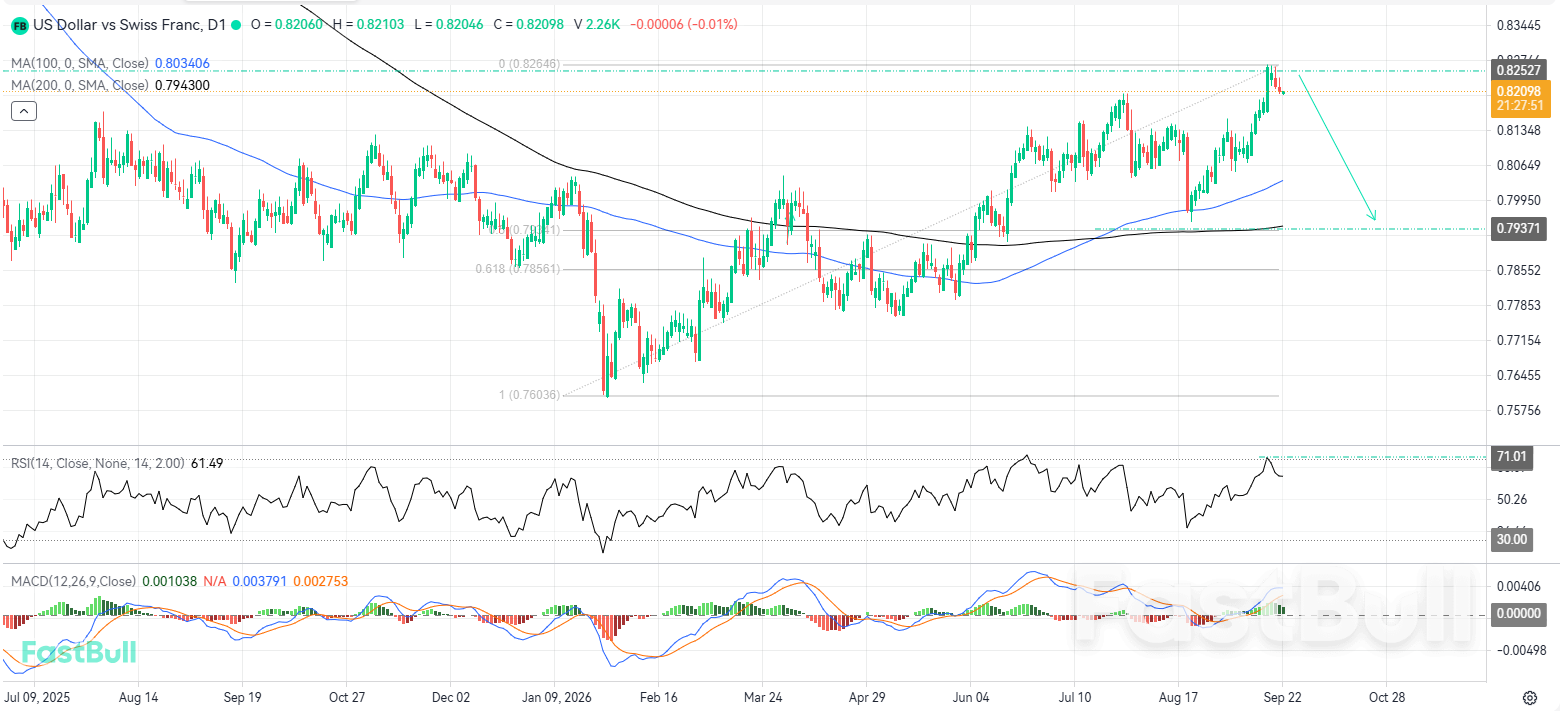
Technical Analysis
USDCHF recently rejected lower after reaching the resistance area around 0.8252, a level that had not been tested since early June. The rejection from this zone raises the possibility of a broader corrective move to the downside, particularly after the pair completed a strong advance into a significant technical resistance area.
Should the correction develop further, the next downside objective could be located near 0.7937. This area gains additional importance because it aligns closely with the 0.50 Fibonacci retracement level and the 200-period moving average, currently positioned at 0.7942. Meanwhile, the 100-period moving average continues to provide dynamic support and is currently located at 0.8034. As a result, this region could become a natural target for a corrective pullback before buyers attempt to re-establish the broader bullish trend.
Looking at momentum indicators, the Relative Strength Index (RSI) recently climbed to 71, briefly entering overbought territory. This development adds weight to the argument that a corrective move may be beginning to form after the recent advance. The indicator suggests that bullish momentum has become extended and may require a period of consolidation or retracement before another sustained move higher can develop.
Meanwhile, the MACD remains in bullish territory, but the histogram has begun to lose depth at a relatively rapid pace, indicating that upside momentum is gradually weakening. A bearish crossover in the histogram would strengthen the corrective scenario and could accelerate downside pressure. At the same time, the signal lines remain in positive territory, but a bearish crossover would provide additional confirmation that momentum is shifting in favor of sellers and could allow the correction to extend further. For now, the area around 0.8250 continues to stand out as the most relevant zone where sellers may look for renewed opportunities should resistance continue to hold.
Trading Recommendations
Trading direction: Sell
Entry price: 0.8250
Target price: 0.7937
Stop loss: 0.8340
Validity: Oct 02, 2026 15:00:00


