The global geopolitical landscape has entered a phase of heightened intensity, characterized by fragile attempts at containment amidst ongoing kinetic escalations. U.S. President Donald Trump recently announced via Truth Social a strategic two-week suspension of military operations against Iran. This tactical moratorium, however, remains strictly contingent upon Tehran ensuring the "complete, immediate, and secure" navigation of the Strait of Hormuz. While Iran initially signaled a willingness to coordinate safe transit with its armed forces during this period, the situation on the ground has continued to deteriorate.
Despite the announced ceasefire, hostilities in the Middle East have persisted with significant severity, particularly in Lebanon. Recent Israeli aerial operations have targeted over 100 objectives in what the Israel Defense Forces (IDF) described as the most significant coordinated offensive since the inception of the conflict. Tehran has characterized these strikes as a direct violation of the nascent truce—which had been in effect for less than 24 hours—asserting that it would be "unreasonable" to pursue a permanent peace accord with the United States under such volatile conditions.
Parallel to these geopolitical shifts, market participants remain hyper-focused on the trajectory of U.S. monetary policy. The minutes from the Federal Reserve’s March assembly revealed that policymakers are still entertaining the possibility of rate cuts later this year. However, this outlook is clouded by the systemic uncertainty stemming from regional conflicts and evolving trade tensions. Fed officials emphasized the necessity of a "nimble" policy posture, requiring a constant re-evaluation of how these exogenous shocks impact an inflation rate that remains above target and a labor market that has, thus far, exhibited remarkable stability.
The U.S. employment sector continues to reflect this resilient, albeit complex, dynamic. According to the Bureau of Labor Statistics (BLS), the domestic economy generated a robust 178,000 jobs in March, significantly outperforming market expectations of 60,000. This headline strength was partially tempered by a substantial downward revision to February’s figures, which now reflect a contraction of 133,000 positions compared to the previously estimated loss of 92,000. Concurrently, the national unemployment rate showed marginal improvement, descending to 4.3% from its previous 4.4% reading.
In Canada, a relatively benign inflationary backdrop has granted the Bank of Canada (BoC) essential maneuvering room to absorb the impact of surging crude prices. This has allowed the central bank to avoid further policy tightening for the time being, particularly as the domestic labor market begins to show signs of structural fatigue.
However, the broader Canadian economy signaled burgeoning weakness in March. The S&P Global Canada Manufacturing PMI retreated to 50.0, down from February’s 51.0, settling precisely on the psychological threshold that separates expansion from contraction. This stagnation suggests a stalling of business activity and has intensified concerns regarding the economic repercussions of Middle Eastern tensions, which continue to obscure the outlook for global trade.
Against this backdrop, the BoC elected to maintain its benchmark overnight rate at 2.25%, a level sustained since October. During the post-meeting press conference, Governor Tiff Macklem reaffirmed that the institution stands prepared to tighten its posture should energy-driven costs manifest as persistent, broad-based inflationary pressures. Conversely, Macklem maintained strategic optionality, leaving the door open for potential rate cuts should energy prices retreat and economic activity exhibit further deceleration.
Technical Analysis
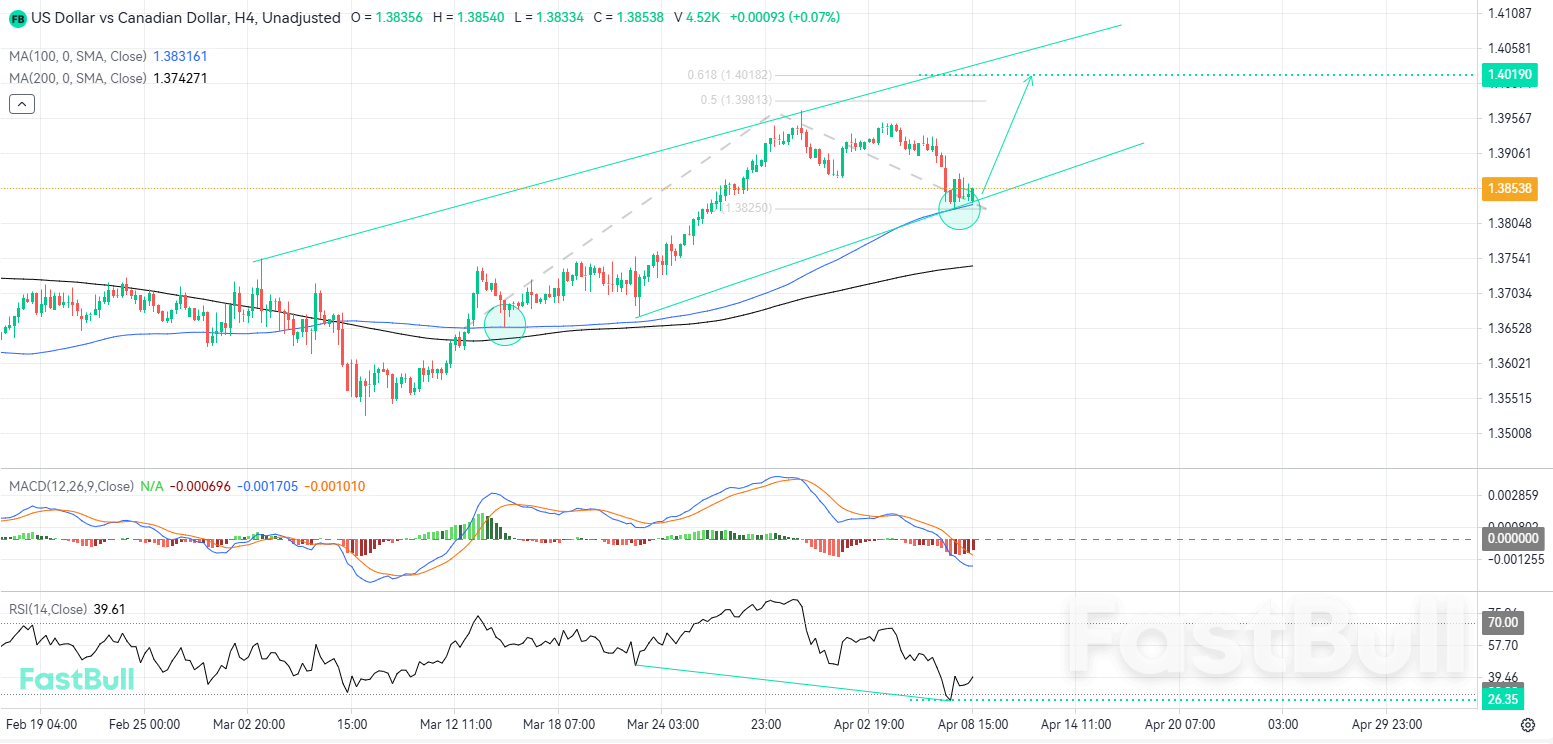
From a technical perspective, USD/CAD appears entrenched in a well-defined ascending channel, a structure originating from the 1.3524 floor established on March 9 and extending toward the local peak of 1.3966 reached on March 31. Since striking that high, the pair has undergone a technical retracement that has brought price action directly into contact with the 100-period Moving Average (MA), currently situated at 1.3831. The 200-period MA tracks further below at 1.3742.
This specific support level carries significant historical weight; on March 16, a test of the 100-period MA served as the catalyst for a renewed bullish impulse. Should this pattern repeat, we anticipate a secondary leg higher targeting the 1.4019 handle. This objective is of high technical interest as it aligns the 0.618 Fibonacci expansion with the upper boundary of the prevailing ascending channel.
Our analysis of momentum oscillators provides a compelling case for a bullish pivot. The Relative Strength Index (RSI) is exhibiting a pronounced bullish divergence. The RSI recently struck a low of 26.35—an extreme oversold reading not witnessed even during the early stages of the current rally. This suggests that bearish momentum has reached a point of exhaustion, often a precursor to a sharp reversal.
Simultaneously, the MACD is printing a bearish histogram; however, the bars are visibly losing depth, indicating that the downward momentum is dissipating. A bullish crossover in the histogram appears imminent. Given that the signal lines are currently oscillating just beneath the neutral baseline, a positive histogram transition would likely precede a decisive move of the signal lines back into bullish territory, validating a resumption of the primary trend.
Trading Recommendations
Trading direction: Buy
Entry price: 1.3853
Target price: 1.4019
Stop loss: 1.3770
Validity: Apr 17, 2026 15:00:00


