U.S. President Donald Trump announced that American and Iranian delegations had recently met in what he described as a very productive discussion. Regarding the conflict between Russia and Ukraine, Trump stated that both he and Ukrainian President Volodymyr Zelensky are seeking a path toward ending the war and added that Russian President Vladimir Putin is willing to meet in an effort to bring the conflict to a close.
From the monetary policy front, St. Louis Federal Reserve President Alberto Musalem stated that interest rates will likely need to move higher in order to contain inflationary pressures stemming from both demand and supply-side factors. He warned that without additional policy tightening, inflation could remain meaningfully above the Federal Reserve’s 2% target over the next 18 months. Musalem also argued that implementing rate increases earlier and gradually would be preferable to delaying action and ultimately requiring larger adjustments later.
Boston Federal Reserve President Susan Collins similarly pointed to the renewed escalation of tensions in the Middle East as an important factor behind her support for last week’s increase in the federal funds rate. Her comments reinforced concerns that geopolitical developments could continue feeding inflation through higher energy costs and broader supply-chain disruptions.
Meanwhile, Chicago Fed President Austan Goolsbee stated that he remains confident in the Federal Reserve’s ability to guide inflation back toward the 2% target, provided there is no further evidence of excessive demand across the economy. He also noted that lower interest rates could eventually become appropriate if convincing evidence emerges showing that inflation is moving sustainably back toward target levels.
Adding to the discussion, Richmond Federal Reserve President Thomas Barkin commented that inflationary pressures may take time to ease and warned that additional rate increases could still be necessary in order to return inflation to the Federal Reserve’s long-term objective.
In Canada, Bank of Canada Governor Tiff Macklem adopted a more hawkish tone, warning that consecutive rate increases could become necessary if elevated energy prices and ongoing trade uncertainties begin feeding into broader inflation pressures.
The Bank of Canada left its benchmark interest rate unchanged at 2.25% during its September policy meeting, a decision that was widely anticipated by financial markets. However, policymakers emphasized that inflation risks have increased, while newly introduced tariffs have added uncertainty to the growth outlook. Market participants currently estimate nearly a 60% probability that the Bank of Canada will deliver a rate increase at its next monetary policy announcement on October 28.
Technical Analysis
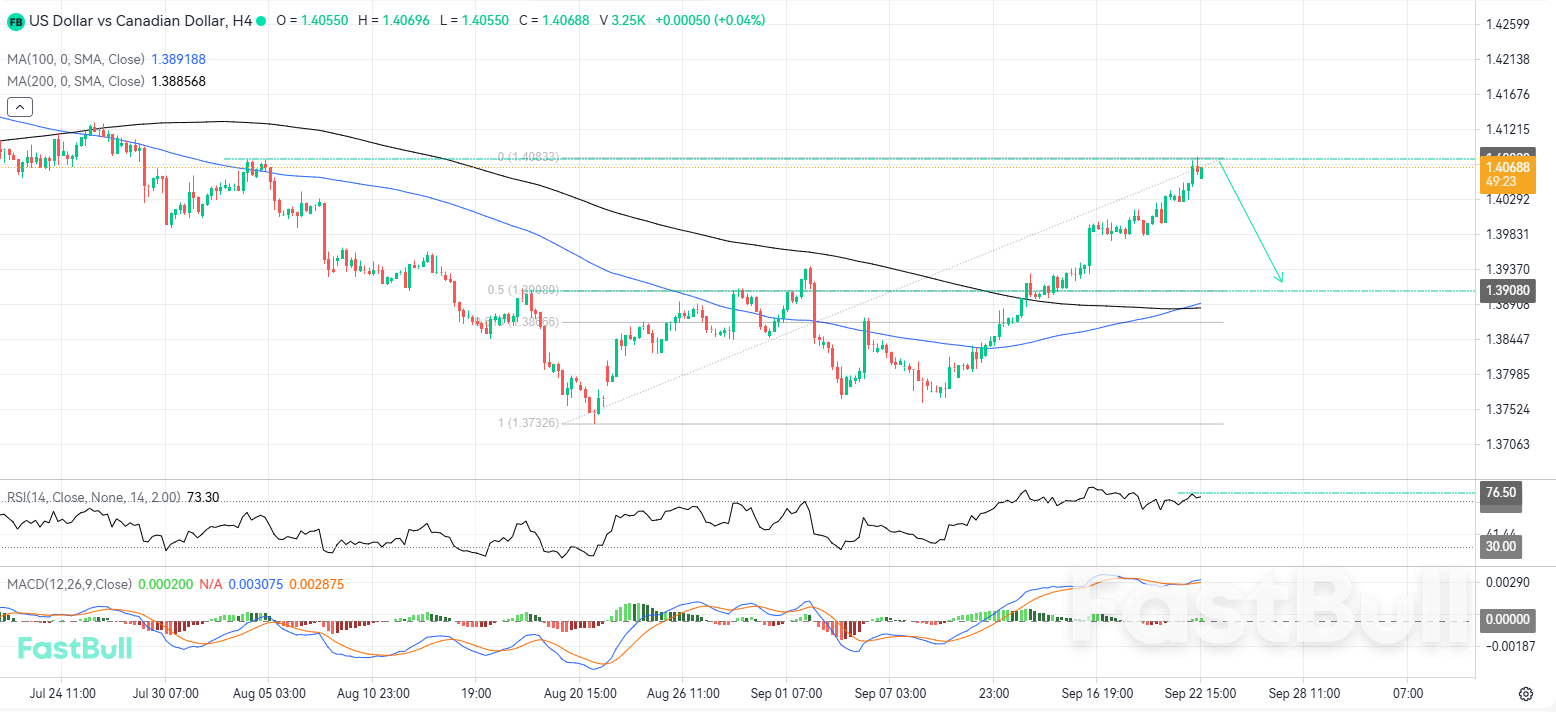
USDCAD recently reached the resistance level at 1.4083, an area that had not been tested since August 4, when price previously reacted lower from the same region. As a result, this level has once again emerged as an important resistance zone. If sellers continue defending this area successfully, the pair could enter a corrective phase with downside potential toward the 1.3908 region.
This support area gains additional significance because it aligns with the 0.50 Fibonacci retracement level. Furthermore, the 100-period and 200-period moving averages are currently positioned at 1.4065 and 1.4128 respectively. The relatively close proximity between these moving averages suggests that the average price across both periods remains concentrated near the current trading zone, adding further technical weight to the possibility of a corrective move developing before the broader trend attempts to resume.
Looking at momentum indicators, the Relative Strength Index (RSI) recently climbed to 76, placing it firmly within overbought territory. In addition, the latest leg higher has spent an extended period at elevated RSI readings, a condition that can sometimes signal momentum exhaustion after a prolonged advance. While this does not necessarily imply a trend reversal, it does increase the likelihood that a temporary pullback could develop as part of a healthier trend structure.
Meanwhile, the MACD continues to display a bullish histogram, although its depth remains very limited despite the recent advance. At the same time, the signal lines remain firmly positioned in bullish territory, suggesting that the broader trend structure continues to favor the upside. For that reason, the current downside scenario is better interpreted as a potential correction rather than a complete change in trend. Should price retreat toward key support levels, the broader bullish structure could find an opportunity to re-establish itself and resume the move higher from a more favorable technical position.
Trading Recommendations
Trading direction: Sell
Entry price: 1.4069
Target price: 1.3910
Stop loss:1.4171
Validity: Oct 02, 2026 15:00:00


