The Reserve Bank of Australia (RBA) further tightened its monetary policy stance during its March deliberations, elevating the official cash rate by 25 basis points to 4.10%. This move, finalized via a narrowly contested 5-4 vote, represents the institution's second consecutive rate hike. Consequently, the release of the RBA’s meeting minutes this Tuesday will be meticulously analyzed by market participants seeking to gauge the Board’s appetite for a potential third consecutive increase in May.
Reinforcing this hawkish sentiment, RBA Assistant Governor Christopher Kent issued a stark warning last week. He observed that a protracted supply-side shock—fueled by the ongoing hostilities in the Middle East—could substantially drive up both headline inflation and long-term inflationary expectations. Under such a scenario, Kent suggested that a more restrictive policy posture might be necessary to maintain price stability.
Simultaneously, the global geopolitical landscape remains fraught with systemic risk. Iranian state media has reported that the Islamic Revolutionary Guard Corps (IRGC) is actively contemplating significant reprisals against American strategic interests across the region. A specific list of 18 prominent corporations has been identified as potential high-value targets, including global technological and industrial titans such as Microsoft, Apple, Google, Intel, and Boeing.
Against this backdrop, Iranian President Masoud Pezeshkian signaled a tentative willingness to conclude the current conflict, provided that Tehran receives ironclad security guarantees. This development follows a recent report from the Wall Street Journal suggesting that Donald Trump has communicated to his advisors a strategic readiness to terminate the U.S. military campaign against Iran, even if the Strait of Hormuz remains largely inaccessible to global shipping.
The United Kingdom's economy exhibited only marginal advancement as 2025 drew to a close. According to the latest data from the Office for National Statistics (ONS), Gross Domestic Product (GDP) expanded by a tepid 0.1% in the fourth quarter, aligning seamlessly with broader market expectations. On a year-over-year basis, growth remained stagnant at 1.0%. Compounding these structural concerns, the OECD recently recalibrated its growth projections for the UK, slashing its 2026 estimate from 1.2% down to a more conservative 0.7%.
This fundamental backdrop strongly suggests that the UK is gravitating toward a stagflationary environment. This duality is driven by a persistent surge in energy expenditures—amplified by the intensification of Middle Eastern hostilities—colliding with a domestic economy that is visibly losing traction. Despite these headwinds, money markets have already fully priced in a potential easing cycle by the Bank of England (BoE), with cumulative rate cuts for the year currently estimated near 59 basis points.
Technical Analysis
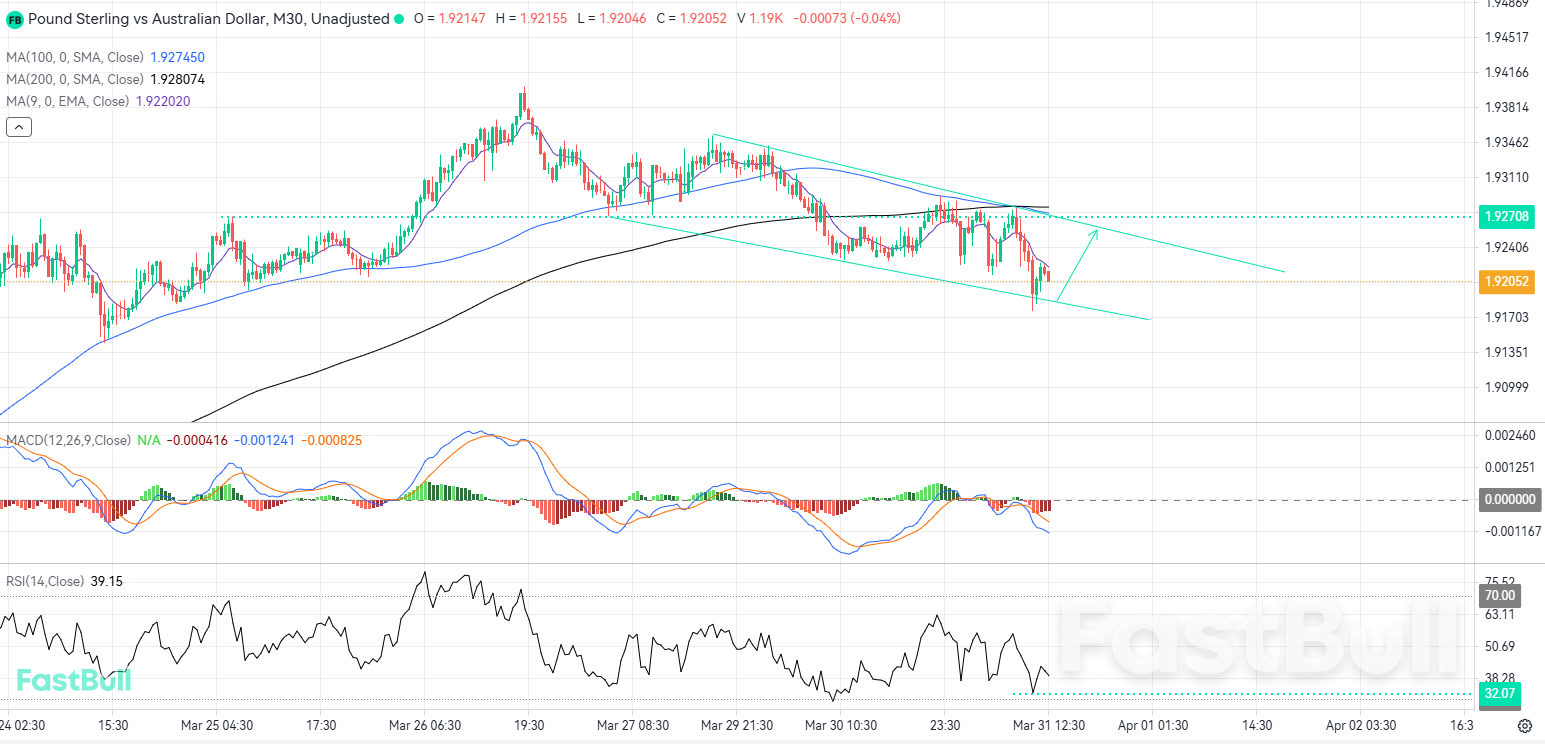
From a technical perspective, GBP/AUD is currently exhibiting a bullish rejection after testing the lower boundary of a well-defined descending channel. This rebound has the potential to evolve into a broader corrective move, with primary upside targets situated at the 1.9270 resistance zone.
This specific price level is of high technical significance as it serves as a major confluence point. The 100 and 200-period Moving Averages (MAs) are currently tracking at 1.9275 and 1.9280, respectively. The extreme proximity of these dynamic indicators to the horizontal resistance suggests that this cluster will act as a powerful technical "magnet" for price action, provided the current bullish impulse maintains its structural integrity.
Our analysis of momentum oscillators reinforces the potential for a bullish pivot. The RSI is currently hovering at the 32 level, moving deeply into territory that historically signals technical exhaustion. This positioning invites buy-side participation as traders look to capitalize on a mean-reversion play.
While the MACD still exhibits a bearish orientation, the histogram is visibly contracting, suggesting that downward momentum is dissipating. Currently, the signal lines remain entrenched beneath the neutral threshold; however, a decisive crossover back into positive territory would provide the necessary technical validation for a more persistent and robust bullish expansion.
Trading Recommendations
Trading direction: Buy
Entry price: 1.9200
Target price: 1.9270
Stop loss: 1.9170
Validity: Apr 10, 2026 15:00:00


