In contrast to its southern neighbor, the S&P Global Canada Manufacturing PMI retreated to 50.0 in March, down from February's 51.0. This move to the psychological 50-mark—the threshold between expansion and stagnation—indicates that business activity has stalled, heightening systemic concerns regarding the broader economic fallout resulting from the intensifying conflict in the Middle East.
Prior to these readings, the Bank of Canada (BoC) elected to anchor its benchmark overnight rate at 2.25%, a level that has remained unchanged since October. During the subsequent press conference, Governor Tiff Macklem signaled that the Governing Council remains prepared to implement further tightening should energy-driven costs translate into persistent, broad-based inflationary pressures. Conversely, he maintained a degree of strategic optionality, suggesting that rate cuts remain on the table if energy prices retreat and broader economic activity exhibits further signs of deceleration.
In the official communiqué, Macklem emphasized that elevated levels of uncertainty continue to plague the outlook, primarily driven by shifting U.S. trade policy and heightened geopolitical risks. Specifically, he warned that the Middle Eastern conflict is driving crude prices higher, which could trigger an immediate, short-term inflationary spike. While higher oil prices historically bolster Canada’s energy export revenues, Macklem cautioned that this macro benefit is often offset by increased costs for domestic consumers, which effectively curtails discretionary spending across other vital sectors of the economy. Ultimately, the BoC indicated a preference to "look through" the transitory inflationary effects of the conflict, provided they do not become entrenched.
Simultaneously, in a strategic national address, President Trump provided a comprehensive update regarding the administration's stance on Iran. The central narrative propagated by the White House focused on the assertion that "fundamental U.S. strategic objectives" are nearing completion. Trump reinforced this perspective by claiming a resolution would materialize "very quickly," suggesting the nation is "very close" to achieving its final goals. This rhetoric is strategically designed to soothe the American public and mitigate anxieties surrounding a potential long-term military quagmire, reminiscent of past engagements in Iraq, Afghanistan, or Vietnam.
However, the President refrained from clarifying these definitionally ambiguous objectives. Simultaneously, the address maintained a dual-track approach, pairing these assurances with hawkish rhetoric that threatened Iran with potentially destructive escalation—a pivot that commanded significant market and media attention.
On the economic front, the U.S. continues to exhibit robust momentum. The ISM Manufacturing PMI ascended to 52.7 in March, outperforming analyst expectations and building upon previous gains. The labor market also delivered a notably hawkish surprise, as the ADP Employment Change reported an addition of 62,000 positions, vastly exceeding the projected 40,000. Furthermore, consumer resilience was underscored by a 0.6% surge in February Retail Sales, signaling a decisive recovery from January’s downwardly revised contraction.
According to the CME FedWatch Tool, market participants have aggressively recalibrated their expectations, now widely anticipating that the Federal Reserve will maintain interest rates within the 3.50%–3.75% range for the remainder of the year. This marks a significant departure from previous forecasts, which had priced in at least two rate cuts.
Technical Analysis
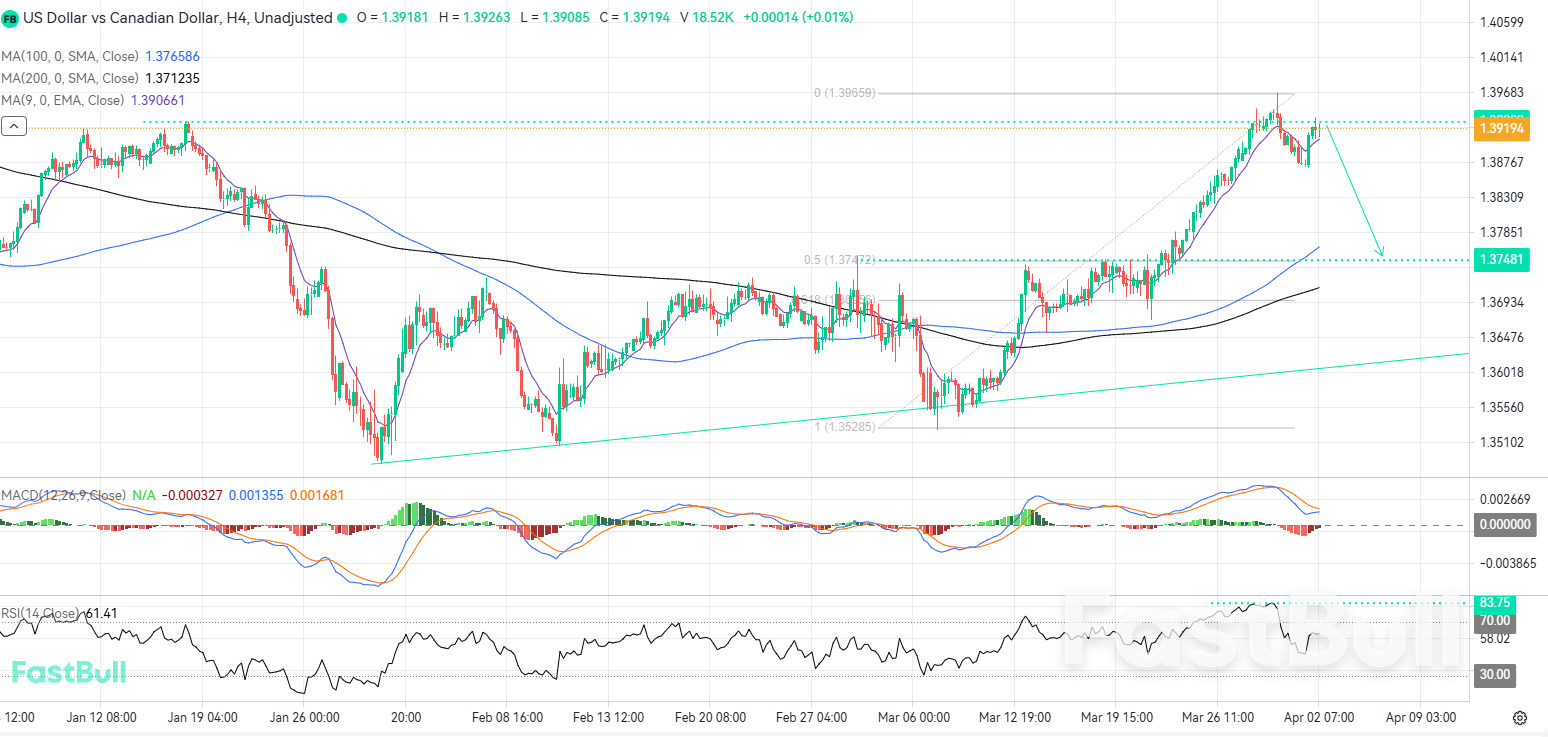
From a technical perspective, USD/CAD has recently exhibited a renewed bearish rejection upon testing the critical resistance handle at 1.3930. This persistent inability to breach the local supply wall suggests that the door remains open for a corrective downward impulse. The primary downside objective is targeted at the 1.3748 zone, which aligns perfectly with the 0.50 Fibonacci retracement level.
The structural integrity of this zone is further reinforced by a high-confluence cluster of indicators. Specifically, the 100 and 200-period Moving Averages (MAs) are currently tracking at 1.3765 and 1.3712, respectively. Their proximity to the aforementioned Fibonacci support zone makes this area a region of high technical interest for market participants seeking a potential floor.
Oscillator readings provide further context for this potential mean-reversion move. The Relative Strength Index (RSI) is currently tracking at the 60 level, signaling a meaningful cooling from the extreme overbought peak of 83 recorded on March 31. This lack of overbought pressure suggests that sellers have more technical "runway" to push the price lower.
While the MACD currently displays a bearish histogram, it is notably losing depth. However, the signal lines remain resiliently positioned above the neutral threshold. Consequently, a deeper expansion in the negative histogram, accompanied by a decisive bearish crossover of the signal lines, would provide the final technical confirmation required for a more prolonged and sustained downward move.
Trading Recommendations
Trading direction: Sell
Entry price: 1.3930
Target price: 1.3750
Stop loss: 1.4020
Validity: Apr 15, 2026 15:00:00


